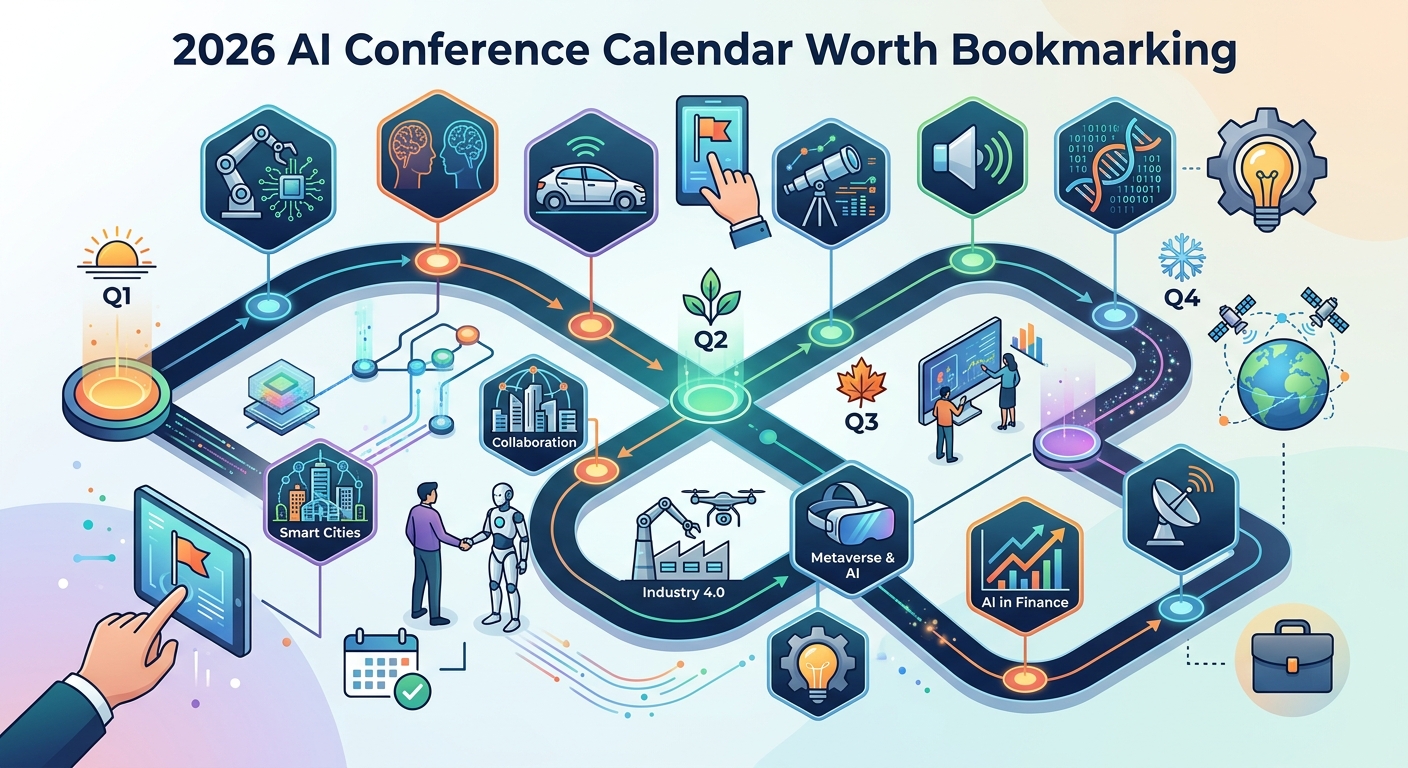
2026 AI Conference Calendar Worth Bookmarking
A GitHub-curated list tracks 2026 AI, ML, healthcare, startup, and EA events across Europe, the US, Asia, and Australia.
One small GitHub repository has done something useful for anyone planning their 2026 conference budget early: it pulls dozens of AI, machine learning, healthcare, startup, and Effective Altruism events into one place. The list is still tiny by GitHub standards, with just 1 star at the time of writing, but the actual content is much more useful than that number suggests.
The repo is basically a living calendar for 2026, and it is especially strong on European events, with a heavy concentration in Switzerland. If you work in applied AI, research, policy, or digital health, this is the kind of link you save now and revisit every few weeks.
A practical index of AI events, not a hype project
Get the latest AI news in your inbox
Weekly picks of model releases, tools, and deep dives — no spam, unsubscribe anytime.
No spam. Unsubscribe at any time.
The repository groups conferences into AI and machine learning, startup and innovation, medicine and healthcare, plus Effective Altruism. That structure makes it more practical than a random spreadsheet because you can quickly scan by topic and region.
The biggest strength is breadth. It includes academic heavyweights like ICML 2026, NeurIPS 2026, ICLR 2026, CVPR 2026, and ACL 2026. It also mixes in applied and industry-facing events like Applied Machine Learning Days, AI for Good Global Summit, and Swiss AI Summit.
That mix matters. A lot of event roundups skew too academic or too sales-driven. This one gives you enough range to plan around papers, recruiting, customer meetings, and policy conversations without opening 20 tabs.
- The list includes more than 40 named events across AI, ML, healthcare, startups, and EA.
- Switzerland appears often, with Zurich, Lausanne, Bern, Davos, Geneva, Locarno, and Winterthur all represented.
- Major 2026 anchor dates already listed include CVPR on June 3–7, ACL on July 2–7, ICML on July 6–11, IJCAI-ECAI on August 15–21, ECCV on September 8–13, and NeurIPS on December 6–12.
- Healthcare coverage is smaller but relevant, with ESMO AI and Digital Oncology Congress 2026 and ESMO Congress 2026 already included.
Why the Switzerland bias is actually useful
The repo clearly reflects the curator’s location and network. Zurich and the broader Swiss ecosystem get far more attention than most public conference lists. In this case, that is a feature, not a flaw.
Europe often gets treated as a side note in AI coverage, even though it hosts a dense mix of research labs, regulators, startups, and enterprise buyers. This list puts that ecosystem in plain view through events like Zurich AI Events, ETH AI Center Academic Talk Series, GenAI Zurich, AI+X Summit, and AI House Davos.
That local density can be valuable if you are choosing where to spend travel money. A week in Zurich or a short train loop through Switzerland, Germany, and France can put you close to researchers, founders, and governance people in a way that many US-centric calendars miss.
“Switzerland is one of the world’s leading innovation hotspots.” — World Economic Forum
That quote matters here because the repo’s event map lines up with a real pattern: Switzerland keeps punching above its weight in research, biotech, enterprise software, and AI policy conversations. A conference list centered there is not random; it reflects where a lot of serious work is happening.
Academic flagships vs applied events
If you scan the 2026 calendar, you can see two very different conference tracks forming. One track is paper-driven and prestige-heavy. The other is commercial, operational, and often more useful for people shipping products.
The paper circuit is familiar: CVPR, ACL, ICML, ICLR, IJCAI-ECAI 2026, ECCV 2026, and NeurIPS. These events matter for publication deadlines, recruiting, and keeping up with the state of the field. They also come with higher travel competition, pricier hotels, and a lot of parallel sessions.
The applied side looks different. Events such as Applied Machine Learning Days, IAPP AI Governance Global Europe, MLCon Munich, AI World Congress, and AI for Good often attract operators, policy teams, startup founders, and enterprise decision-makers. If your job involves deployment, procurement, compliance, or partnerships, these may be the better bet.
- CVPR 2026: June 3–7 in Denver, focused on computer vision research.
- ACL 2026: July 2–7 in San Diego, centered on natural language processing.
- ICML 2026: July 6–11 in Seoul, broad machine learning research with major industry presence.
- NeurIPS 2026: December 6–12 in Sydney, likely the year’s biggest general ML gathering by visibility and attendance.
- Applied Machine Learning Days 2026: February 10–12 in Lausanne, earlier in the year and easier to use for practical planning.
- AI for Good Global Summit 2026: July 7–10 in Geneva, where AI policy and public-interest use cases get more attention than benchmark chasing.
A simple way to use this repo is to split your shortlist into “publish,” “buy,” “hire,” and “meet.” Most people do not need ten conferences. They need the right two or four.
What the list gets right, and what it still needs
The repo gets the hard part right: it is readable, current enough to be useful, and broad enough to save time. It also includes external resources like MLCiv AI Deadlines and Innovation Zurich Events, which makes it easier to verify dates or find adjacent meetups.
Still, it has obvious gaps. Some entries still say TBD for date or location. A few links point to event hubs rather than event-specific pages. The healthcare section is much thinner than the AI section, and there is no filtering by submission deadline, ticket price, audience type, or CFP status. Those details matter a lot once people move from browsing to booking.
If the maintainer keeps updating it, this could become a genuinely handy planning resource for 2026. If you are the kind of person who tracks conference strategy early, you could also contribute missing events, fix stale links, or add metadata fields directly on GitHub.
We have seen this format work well in other corners of developer culture: simple curated repos often beat polished event directories because they are easier to update and easier to fork. For readers who follow AI tools and research roundups on OraCore.dev, this list would pair well with future deadline trackers or regional event guides.
The smart move: shortlist by goal before prices jump
The useful prediction here is simple: by late 2025, hotel prices around the biggest 2026 AI conferences will already be painful, especially for Denver, San Diego, Seoul, and Sydney. If one of those events matters to your team, the planning window is much earlier than most people expect.
So the actionable move is to open the repo now, pick two or four events that match your actual goals, and put tentative holds on budget and travel. If you are Europe-based, the Switzerland-heavy section is probably the fastest win. If you are research-focused, lock in the flagship dates early. And if you work in health AI, keep an eye on that thinner healthcare section, because it is the part most likely to grow as more 2026 details go live.
// Related Articles
- [IND]
Skatteetaten proves public sector AI should be judged by outcomes
- [IND]
OpenAI’s IPO filing puts AI’s biggest test on Wall Street
- [IND]
OpenAI’s latest moves now center on pricing, safety, and scale
- [IND]
RISC-V mini PCs are worth buying now, but only as a bet on the future
- [IND]
Fedora 44 RISC-V widens Linux board support
- [IND]
June 2026 agentic AI platform war centers on memory