5 MLOps goals for production teams
5 MLOps goals that help teams ship, monitor, and govern machine learning systems in production.
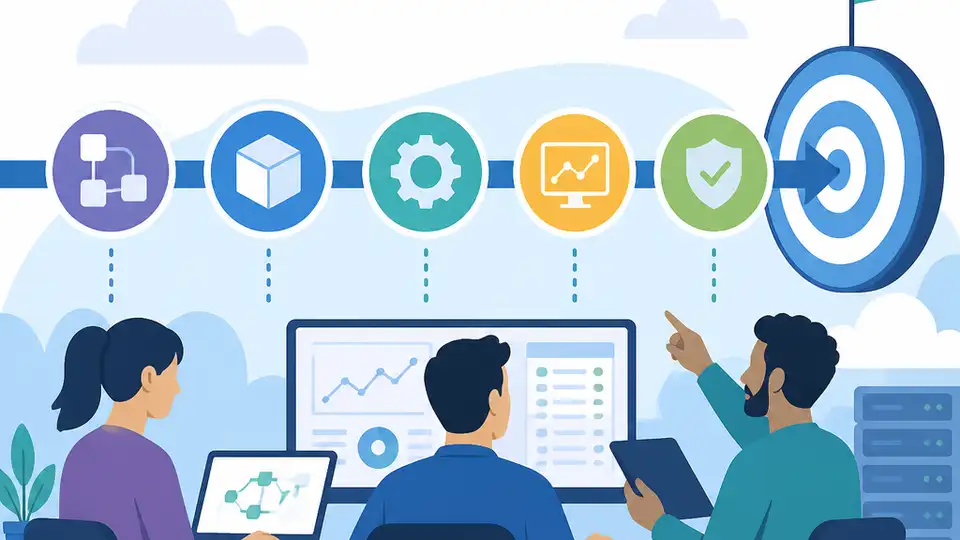
MLOps is the set of practices for shipping and managing machine learning in production.
Reading these 5 items gives you a clear map of what MLOps does, why teams adopt it, and which goals matter most. A 2024 market estimate put MLOps at USD 2,191.8 million.
| Item | Primary focus | Why it matters |
|---|---|---|
| Deployment and automation | Move models into production | Reduces manual release work |
| Reproducibility | Track data, code, and model state | Makes results easier to repeat |
| Monitoring and management | Watch model health after launch | Helps catch drift and failures |
| Governance and compliance | Meet policy and regulatory needs | Supports safer enterprise use |
| Collaboration and scalability | Coordinate teams and expand usage | Helps ML move beyond pilots |
1. Deployment and automation
Get the latest AI news in your inbox
Weekly picks of model releases, tools, and deep dives — no spam, unsubscribe anytime.
No spam. Unsubscribe at any time.
MLOps starts with getting models out of notebooks and into production systems. It connects machine learning work with DevOps-style delivery so teams can move from experiments to repeatable releases instead of one-off handoffs.

That usually means automating parts of the path from training to serving, plus orchestration across data, code, and infrastructure. Common building blocks include CI/CD, workflow orchestration, and endpoint deployment.
- Automated model packaging and release steps
- Pipeline orchestration for training and serving
- Endpoint deployment for live predictions
2. Reproducibility of models and predictions
Reproducibility is the ability to recreate a model, its outputs, and the conditions that produced them. In MLOps, that means versioning data, model artifacts, and code so a team can answer what changed and why results shifted.
This matters because machine learning systems are sensitive to small changes in data and training setup. Without reproducibility, debugging becomes guesswork, and audits become slow. It also helps teams compare models fairly over time.
- Version control for code, data, and model files
- Metadata tracking and logging
- Recorded training runs and evaluation results
3. Monitoring and diagnostics
Once a model is live, MLOps keeps watch on its behavior. Monitoring covers performance, data drift, failures, latency, and other signals that show whether the model still fits real-world conditions.
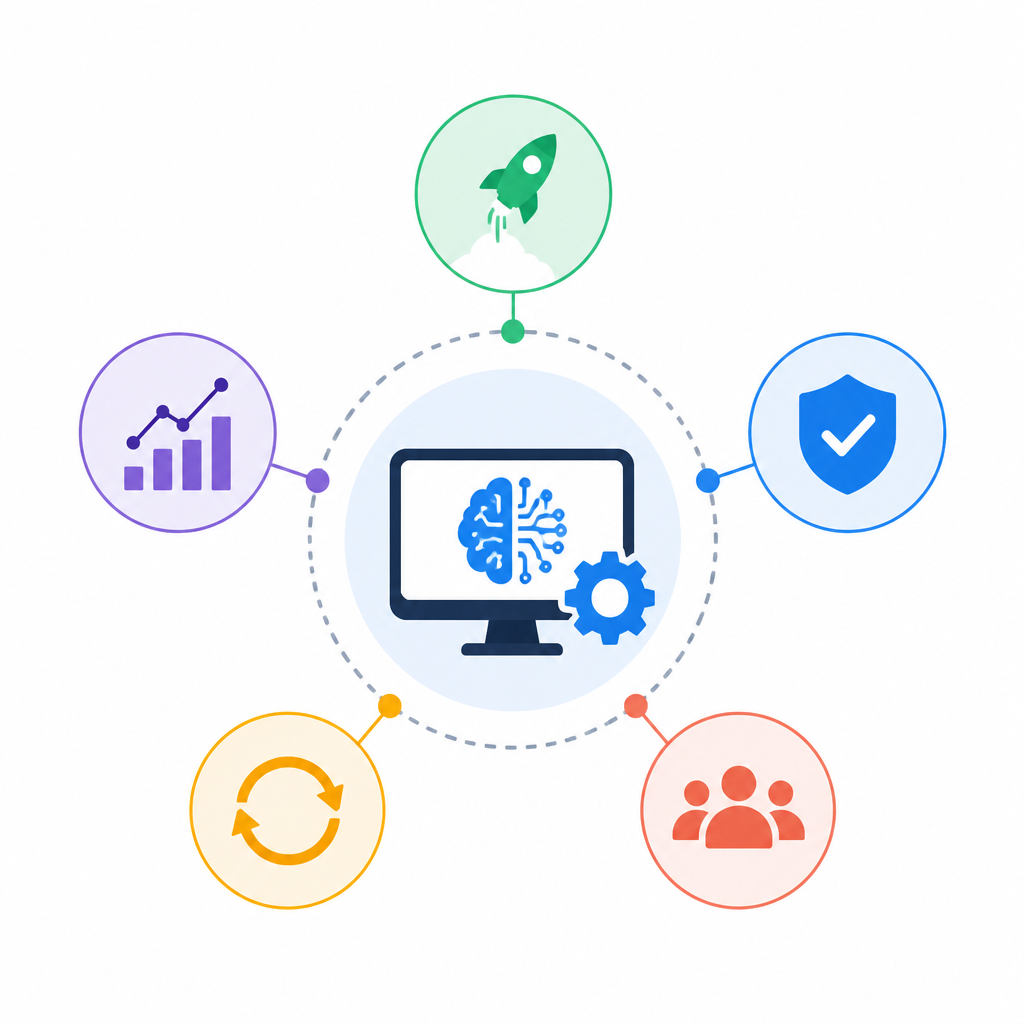
Diagnostics go a step further by helping teams trace problems back to their source. If input data changes, labels shift, or a feature pipeline breaks, the system needs enough visibility to explain the failure and support a fix.
- Continuous monitoring of model outputs
- Health checks for endpoints and pipelines
- Alerts for drift, errors, or degraded accuracy
4. Governance and regulatory compliance
MLOps also helps organizations control how machine learning is used. Governance covers approval paths, access rules, documentation, and policy checks, while compliance focuses on meeting internal and external requirements.
This is especially important in regulated settings such as finance, healthcare, and public sector work. The goal is not only to deploy models, but to do it in a way that can be reviewed, explained, and defended.
- Approval workflows for model release
- Audit trails for data and model changes
- Policy checks tied to business and legal rules
5. Collaboration and scalability
MLOps is built for teams, not solo experimentation. It brings data scientists, machine learning engineers, DevOps staff, and business stakeholders into a shared process so models can move through development and production with fewer bottlenecks.
It also supports scale. Wikipedia notes that many corporate ML efforts struggle to get past test stages, while organizations that do reach production can see profit margin gains of 3–15%. MLOps helps close that gap by making ML work more repeatable across projects and departments.
- Shared workflows across data, engineering, and operations
- Reusable pipelines for multiple models
- Enterprise systems for scaling ML across teams
How to decide
If you are just trying to ship a first model, start with deployment and automation. If your team already has models in production, prioritize monitoring, reproducibility, and governance so releases stay measurable and safe.
If your organization is growing ML across many teams, collaboration and scalability should move to the top. That is where MLOps becomes less about a single pipeline and more about a production system for the full machine learning lifecycle.
// Related Articles
- [IND]
AMD and Microsoft push Windows ML on GPU and NPU
- [IND]
OpenAI’s IPO filing turns hype into scrutiny
- [IND]
Skatteetaten proves public sector AI should be judged by outcomes
- [IND]
OpenAI’s IPO filing puts AI’s biggest test on Wall Street
- [IND]
OpenAI’s latest moves now center on pricing, safety, and scale
- [IND]
RISC-V mini PCs are worth buying now, but only as a bet on the future