5 RISC-V basics for builders
5 RISC-V basics explain the open ISA, its extensions, and why chips from MCUs to servers now use it.
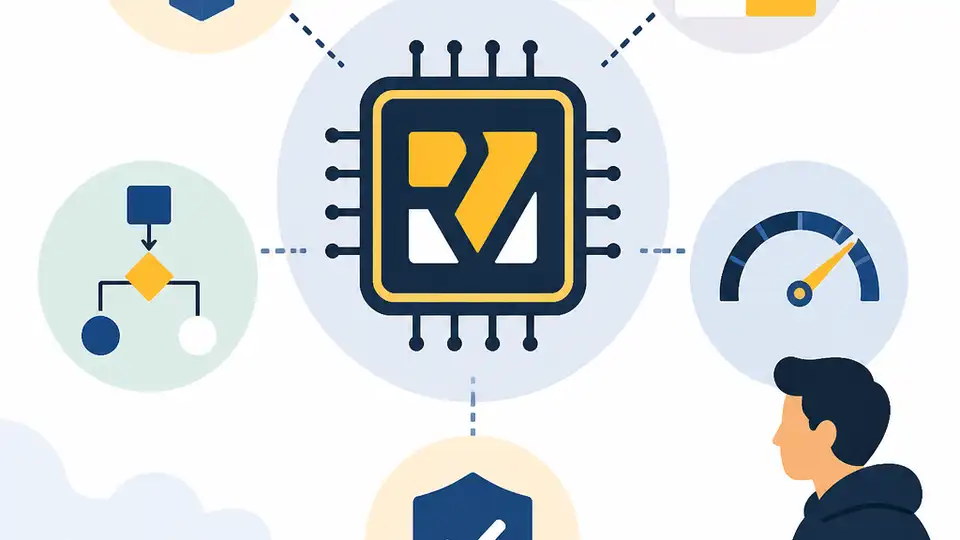
RISC-V is an open instruction set architecture used from microcontrollers to servers.
RISC-V is an open CPU instruction set architecture that now powers chips from tiny embedded parts to server-class designs. It was introduced in 2014, and RISC-V International now has more than 4,500 members, which shows how fast the ecosystem has grown.
| Item | What it is | Notable detail |
|---|---|---|
| RISC-V base ISA | Open instruction set architecture | Royalty-free and license-friendly |
| Standard extensions | Optional capability blocks | M, A, F, D, Q, C, B, V |
| Register sets | Core architecture resources | 16 or 32 general-purpose registers |
| Bit widths | Supported implementations | 32, 64, and 128 bits |
1. The open ISA model
Get the latest AI news in your inbox
Weekly picks of model releases, tools, and deep dives — no spam, unsubscribe anytime.
No spam. Unsubscribe at any time.
RISC-V is not a single chip or a single company product. It is a specification for how software talks to hardware, and that makes it useful for groups that want control over their own processor design. Because the spec is open and royalty-free, teams can build compatible cores without paying per-unit fees.

That matters for both research and shipping products. The architecture was developed at the University of California, Berkeley, and later maintained by RISC-V International, which moved to Switzerland in 2019 and became a Swiss nonprofit business association in 2020.
- Open specification, not a vendor lock-in program
- Compatible implementations can be open source or proprietary
- Works for academic projects and commercial silicon
2. The base design choices
RISC-V follows reduced instruction set computer principles. It uses a load-store design, variable instruction encoding, and little-endian byte order in common implementations. The core idea is to keep the base simple, then add only the features a design really needs.
That simplicity is one reason it fits so many targets. The ISA supports 32-bit, 64-bit, and 128-bit variants, and it defines a small set of general-purpose registers with optional floating-point and vector registers.
- Load-store architecture
- Variable encoding, including compressed 16-bit instructions
- General-purpose registers: 16 or 32, depending on the profile
3. The standard extension set
RISC-V gets much of its flexibility from extensions. The base ISA can be expanded with modules for multiplication, atomics, floating point, compressed code, bit manipulation, and vectors. That lets a microcontroller stay small while a performance chip can add the features needed for heavier workloads.

The extension model also helps software teams plan for different classes of hardware. A compiler or operating system can target a specific profile, while silicon vendors choose the mix that fits power, area, and speed goals.
Common extensions: M, A, F, D, Q, C, B, V
Control support: Zicsr
Fence support: Zifencei
4. The range of implementations
RISC-V is already used in commercial SoCs and MCUs from companies such as [SiFive](https://www.sifive.com/), [Andes Technology](https://www.andestech.com/), [Espressif Systems](https://www.espressif.com/), [StarFive](https://www.starfivetech.com/), and [Raspberry Pi](https://www.raspberrypi.com/). The architecture is also supported by several major Linux distributions, which makes it more practical for general-purpose computing.
Performance claims vary widely across implementations, and that is normal for an ISA. The source notes one headline example from Micro Magic Inc. in October 2020: a 64-bit RISC-V core reported at 5 GHz and 13,000 CoreMarks. That kind of result shows how far the upper end of the ecosystem has moved.
- Microcontrollers for low-power devices
- Embedded systems for appliances and industrial gear
- Higher-performance chips aimed at mobile, desktop, and server use
5. The software and tooling story
A CPU architecture matters only if the software stack follows. RISC-V has compiler, operating system, and development-tool support, which is why it has moved beyond lab demos and into shipping hardware. The ecosystem also includes the RISC-V Software Ecosystem, or RISE, launched by the Linux Foundation Europe in 2023.
RISE is meant to expand software availability for power-efficient and high-performance RISC-V processors. Its initial members include Red Hat, Samsung, Qualcomm, Nvidia, MediaTek, Intel, and Google, which signals broad industry interest in making the platform easier to use.
- Compiler support for mainstream toolchains
- Linux support across multiple distributions
- Growing vendor participation in software enablement
How to decide
If you want the simplest mental model, think of RISC-V as an open rulebook for building processors. If you are a hardware team, the open ISA and extension system give you room to tune cost, power, and performance. If you are a software or systems team, the growing toolchain and Linux support make it easier to treat RISC-V like a real deployment target.
For readers comparing it with older proprietary ISA families, the main appeal is control: no royalties, public specs, and enough flexibility to scale from tiny MCUs to larger SoCs. That combination is what has made RISC-V a serious option across embedded and general-purpose computing.
// Related Articles
- [IND]
OpenAI’s IPO filing turns hype into scrutiny
- [IND]
Skatteetaten proves public sector AI should be judged by outcomes
- [IND]
OpenAI’s IPO filing puts AI’s biggest test on Wall Street
- [IND]
OpenAI’s latest moves now center on pricing, safety, and scale
- [IND]
RISC-V mini PCs are worth buying now, but only as a bet on the future
- [IND]
Fedora 44 RISC-V widens Linux board support