5 takeaways on Replit’s enterprise push
5 takeaways from Replit’s Visa deal, enterprise growth, and the rise of vibe coding in AI software development.
Replit’s Visa deal shows vibe coding is moving into enterprise software.
Replit’s latest move shows how fast AI-assisted app building is moving from novelty to business infrastructure. The company says it has more than 50 million users worldwide and usage inside 85% of Fortune 500 companies.
| Item | Enterprise signal | Notable detail |
|---|---|---|
| Visa partnership | Payments integration | Visa invested and is testing Replit internally with 1,000+ employees |
| Replit enterprise footprint | Adoption scale | More than 50 million users worldwide |
| Fortune 500 reach | Market penetration | Used inside 85% of Fortune 500 companies |
| Agent 4 | AI app creation | Collaborative agents, task orchestration, parallel execution |
| Enterprise controls | Governance | SSO, audit logs, SCIM, RBAC |
1. Visa is treating AI app building as a real business channel
Get the latest AI news in your inbox
Weekly picks of model releases, tools, and deep dives — no spam, unsubscribe anytime.
No spam. Unsubscribe at any time.
The biggest signal in the announcement is not just that Visa invested in Replit, but that it is also using the platform internally. More than 1,000 Visa employees are already working with it, which suggests this is not a branding exercise. It is an operational bet.
Replit and Visa are also exploring ways to connect Visa Intelligent Commerce directly into apps built on Replit. That could let developers and AI agents initiate payments without the usual integration-heavy setup.
- Investment plus internal deployment is a stronger signal than a pilot alone.
- Payment flows are moving toward machine-to-machine use cases.
- Low-value, high-frequency transactions are the likely first fit.
2. Replit is no longer just for hobbyists
Replit first became popular with students and independent developers, but its current numbers point to a much broader audience. The company says it now reaches more than 50 million users and is used inside 85% of Fortune 500 companies. That is a major shift in who sees it as useful.
Enterprise customers already include Adobe, Atlassian, Databricks, and Okta. Those names matter because they show Replit is being evaluated by large teams that care about governance, scale, and procurement fit.
- Broad user growth helps, but enterprise logos build trust.
- Large companies want fast prototyping without long setup cycles.
- Browser-based development lowers the barrier for non-traditional builders.
3. Self-serve enterprise onboarding changes the buying motion
One of Replit’s most practical updates is self-serve enterprise onboarding. Instead of waiting for a traditional sales process, organizations can start using enterprise-grade controls on their own. That matters because AI tools are often adopted bottom-up before IT fully standardizes them.
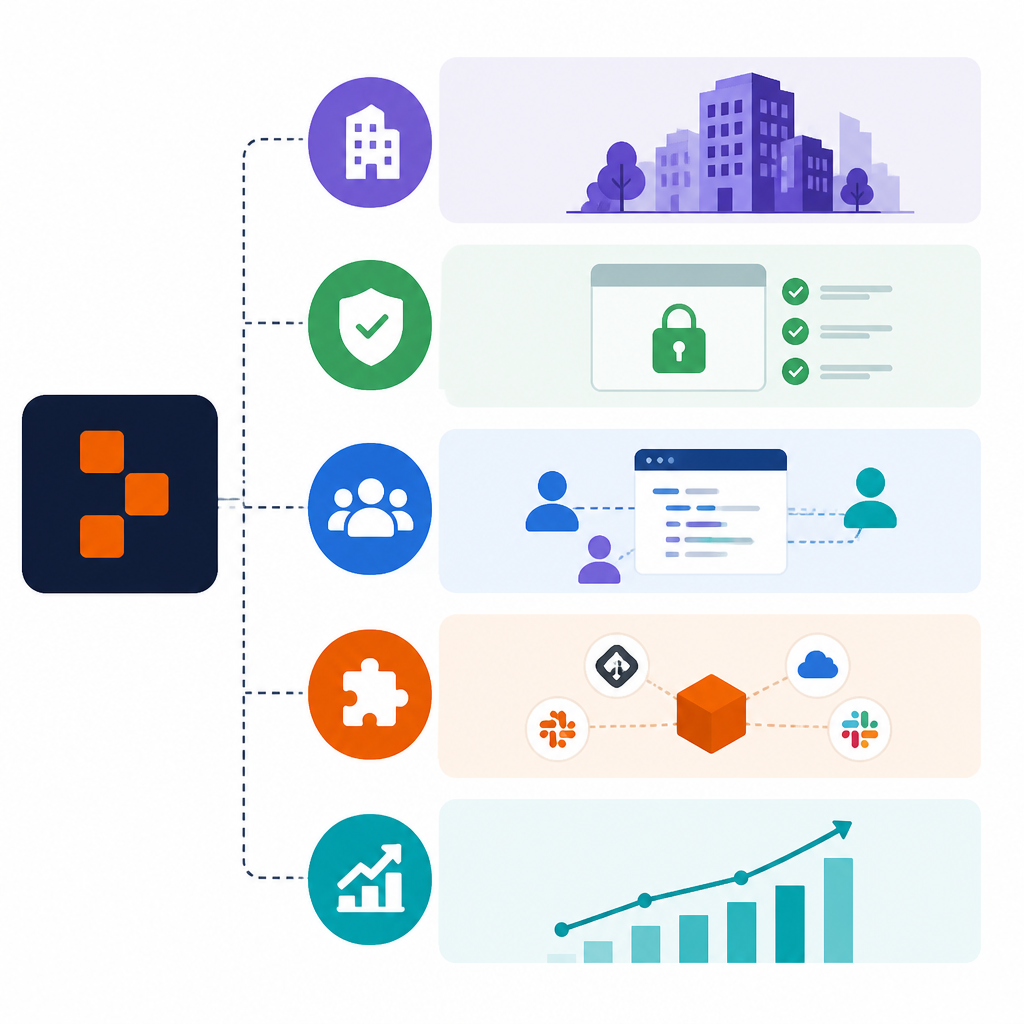
The available controls include SSO, audit logs, SCIM directory sync, and role-based access control. For IT and security teams, those features are often the difference between a tool that gets tested and one that gets approved.
Enterprise controls mentioned by Replit:
- SSO
- Audit logs
- SCIM directory sync
- Role-based access control
4. “Vibe coding” is becoming a real workflow, not a slogan
Replit defines vibe coding as building apps almost entirely with AI, using natural language prompts instead of writing every line by hand. That idea is now moving from an experimental label to a working method for product teams, founders, and operators.
The company’s Agent 4 release pushes that further with collaborative AI agents, task orchestration, parallel execution, and deployment tools. In practice, that means users can work on front-end design, authentication, databases, and infrastructure at the same time while iterating on the product idea.
- Prompting replaces a chunk of manual coding.
- Iteration becomes faster because multiple tasks can run together.
- More roles can prototype software without deep engineering training.
5. Governance is now the real test for AI-generated software
As AI-generated apps spread, security and reliability become harder to ignore. Research has shown that AI-written code can still introduce vulnerabilities, especially when non-technical users ship apps without enough review. That makes governance a product feature, not just a policy issue.
Replit is responding with tools such as Replit Security Agent, Auto-Protect, and Global App Hosting, plus partner support from Accenture, Slalom, and Hexaware. The companies that combine speed with control are likely to win the next phase of enterprise AI adoption.
How to decide
If you are a developer, Replit is the most interesting if you want fast app creation with AI agents and built-in deployment. If you are an enterprise buyer, the key question is whether its controls, security features, and partner ecosystem fit your internal standards.
If you are watching the market more broadly, the Visa partnership is the clearest sign that vibe coding is moving into systems that handle real business transactions, not just prototypes.
// Related Articles
- [IND]
OpenAI’s IPO filing turns hype into scrutiny
- [IND]
Skatteetaten proves public sector AI should be judged by outcomes
- [IND]
OpenAI’s IPO filing puts AI’s biggest test on Wall Street
- [IND]
OpenAI’s latest moves now center on pricing, safety, and scale
- [IND]
RISC-V mini PCs are worth buying now, but only as a bet on the future
- [IND]
Fedora 44 RISC-V widens Linux board support