500 AI agent projects show where agents work now
This GitHub repo catalogs 500+ AI agent projects across frameworks, industries, and working code examples.

This GitHub repo catalogs 500+ AI agent projects across frameworks, industries, and working code examples.
500 AI Agents Projects is not a theory dump; it is a large, organized map of real agent code, use cases, and framework choices. The repository says it covers 500+ projects, spans LangGraph, CrewAI, AutoGen, and Agno, and it gives developers a fast way to move from curiosity to runnable code.
The useful part is that the repo treats agents like software, not buzzwords. It groups examples by framework, by industry, and by task, so a developer can compare a health assistant, a trading bot, and a customer service bot without leaving the same README.
| Fact | Value | Why it matters |
|---|---|---|
| Projects listed | 500+ | Enough examples to spot patterns across agent design |
| GitHub stars | 32.1k | Signals strong community interest |
| Forks | 5.6k | Shows people are copying and adapting it |
| Commits | 55 | Indicates active curation, not a dead bookmark page |
What the repository actually gives you
Get the latest AI news in your inbox
Weekly picks of model releases, tools, and deep dives — no spam, unsubscribe anytime.
No spam. Unsubscribe at any time.
The repo is a directory of runnable examples, not a gallery of abstract prompts. Under agents/, each project has its own requirements file and environment example, which means you can clone one folder and start testing instead of wiring together a giant monorepo.

That matters because a lot of agent content online stops at architecture diagrams. This collection is more practical: it shows how to build a web research agent, a meeting assistant, a stock analysis tool, a recruitment workflow, and a legal document reviewer with real code paths.
The repo also includes a quick-start flow that points to a working agent in under five minutes. That is a strong signal about the audience: people who want to ship something, compare frameworks, or learn by running code instead of reading a whitepaper.
- Clone the repo and jump into one agent folder.
- Install the listed dependencies for that project only.
- Copy the sample environment file and add your API key.
- Run the agent script directly from the folder.
Framework choice is the hidden value here
The most useful section for builders is the framework comparison. It compresses a messy ecosystem into a decision aid: LangGraph for stateful workflows and RAG pipelines, CrewAI for role-based teams and quick prototypes, AutoGen for code generation and self-healing workflows, Agno for lightweight single agents, and LlamaIndex for document Q&A and enterprise data pipelines.
“I’m not interested in building another demo. I want to build systems that solve real problems.” — Andrew Ng
That quote fits this repo’s vibe because the collection keeps pulling the conversation back to implementation. It is less about agent hype and more about which framework fits which job, which is exactly where a lot of teams get stuck.
The README even gives a plain-English shortcut: if you are just starting, use Agno or CrewAI; if you need stateful graphs plus retrieval, use LangGraph; if you are building code-writing or research agents, use AutoGen; if you are working on document-heavy pipelines, use LlamaIndex.
Industry examples make the trend easier to trust
The industry section is where the repo stops feeling abstract. It lists concrete use cases such as a health insights agent for medical reports, an automated trading bot for finance, a virtual AI tutor for education, and a real-time threat detection agent for cybersecurity. Those examples are broad enough to show range, but specific enough to be useful.
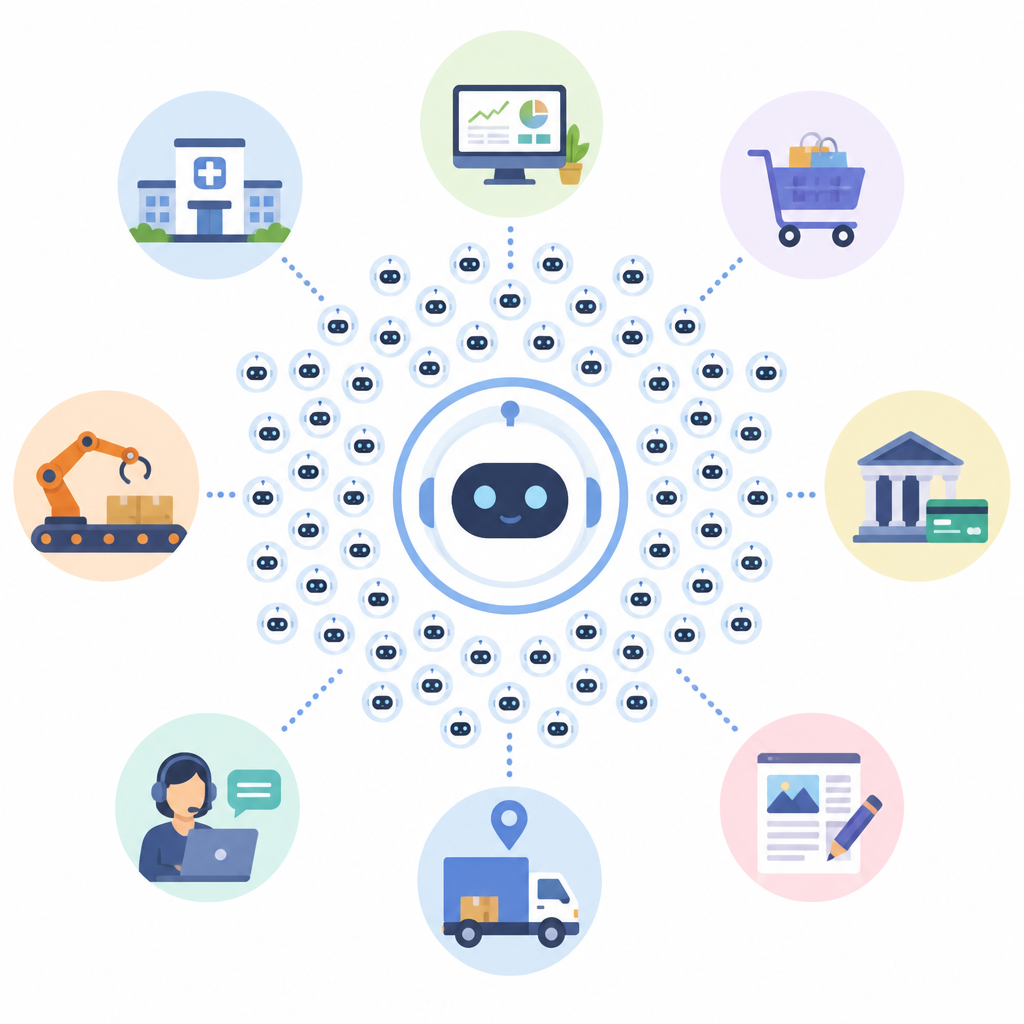
That breadth matters because agents are often discussed as if they belong to one niche. This repo shows the opposite: the same core pattern, a model plus tools plus memory or workflow control, can be adapted to insurance claims, delivery routing, manufacturing monitoring, and product recommendations.
- Healthcare examples focus on analysis, triage, and patient support.
- Finance examples lean toward trading, wallet control, and risk-aware automation.
- Education examples center on tutoring, personalization, and scheduling help.
- Cybersecurity examples emphasize threat detection and red-team testing.
There is also a nice spread across business functions. Sales, HR, marketing, travel, logistics, and e-commerce all show up with working examples, which makes the repo useful for product teams that want to test whether agents can take real operational load.
For teams comparing options, the repo’s framework matrix is more useful than generic benchmarks because it connects architecture to use case. A stateful support workflow needs different tradeoffs than a one-shot content generator, and the examples make that difference obvious.
Why this repo matters right now
AI agents are moving from conference demos into the boring parts of software: ticket triage, report review, lead scoring, meeting prep, and internal search. A curated repo like this helps developers avoid starting from scratch and gives teams a shared reference point when they debate which stack to use.
It also lowers the barrier for students and researchers who want to study agent design patterns across multiple frameworks. Instead of reading isolated examples, they can compare how the same task is handled by different toolchains and spot where each one gets messy.
That said, a big collection can also create false confidence. A repo with 500 entries does not mean every agent is production-ready, and the README does not hide that. The real value is in the structure: it shows what to try, what to compare, and what to ignore when a demo looks clever but cannot survive real usage.
If your team is deciding where to start, the smartest move is to pick one use case, clone one agent, and test it against your own data and latency budget. The repo gives you the map; the next step is finding out whether your problem fits one of the examples or needs a different design entirely.
For readers tracking this space, this is also a good companion to our guide on AI agent frameworks for production. The bigger question now is not whether agents can do impressive things, but which tasks are stable enough to automate without turning your workflow into a debugging session.
// Related Articles
- [TOOLS]
Chocolatey’s Go package turns installs into policy
- [TOOLS]
Go support policy turns releases into a checklist
- [TOOLS]
RustDesk self-hosting setup for secure remote access
- [TOOLS]
Aider turns open-source coding into repo edits
- [TOOLS]
WWDC 2026 rumors turn Siri into a real assistant
- [TOOLS]
Figma adds MCP-linked Make, agent, and QA tools