Actian’s VectorAI DB Claims 22x Faster Search
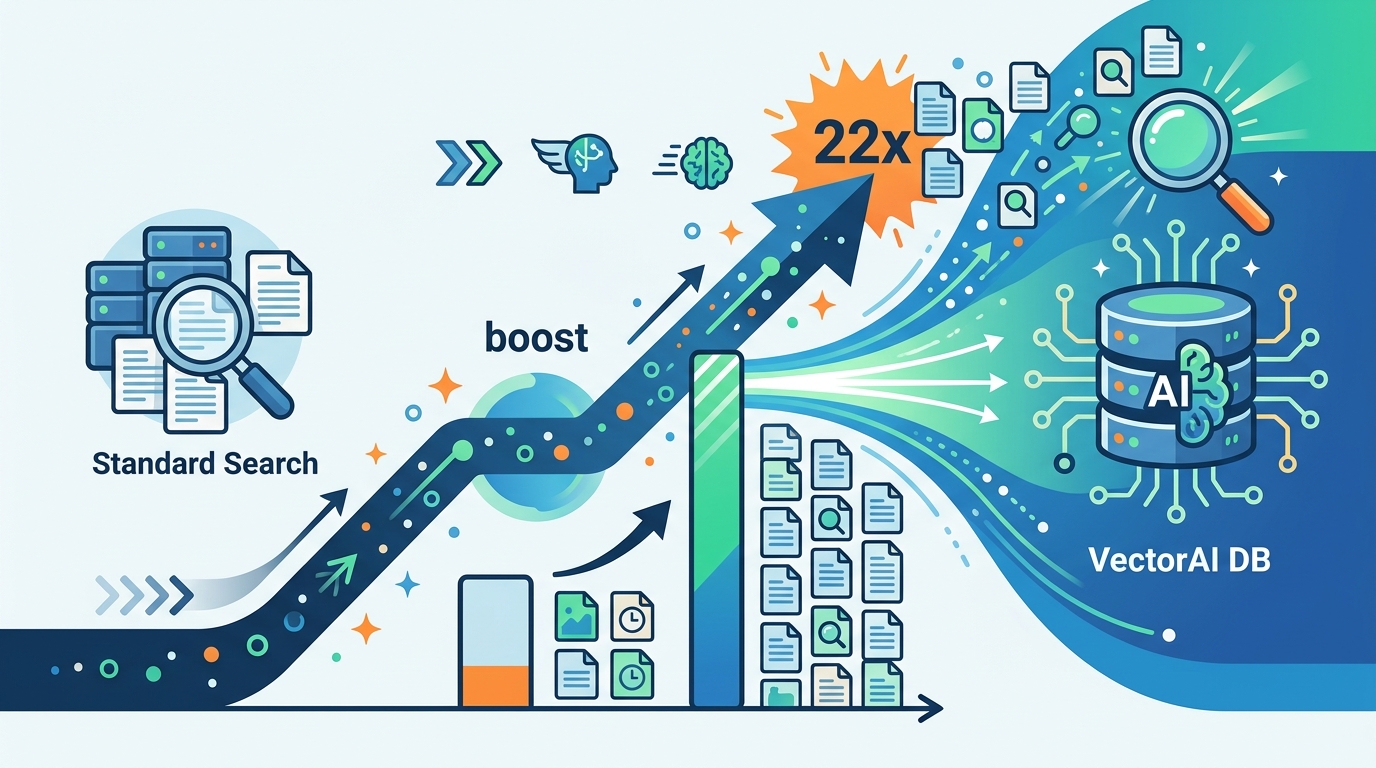
Actian says VectorAI DB embeds vector search inside apps and delivers up to 22x faster retrieval than common alternatives.

Actian says VectorAI DB embeds vector search inside apps and returns results up to 22x faster.
Actian has introduced VectorAI DB, a database designed to keep vector retrieval inside the application instead of pushing it through a separate service. The company says that approach can cut latency and simplify how teams build retrieval-augmented apps, with performance claims that go as high as 22x faster than competing options.
| Metric | Value | What it means |
|---|---|---|
| Speed claim | 22x faster | Actian’s headline vector search claim |
| Architecture | Embedded in application | Retrieval can run locally inside the app |
| Integration model | No separate vector database pipeline | Less glue code and fewer moving parts |
Why Actian is betting on embedded retrieval
Get the latest AI news in your inbox
Weekly picks of model releases, tools, and deep dives — no spam, unsubscribe anytime.
No spam. Unsubscribe at any time.
The most interesting part of VectorAI DB is not the speed number. It is the architecture. Instead of asking developers to move data into a dedicated vector store, Actian wants retrieval to live where the application already runs. That matters because every extra hop between the app, the database, and an external vector system adds latency, operational work, and another place for things to break.

For teams building search, chat, or recommendation features, the usual setup often looks like this: data gets indexed elsewhere, embeddings get synced through a pipeline, and the app queries that separate system when it needs semantic matches. Actian’s pitch removes that middle layer. If the database can do vector search directly, developers spend less time stitching systems together and more time tuning the actual product behavior.
This is also a practical answer to a common complaint about vector stacks. A lot of teams do not want a second database just for embeddings. They want the relational data, operational queries, and semantic retrieval to live in one place. That reduces duplication and makes deployment easier, especially for teams that already trust Actian’s data platform.
- Fewer moving parts in the retrieval path
- Lower dependency on sync pipelines
- Better fit for app-local search and RAG workflows
What 22x faster actually means
Speed claims in database marketing always deserve a close read. A 22x figure sounds dramatic, but the real question is what Actian measured, on which dataset, and against which baseline. Was it raw nearest-neighbor lookup, filtered search, or a full retrieval pipeline with embeddings and ranking? Those details matter more than the headline.
Still, the number is useful because it signals where Actian wants to compete. The company is not just trying to be another vector search option. It is trying to make vector retrieval feel like a native database feature. If the performance holds up in production-like workloads, the value is less about benchmark bragging rights and more about making semantic search cheap enough to use everywhere.
“The next step in the evolution of the database is to make it context-aware, so it can understand relationships, patterns and meaning in the data.” — Ram Venkatesh, CTO, Actian
That quote matters because it frames the product around database behavior, not a separate AI add-on. Actian is treating vector search as something the database should do by itself, the same way it already handles indexing, filtering, and transactional work.
- 22x faster is the headline claim
- Benchmark context is still the key question
- Native vector search only matters if it stays fast under real load
How it compares with the usual vector stack
Most teams today reach for a dedicated vector database or a managed search service when they need semantic retrieval. That can work well, but it also introduces another system to provision, monitor, and secure. Actian is aiming at a different tradeoff: keep the data and the retrieval logic close together, then let the application query one system instead of two or three.
That approach has clear benefits for operational simplicity. It also changes how teams think about architecture. If the vector layer is embedded, then retrieval can be optimized alongside the rest of the workload rather than treated like a sidecar service. For smaller teams and internal tools, that may matter more than squeezing out the absolute best recall score.
- Dedicated vector DBs usually add a separate sync layer
- Embedded retrieval reduces infrastructure sprawl
- Single-system designs can simplify security and deployment
- External systems may still win when workloads need specialized scaling
There is also a strategic angle here. The vector database market has grown crowded, with vendors pushing toward faster indexing, hybrid search, and tighter integration with AI apps. Actian’s move suggests the company thinks the next buying decision will be less about exotic features and more about whether vector search can live inside existing operational systems without adding friction.
What developers should watch next
If Actian publishes detailed benchmarks, the first thing to check is whether the 22x number holds across different query types and data sizes. The second thing is how VectorAI DB behaves when it is used in a real application with filters, updates, and concurrent traffic. Those are the conditions that expose whether a database is genuinely practical or just impressive in a lab demo.
For developers, the takeaway is simple: embedded vector retrieval is becoming a serious design choice, not a niche experiment. If Actian can prove that VectorAI DB keeps latency low while cutting integration work, other database vendors will have to answer the same question. Do they want to sell a separate vector layer, or make semantic search part of the database itself?
That is the real story here. The 22x claim gets attention, but the bigger test is whether teams decide they can finally stop building a vector stack around their app and let the app query one system directly.
// Related Articles
- [TOOLS]
500 AI agent projects show where agents work now
- [TOOLS]
Chocolatey’s Go package turns installs into policy
- [TOOLS]
Go support policy turns releases into a checklist
- [TOOLS]
RustDesk self-hosting setup for secure remote access
- [TOOLS]
Aider turns open-source coding into repo edits
- [TOOLS]
WWDC 2026 rumors turn Siri into a real assistant