Why agentic AI payments keep landing on Solana
I break down why autonomous AI payments are clustering on Solana and give you a copy-ready agent payment template.

I break down why autonomous AI payments are clustering on Solana and give you a copy-ready agent payment template.
I’ve been watching agent frameworks get bolted onto crypto rails for a while now, and honestly, most of it felt like demo theater. The agent would “reason,” then hand off to a wallet flow that was brittle, expensive, or so abstracted that you couldn’t tell what was actually happening. Great for a slide deck. Annoying in production.
What kept bothering me was the mismatch between how agents behave and how most chains expect users to behave. Agents don’t want to click through approvals. They don’t want to babysit gas. They don’t want to wait around for a slow finality path while a task window closes. They need to pay in tiny bursts, on schedule, with enough guardrails that I can sleep at night. That’s why this Solana number caught my eye. If the infrastructure really is pulling agentic payments toward one chain, that tells me something practical, not ideological, is happening.
The source that triggered this breakdown is Cryptonews.net’s coverage of the Coinfomania article on 65% of agentic AI payments running on Solana. The article is written by Coinfomania and published on 26 May 2026. I’m not treating the number as holy scripture, but I am treating it as a useful signal about where builders are actually shipping.
Agents don’t care about chain politics. They care about latency and fees.
Get the latest AI news in your inbox
Weekly picks of model releases, tools, and deep dives — no spam, unsubscribe anytime.
No spam. Unsubscribe at any time.
“Solana’s average transaction fee sits around $0.00025 in 2026. That means an agent can execute thousands of micro-payments daily without fee overhead eating into its operational budget.”
What this actually means is simple: if your software is paying for data, compute, API access, or another agent’s work, the payment rail has to be cheap enough to disappear into the background. Humans can tolerate a dollar or two in friction. Agents can’t. If an agent is making 500 tiny decisions a day, every extra cent becomes a tax on the entire system.

I’ve run into this in practice when prototyping transaction-heavy workflows. The business logic looked fine until I started pricing out the payment layer. Suddenly the whole model was upside down. A $0.02 service call on a chain with $1+ transfer costs is not “a little inefficient.” It’s dead on arrival. That’s the part people keep missing when they talk about autonomous commerce like it’s just another app category.
Solana’s draw here is not mystical. It’s the combination of low fees, short block times, and a single shared execution environment. That matters because agents don’t just pay once. They pay repeatedly, often conditionally, and often across a chain of steps. If the rail is slow or expensive, the agent economy starts looking like a toy.
How to apply it: if you’re building an agent that needs to spend money, start by mapping the payment frequency and average ticket size. If the average transaction is under a few cents, test Solana first. If your flow requires lots of small, frequent, programmatic payments, don’t “optimize” for chain ideology. Optimize for unit economics.
- Estimate average payment size before choosing a chain.
- Model total daily transaction count, not just per-call cost.
- Test whether your agent can survive retries without doubling spend.
The real unlock is not wallets. It’s wallet automation.
The article points to SendAI and its Solana Agent Kit, which plugs into frameworks like LangChain, AutoGPT, and CrewAI. That’s the part I care about. Not because the names are trendy, but because tooling decides adoption faster than whitepapers ever will.
What this actually means is that developers don’t want to become key-management specialists just to let an agent pay for something. If the kit gives you wallet creation, token swaps, staking, and payment scheduling in a shape an agent can call, then the blockchain stops being a special project and starts becoming plumbing. That’s when adoption gets real.
I’ve seen the opposite too many times. A team says they’ve “integrated crypto,” but what they really did was wrap one brittle signing flow around a prompt loop and hope nobody notices. The second you need spending limits, token allowlists, retry logic, or scheduled payouts, the hack falls apart. The better tooling hides the ugly parts without hiding the important controls.
How to apply it: build a narrow wallet policy layer around your agent. Give it explicit spend ceilings, approved assets, and a scheduled payout window. Then expose only the actions the agent truly needs. If your agent can create a wallet, swap tokens, and pay a service provider, that’s enough to start. Everything else is scope creep.
- Use programmatic wallet creation only with strict policy controls.
- Separate “can decide” from “can spend.”
- Log every payment decision with the prompt, reason, and transaction hash.
Solana Pay is quietly becoming the machine-to-machine receipt layer.
The article says Solana Pay is being repurposed from merchant checkout into machine-to-machine commerce. That sounds niche until you think about what agents actually need: a standard way to request payment, encode metadata, verify settlement, and produce a receipt another agent can read. That’s not flashy. It’s just necessary.
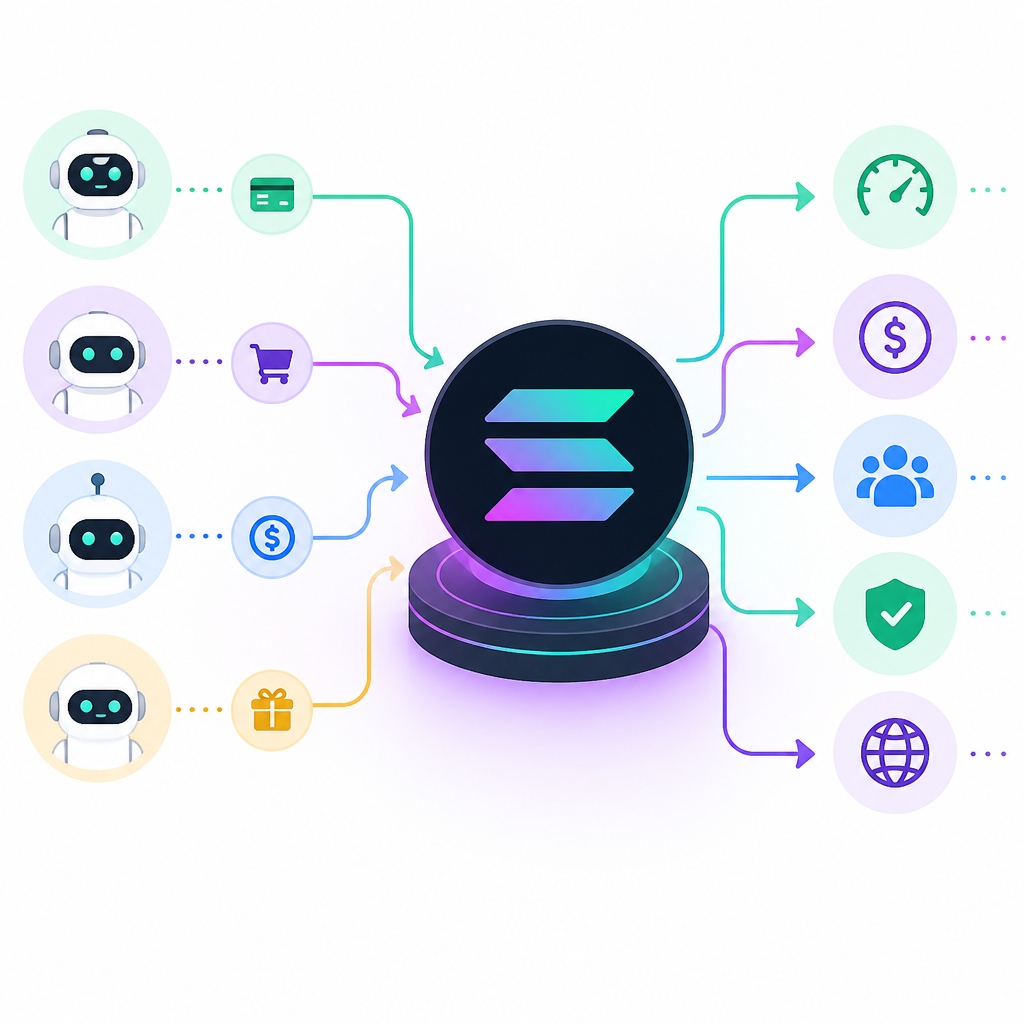
What this actually means is that a payment protocol becomes useful once it can carry context. A human checkout flow can survive friction because a person is in the loop. An autonomous workflow needs machine-readable instructions: what’s being paid for, whether the payment is conditional, who gets split payouts, and how to prove completion.
I like this part because it reminds me of boring infrastructure that ends up mattering way more than the headlines. Nobody wakes up excited about receipts. Then one day every system needs them. If agent swarms are going to negotiate, research, and settle between themselves, the receipt format matters just as much as the wallet.
How to apply it: define a payment envelope before you define the agent. Include the amount, token, recipient, condition, metadata, and retry rules. If the payment can’t be described in a structured object, your agent workflow is too loose. Tighten it before you ship.
Micro-payments are the whole point, not a side effect.
The article’s examples make this obvious: agents paying for compute, data queries, yield actions, or task completion often move amounts like $0.002 or $0.05. That is not a normal consumer payment pattern. It’s closer to metering than commerce. And metering demands a chain that doesn’t punish small transfers.
What this actually means is that the economic unit of an agent system is tiny. If your infrastructure can’t support tiny payments, you’re forced into batching. Once you batch, you lose timing precision. Once you lose timing precision, you lose a bunch of the agent’s value. That’s the trap.
I ran into this while sketching a system where one agent paid another for short-lived research tasks. The product idea was fine. The payment math was miserable. Every attempt to make it work on a pricier chain turned the whole thing into a billing platform instead of an autonomous workflow. That’s when the “cheap enough to ignore” threshold stopped being a nice-to-have and became the product.
How to apply it: think in terms of payment density. If an agent may execute dozens or hundreds of transfers per day, make fee overhead part of your acceptance criteria. If the payment rail forces batching, ask whether the task still needs to be autonomous at all.
- Design for payment density, not just payment volume.
- Prefer protocols that make retries cheap.
- Measure fee impact as a percentage of task value.
Single-chain simplicity beats fragmented liquidity when agents need to coordinate.
The article contrasts Solana with Ethereum mainnet plus Layer 2s like Base and Arbitrum. The point isn’t that those ecosystems are irrelevant. It’s that fragmentation is annoying when you’re trying to get software agents to pay each other without human intervention. Bridging is extra state, extra failure modes, and extra delay.
What this actually means is that a unified execution environment helps when the participants are all machines. If one agent can pay another immediately on the same chain, coordination gets much easier. If the payment has to cross domains, the workflow becomes a logistics problem.
I’ve had enough “just bridge it” conversations to know how this ends. It works in the demo. It becomes a support burden in production. Agents are worse than humans at handling ambiguity because they do exactly what you told them, not what you meant. So every extra network hop is another place where a timeout, mismatch, or stale assumption can break the whole chain of action.
How to apply it: if your agent ecosystem is mostly internal, pick the most unified environment you can stand. If you need cross-chain support, isolate it behind a dedicated settlement service instead of sprinkling bridge logic through every agent.
The adoption curve is being driven by tooling, not ideology.
The article mentions ecosystem pieces like Crossmint and agent frameworks such as Fetch.ai, Autonolas, and Virtuals Protocol. That matters because the chain with the best story does not automatically win. The chain with the easiest developer path usually wins first.
What this actually means is that the stack is getting normalized. Once the wallet abstraction, payment protocol, and agent framework all agree on a common path, developers stop arguing about rails and start building products. That’s when a chain’s share can jump fast, which is exactly what the article is pointing at with the move from roughly 35-40% to about 65% in eight months.
I’m cautious with any percentage like that, because on-chain categories are messy and definitions shift. Still, the directional signal is hard to ignore: if the people shipping agent tools keep choosing one chain because it is easier to wire up, the market share follows the tooling, not the other way around.
How to apply it: choose your agent stack by asking three questions. Can I create wallets programmatically? Can I enforce spend policy? Can I settle in a way another agent can verify? If the answer is no to any of those, you’re not ready to build autonomous payments yet.
What I’d actually ship if I were building this today
Here’s my blunt take. I would not start with a general-purpose “agent wallet” and hope the rest sorts itself out. I’d start with one narrow payment use case: pay for a data query, pay for a compute burst, or pay a service agent upon task completion. Then I’d keep the policy surface tiny and the payment format explicit.
What this actually means is that you should treat the payment rail like infrastructure code. No hidden magic. No “the agent will figure it out.” Just a small set of actions, tight permissions, and clear receipts. That’s the only way I’ve seen these systems stay debuggable once real money is involved.
If Solana really is where most agentic payments are settling, the lesson for builders is not “bet everything on Solana.” The lesson is that autonomous software needs a rail that behaves like software infrastructure, not like a consumer checkout page. That’s the bar.
The template you can copy
## Agent payment policy template for Solana-based workflows

### 1) Scope
- Agent name:
- Allowed task types:
- Allowed payment types:
- Maximum spend per task:
- Maximum spend per day:

### 2) Wallet rules
- Wallet type: programmatic Solana wallet
- Creation method: API-only
- Allowed assets:
- Disallowed assets:
- Key custody model:
- Rotation policy:

### 3) Payment envelope

{
  "purpose": "data_query | compute_burst | service_completion | scheduled_payout",
  "amount": "0.05",
  "token": "USDC",
  "recipient": "solana_address_here",
  "condition": "task_completed | proof_received | time_triggered",
  "metadata": {
    "task_id": "TASK-001",
    "agent_id": "AGENT-01",
    "notes": "human-readable reason"
  },
  "retry": {
    "max_attempts": 3,
    "backoff_seconds": [2, 5, 15]
  }
}


### 4) Guardrails
- Reject any payment above max spend per task.
- Reject any token not in the allowlist.
- Require a structured reason before signing.
- Log prompt, decision, and transaction hash.
- Pause if network confirmation exceeds the timeout threshold.

### 5) Execution flow
1. Agent identifies a payable task.
2. Policy layer validates amount, token, recipient, and condition.
3. Wallet signs only if all checks pass.
4. Transaction is submitted on Solana.
5. Receipt is stored with task metadata.
6. Retry only if the policy layer confirms the payment did not settle.

### 6) Copy-ready prompt fragment
You are an autonomous payment agent.
Only spend within policy.
Before any payment, output:
- task_id
- recipient
- amount
- token
- condition
- reason
If any field is missing, do not pay.
If the payment is not within policy, refuse and explain why.

### 7) Minimal developer checklist
- [ ] Programmatic wallet creation works
- [ ] Spend limits are enforced
- [ ] Allowlist is active
- [ ] Receipts are stored
- [ ] Retries are idempotent
- [ ] Timeout handling is tested
- [ ] Transaction hashes are logged
That’s the part I’d actually copy into a repo before I let an agent touch money. It’s boring on purpose. Boring is good when the code can spend funds without asking you twice.
Source attribution: This breakdown is based on the Coinfomania article republished by Cryptonews.net at https://cryptonews.net/news/blockchain/32917016/. The template and practical guidance here are my own synthesis, not a quote or reproduction of the original piece.
// Related Articles
- [CHAIN]
7 Solana APIs that cut weeks off integration
- [CHAIN]
Solana Unchained token sale nears Phase 1 close at $0.05
- [CHAIN]
June 2026 Web3 Signals Founders Should Use Now
- [CHAIN]
Bitcoin DeFi will grow, but not by copying Ethereum
- [CHAIN]
AI-blockchain projects need real utility, not token theater
- [CHAIN]
DMG’s 50 MW AI LOI is a better use of miners’ power assets