AI Code Review Explained: Benefits and Limits
IBM explains how AI code review speeds up pull requests, catches bugs, and still needs human judgment for context.
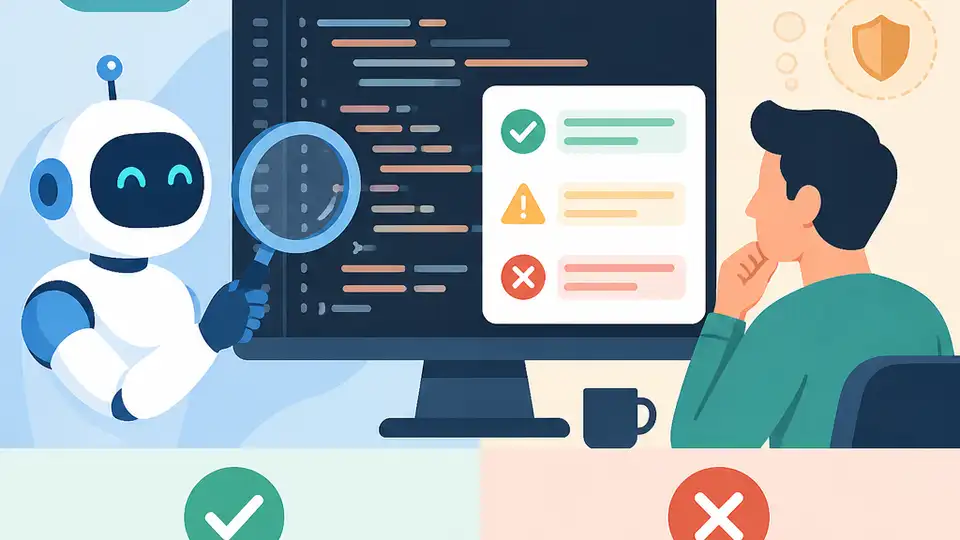
AI code review uses machine learning to flag bugs, speed up reviews, and support human reviewers.
Software teams are shipping more code, more often, and IBM says AI code review is becoming a practical way to keep pull requests moving without lowering the bar. In IBM’s breakdown, the tools can analyze diffs, suggest fixes, and plug into GitHub pull requests, IDE workflows, and CI/CD pipelines.
That matters because code review is one of the slowest parts of modern development. IBM’s article says AI can scan large volumes of code, catch subtle bugs, and return feedback in minutes instead of the hour-long hunts that human reviewers often face.
| Topic | IBM’s detail | Why it matters |
|---|---|---|
| Publication date | 15 October 2024 | Shows the topic is current, not theoretical |
| Update date | 28 May 2026 | Signals IBM is actively maintaining the guidance |
| Review speed | Minutes instead of an hour-long bug hunt | Explains the productivity appeal |
| Core deployment points | IDEs and version control systems | Shows where teams actually use it |
What AI code review actually does
Get the latest AI news in your inbox
Weekly picks of model releases, tools, and deep dives — no spam, unsubscribe anytime.
No spam. Unsubscribe at any time.
IBM defines AI code review as the use of artificial intelligence tools to assess code for quality, style, and functionality. In practice, that usually means a model looks at a diff, compares it with the surrounding code, and then points out issues that may deserve a human’s attention.
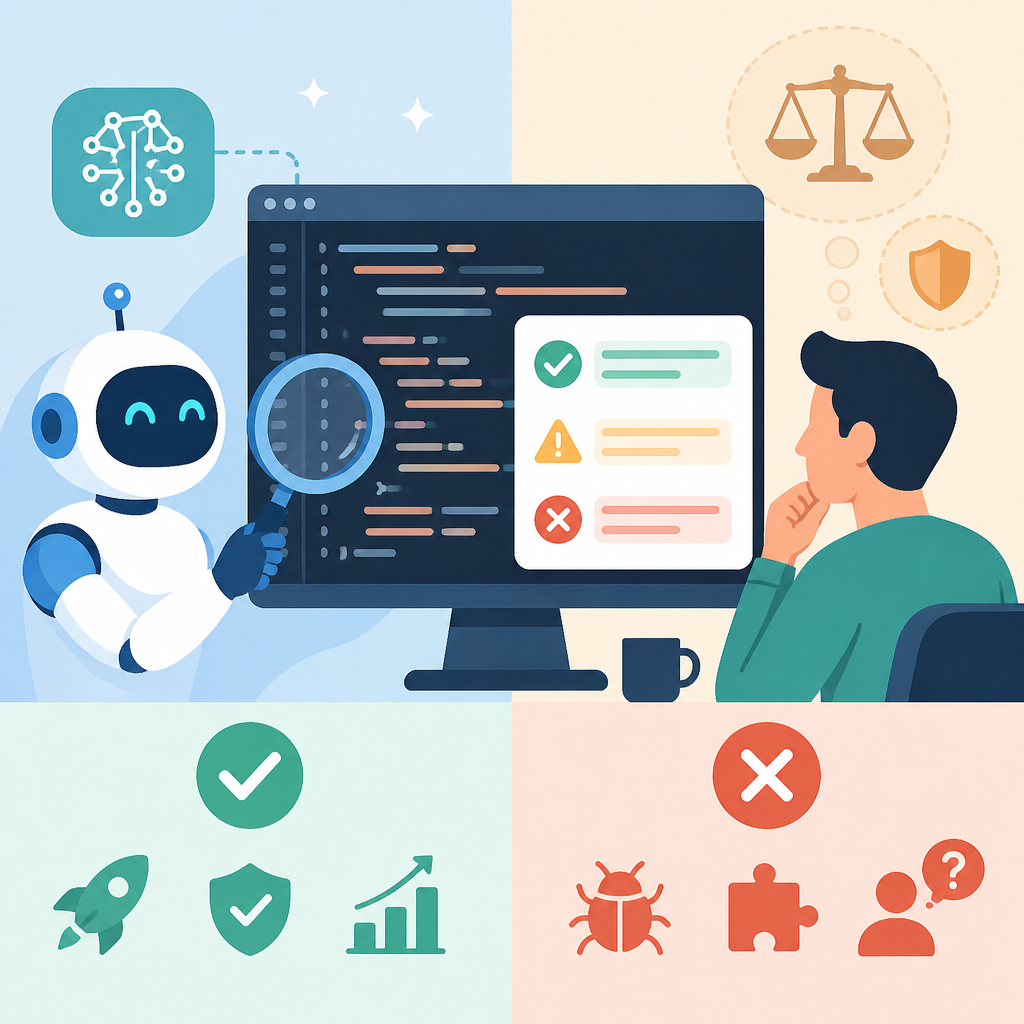
The important part is that these tools do more than spot formatting problems. IBM says they also look for inconsistencies with coding standards and possible security issues. That makes them useful in teams where the codebase is large, the release cadence is fast, and reviewers do not have time to read every line with equal care.
AI review tools usually fit into two places developers already use every day: the editor and the pull request system. That means a developer can get feedback while typing in an IDE or after opening a PR, which is a lot better than waiting until the end of a release cycle.
- They can analyze source code at commit time or when a PR opens.
- They can run inside IDE plugins for faster feedback.
- They can suggest fixes, not just list problems.
- They can help enforce style and security rules across a repo.
How the workflow works in practice
IBM breaks the process into five broad steps: training models, understanding semantics, analyzing code, generating suggestions, and adapting to user feedback. That sequence matters because it shows the system is doing more than keyword matching.
First, large language models are trained on code from many languages and projects. Then they try to infer intent from function names, comments, and variable names. After that, they inspect the changed lines and nearby code, compare the result with static analysis signals, and produce recommendations with explanations.
"The AI code review process typically follows these steps: Training models, understanding semantics, analyzing code, generating suggestions, adapting to user feedback."
That quote from IBM’s article gets to the heart of the product category. The best systems are not one-shot linters with a chatbot wrapper. They are feedback loops that improve as teams accept, reject, and refine recommendations.
IBM also points to static analysis as a baseline. Linters, vulnerability scanners, and code smell detectors still matter because they give the AI a rule-based foundation. In other words, AI review works best when it sits on top of deterministic checks, not when it replaces them.
Why teams are adopting it
The appeal is easy to understand. Human reviewers get tired, PR queues get long, and releases keep coming. AI can keep a steady pace even when a repository is noisy or a team is under deadline pressure.
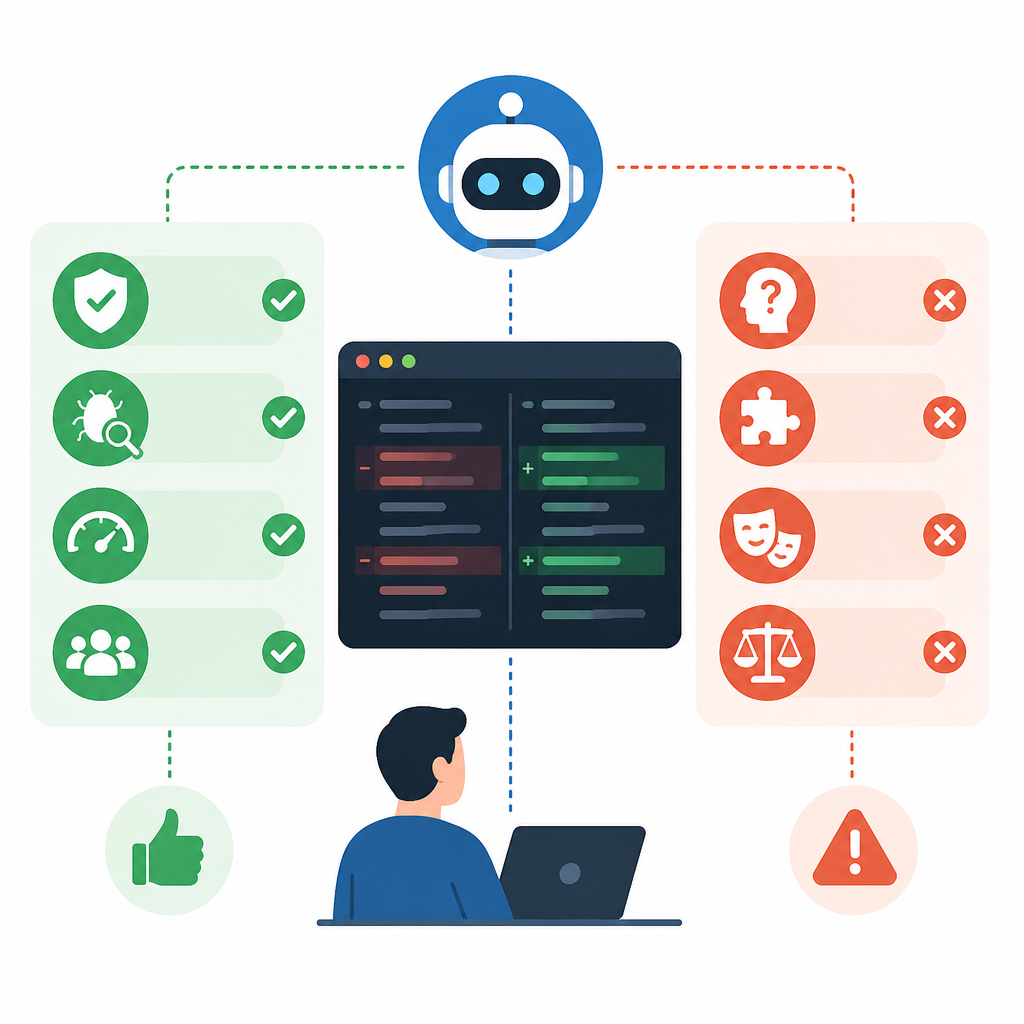
IBM’s article highlights four benefits: better error detection, consistency, efficiency, and higher developer productivity. Those are broad claims, but they map to real pain points in software delivery. If AI can catch a bug before it reaches a PR, that saves time twice: once in review, and again in rework.
- Better error detection catches subtle bugs earlier.
- Consistency helps teams apply the same standards across a large repo.
- Efficiency shortens the path from code change to feedback.
- Productivity improves when humans spend less time on repetitive checks.
There is also a cultural effect here. When AI handles repetitive review comments, human reviewers can focus on architecture, edge cases, and security tradeoffs. That is where experienced engineers add the most value, and it is also where automated systems still struggle.
IBM’s framing is practical rather than hype-driven: AI does the first pass, humans do the judgment call. That split is probably why the category is getting traction inside enterprise teams instead of staying a niche experiment.
Where the limits show up
The same article is careful about the downsides. AI code review can produce false positives, where harmless code gets flagged, and false negatives, where real problems slip through. Either one can waste time, but false negatives are the bigger risk because they create a false sense of safety.
Context is the other major weak spot. A model may understand syntax and patterns, yet still miss business logic, framework quirks, or domain-specific rules. IBM suggests fine-tuning on an enterprise codebase, plus using retrieval-augmented generation and the Model Context Protocol to pull in docs, architecture notes, and secure coding standards.
That last point matters because code quality is rarely about code alone. It depends on the API contract, the service boundaries, the release process, and the team’s own conventions. Without that context, AI review can sound confident while still missing the point.
- False positives can create review fatigue.
- False negatives can leave technical debt untouched.
- Lack of context can weaken suggestions for complex systems.
- Overreliance can dull human review habits.
IBM’s warning about overreliance is the most realistic part of the whole piece. If teams start treating AI comments as final answers, they may stop thinking critically about design, security, and long-term maintainability. That is how a helpful assistant turns into a shortcut that quietly adds risk.
How to choose and use these tools well
IBM ends with a straightforward adoption playbook: pick a tool that matches your workflow, configure it against your standards, train the team, and measure whether code quality actually improves. That sounds simple, but it is where a lot of rollouts fail.
The company also names several tools in the space, including Claude Code, Codacy, CodeRabbit, Cursor, GitHub Copilot, and IBM Bob. Each one approaches review a little differently, but the buying question is the same: does it fit the team’s language mix, repo size, and review habits?
Here is the comparison that matters when teams evaluate AI review tools:
- Best for speed: tools that run inside the editor and comment early.
- Best for governance: platforms that support custom rules and metrics.
- Best for enterprise context: systems that can ingest internal docs and repo-specific guidance.
- Best for trust: tools that explain why they made a suggestion.
The strongest buying signal is not how many issues a tool finds in a demo. It is whether the tool reduces review backlog without creating noisy output that engineers ignore after two weeks. If a team cannot measure that, the tool is probably just adding another layer of alerts.
AI code review will matter most as a filter, not a judge
IBM’s article makes a sensible case: AI code review is useful because it speeds up the first pass, catches routine issues, and helps teams keep quality checks close to the moment code is written. But the article is just as clear that the human reviewer still matters most when context, architecture, and tradeoffs enter the picture.
My read is simple. The teams that get the most value will use AI to shrink the grunt work, then keep humans in charge of the final call. The teams that treat it like an authority will probably spend more time arguing with noisy suggestions than fixing real bugs. The next question is whether your review process is designed to learn from AI, or just to accept its comments blindly.
// Related Articles
- [TOOLS]
500 AI agent projects show where agents work now
- [TOOLS]
Chocolatey’s Go package turns installs into policy
- [TOOLS]
Go support policy turns releases into a checklist
- [TOOLS]
RustDesk self-hosting setup for secure remote access
- [TOOLS]
Aider turns open-source coding into repo edits
- [TOOLS]
WWDC 2026 rumors turn Siri into a real assistant