The AI Resist List maps global pushback
A new AI Resist List documents legal fights, labor action, and community campaigns pushing back on AI deployment worldwide.
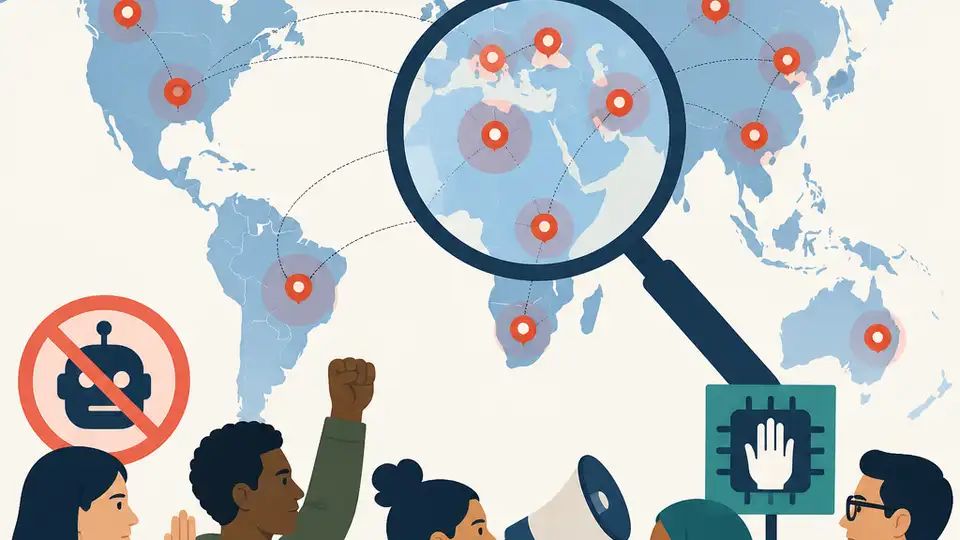
The AI Resist List documents how people around the world are pushing back against AI deployment.
In one story, a 12-hour community chatbot in Chile answered 25,000 prompts from users in 68 countries. In another, more than 1,000 Amazon employees signed an open letter warning about AI, climate, and surveillance risks. Those are the kinds of details that make the new AI Resist List hard to ignore.
| Metric | Value | What it shows |
|---|---|---|
| Quili.ai prompts | 25,000 | Public interest in a community-led alternative |
| Countries reached | 68 | Resistance stories travel far beyond one city |
| Amazon employee signers | 1,000+ | Worker pressure inside a major AI buyer |
| Worker strike length | 6.5 months | How long some labor fights around AI-adjacent work can last |
| Data workers in Kenya pilot | 20 to 50 | Early mental-health support for AI laborers |
What the AI Resist List is actually doing
Get the latest AI news in your inbox
Weekly picks of model releases, tools, and deep dives — no spam, unsubscribe anytime.
No spam. Unsubscribe at any time.
The project is a public database of resistance to AI systems and the companies building them. It was launched by a team of researchers, journalists, and critical scholars working across seven time zones, with support from the Distributed AI Research Institute (DAIR), We and AI, and the Refugee Law Lab at York University.
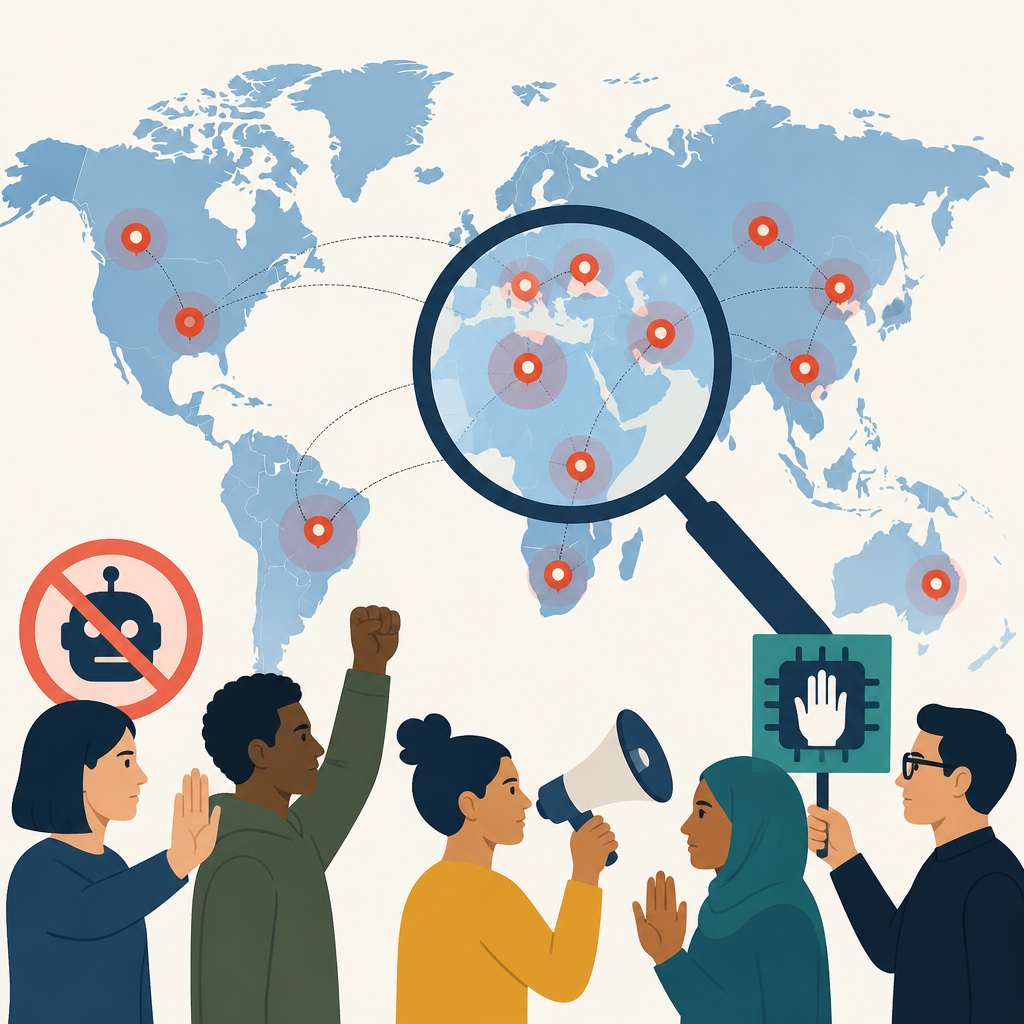
The point is simple: AI expansion is not one smooth, inevitable march. It is being challenged in courtrooms, workplaces, neighborhoods, and cultural spaces. The list captures that pushback in a way that most AI coverage still does not.
That matters because the usual AI story is written from the top down. Executives announce a future, investors fund it, and the rest of us are told to adapt. The AI Resist List flips that script by showing the people who refuse, contest, or reshape deployment before it becomes normal.
- It includes legal challenges to data centers and AI systems.
- It tracks worker organizing inside companies and supply chains.
- It records creative acts that make AI limits visible to the public.
- It centers communities in the Majority World, where harms often arrive first.
Why the map starts outside Silicon Valley
The list was initially scoped by Migration and Technology Monitor fellows Wael Qarssifi and Verónica Martínez. Qarssifi is a journalist from Syria who has reported on surveillance and migration across multiple regions. Martínez is a reporter and photojournalist based in Ciudad Juárez and El Paso whose work tracks surveillance and militarization along the US-Mexico border.
That background shaped the project’s method. Every group named in the database was contacted before publication, descriptions were checked multiple times, and no organization was included without consent, except for one individual whose role was documented in a lawsuit and could not be verified directly. The authors also centered the Majority World, where AI systems often arrive with fewer safeguards and more room for abuse.
“Humans place too much faith in decisions taken by AI.”
That line came from the Japan Metal, Manufacturing, Information and Telecommunication Workers’ Union, or JMITU, in a petition over IBM’s use of AI to help determine wages. The union’s complaint was accepted by the Tokyo Metropolitan Government Labor Relations Commission, and the dispute ended through reconciliation in JMITU’s favor.
It is a good example of why the database matters. These fights are easy to miss if you only read product announcements and earnings calls. They look different depending on where they happen, but they share one thing: people are asking who gets to decide how AI enters daily life.
What resistance looks like in practice
The entries in the AI Resist List are grouped into four modes: Resisting, Refusing, Reclaiming, and Reimagining. That taxonomy gives the project room to include lawsuits, strikes, public campaigns, and art projects without flattening them into one generic category of opposition.
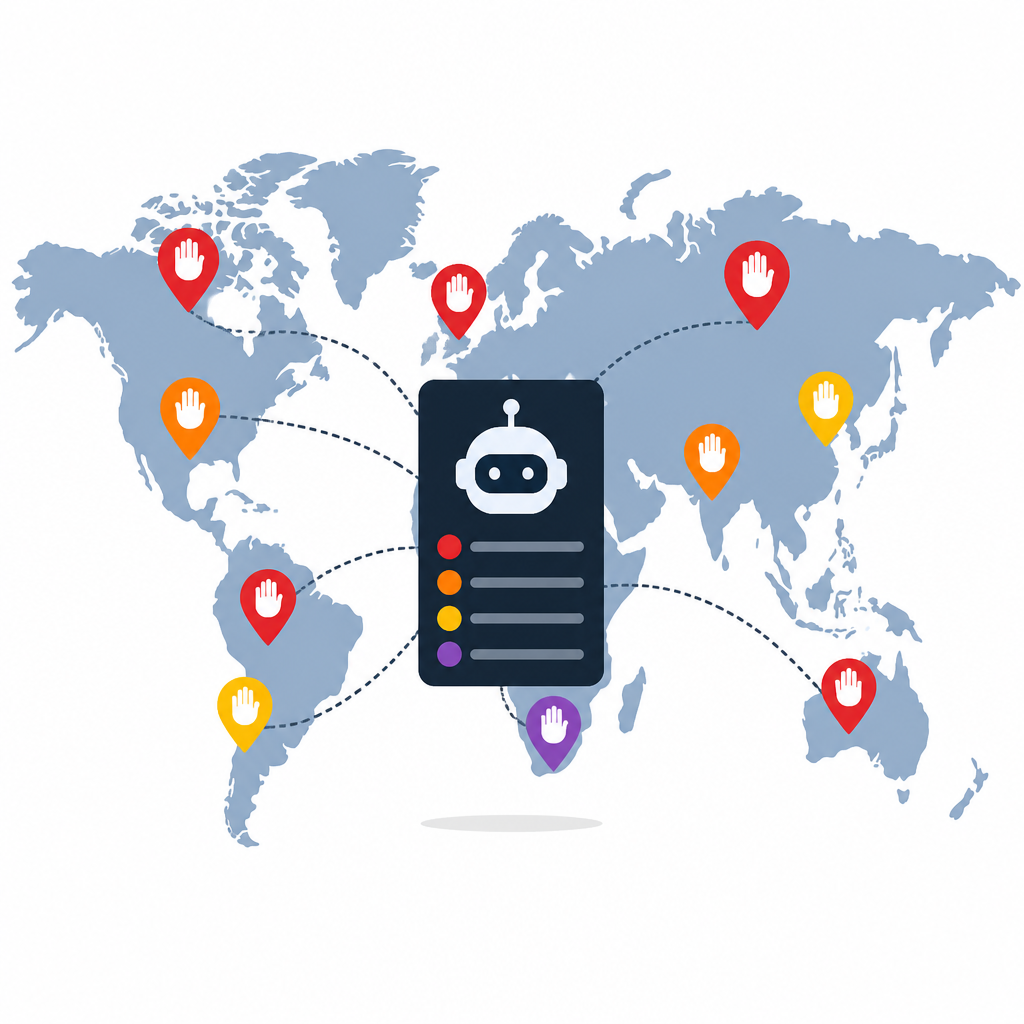
In New Mexico, the New Mexico Environmental Law Center sued over “Project Jupiter,” a hyperscale data center linked to OpenAI’s Stargate initiative. In Uruguay, Movimiento por un Uruguay Sustentable pushed for transparency around a proposed Google data center, including its air-quality impact and the real value of the promised 50 jobs. In Chile, Quilicura residents turned themselves into a human chatbot for a day through Quili.ai.
- Quili.ai handled 25,000 prompts in 12 hours.
- The users came from 68 countries.
- The project was built with local artists and community members.
- The point was to force reflection on what gets lost when people outsource judgment to AI.
Those examples are very different, but they point to the same pressure point: AI systems depend on land, water, labor, and political consent. When communities challenge a data center, a wage algorithm, or a public-sector deployment, they are challenging the claim that those costs are acceptable by default.
The labor story is even harder to miss. In California, Kaiser Permanente mental health workers staged a five-day hunger strike during a 6.5-month work stoppage, with 24 hours dedicated to opposing AI’s future role in therapy. In the Philippines, workers formed CODE AI to demand representation in AI policymaking. In Nairobi, the Data Labelers Association has grown to nearly 900 members while pushing for fair contracts and mental-health support.
There is a pattern here: the people doing the least visible work often bear the heaviest costs. Data labeling, content moderation, and outsourced support jobs are the hidden labor of AI. Without them, the polished product demos do not happen.
The article also points to Amazon employees, more than 1,000 of whom signed an open letter in 2025. Their demands were direct: no AI with dirty energy, no AI without employee voices, and no AI for violence, surveillance, or deportation. That is a sharper corporate challenge than most AI ethics statements ever get.
Why this list matters now
The AI industry has spent years selling inevitability. The list shows a different reality: people are already organizing against harmful deployments, and they are doing it with legal filings, labor action, public pressure, and technical experiments.
That does two things. First, it gives researchers and journalists a way to see patterns across countries and sectors. Second, it gives organizers a shared reference point, which matters when the work is scattered and often invisible.
The deeper question is whether companies will keep treating resistance as noise. If a project like this gains traction, the next AI debate may be less about whether the technology can be stopped and more about which deployments survive public scrutiny. That is a much harder test for the industry, and a more honest one for everyone else.
// Related Articles
- [IND]
OpenAI is right to keep ads out of sensitive chats
- [IND]
AI bootlegs are already draining streaming royalties
- [IND]
AMD and Microsoft push Windows ML on GPU and NPU
- [IND]
OpenAI’s IPO filing turns hype into scrutiny
- [IND]
Skatteetaten proves public sector AI should be judged by outcomes
- [IND]
OpenAI’s IPO filing puts AI’s biggest test on Wall Street