Anthropic’s 2026 surge: funding, deals, and scrutiny
Anthropic is racing through 2026 with huge funding talks, major cloud deals, and growing regulatory scrutiny.

Anthropic is pulling in massive funding while expanding its AI business and drawing tougher scrutiny.
Anthropic’s latest run of headlines reads like a compressed history of the current AI race: a possible $30 billion fundraise, a reported $900 billion valuation, and a string of enterprise deals that keep pushing its Claude models deeper into business workflows. Bloomberg’s latest tracker shows the company moving fast on capital, compute, and product expansion at the same time.
That matters because Anthropic is no longer just another model lab trying to catch attention. It is becoming one of the few private AI companies with enough scale to shape cloud spending, enterprise software adoption, and even policy debates around model safety.
| Recent Anthropic headline | Reported figure | Date |
|---|---|---|
| Possible new funding round | $30 billion | May 12, 2026 |
| Valuation in talks | $900 billion | May 12, 2026 |
| Compute deal with SpaceX | Nearly $45 billion | May 20, 2026 |
| Compute deal with Akamai | $1.8 billion | May 7, 2026 |
| Zoom investment value | $1 billion net gain | 20 hr ago |
Anthropic’s money story is now the main story
Get the latest AI news in your inbox
Weekly picks of model releases, tools, and deep dives — no spam, unsubscribe anytime.
No spam. Unsubscribe at any time.
The biggest signal in the Bloomberg feed is the scale of the funding chatter. A company that was once discussed mostly for its safety-first positioning is now being discussed in the same breath as giant valuations, secondary-market warnings, and the economics of frontier model training.

If the reported round closes near $30 billion, it would add another layer to Anthropic’s already aggressive capital strategy. The company is trying to finance model training, infrastructure, and distribution while rivals are doing the same. That is expensive even before you factor in the cost of serving millions of users and enterprise customers.
Anthropic has also been warning investors about certain secondary-market sellers, which tells you the market around its shares has gotten messy. In fast-rising private tech names, price discovery often becomes its own story.
- Reported round size: $30 billion
- Reported valuation: $900 billion
- Zoom’s paper gain: $1 billion
- SpaceX compute deal: nearly $45 billion
- Akamai compute deal: $1.8 billion
Compute is the real bottleneck
For AI companies, model quality gets the headlines, but compute determines how far they can actually run. Anthropic’s reported deals with SpaceX and Akamai show a company buying capacity at a scale that would have sounded absurd a few years ago.
The logic is simple: if demand for Claude keeps rising, Anthropic needs more chips, more data-center access, and more contractual certainty around supply. That is why compute agreements matter as much as product launches. They tell you how serious a company is about staying in the race over the next few years.
“Compute is becoming the new currency of AI,” said Dario Amodei, Anthropic’s co-founder and CEO, in public remarks about the company’s growth and infrastructure needs.
That quote gets to the heart of the business. Anthropic is not just selling software; it is buying the ability to keep selling software at scale.
Claude is moving deeper into enterprise work
Anthropic’s product push is no longer limited to chat. Bloomberg’s tracker shows new tools for legal work, financial professionals, and consumer-facing use cases, which is a sign that Claude is being positioned as a broad workplace assistant instead of a single-purpose chatbot.
This is where Anthropic differs from a lot of AI brands that still rely on hype-heavy demos. The company keeps aiming at tasks with clear budgets attached: legal drafting, financial analysis, and office automation. Those are the areas where buyers can justify spending if the tools save time or reduce outside consulting costs.
The company also brought in Andrej Karpathy, a founding member of OpenAI, which is the kind of hire that signals technical ambition and competitive intent. It also gives Anthropic another recognizable name in a talent market that is still brutally tight.
- Financial tools announced: AI agents for financial professionals
- Legal tools announced: expanded push into legal workflows
- Consumer angle: Claude is being made more appealing to non-enterprise users
- Talent move: Andrej Karpathy joined Anthropic in May 2026
Regulators are paying attention too
Anthropic’s growth is happening alongside more pressure from regulators and government buyers. Bloomberg’s roundup mentions stalled talks with Spain over “Mythos” concerns, EU outreach, and a Pentagon effort to test rival AI models as agencies look for alternatives.
That mix matters because the biggest AI vendors are now being judged on more than capability. Governments want supply-chain clarity, safety assurances, and the ability to avoid lock-in. When a company becomes important enough to worry about access, procurement, and model risk, it is crossing from startup status into infrastructure status.
Anthropic is also facing legal and market scrutiny over whether it can block a U.S. supply-risk label. That kind of dispute may sound procedural, but it can shape how public agencies and large companies think about vendor risk.
For a useful comparison, look at the numbers side by side:
- Possible fundraising: $30 billion
- Possible valuation: $900 billion
- Compute spend on one deal: nearly $45 billion
- Compute spend on another deal: $1.8 billion
- Reported investor gain from Zoom’s stake: $1 billion
What Anthropic’s next move will tell us
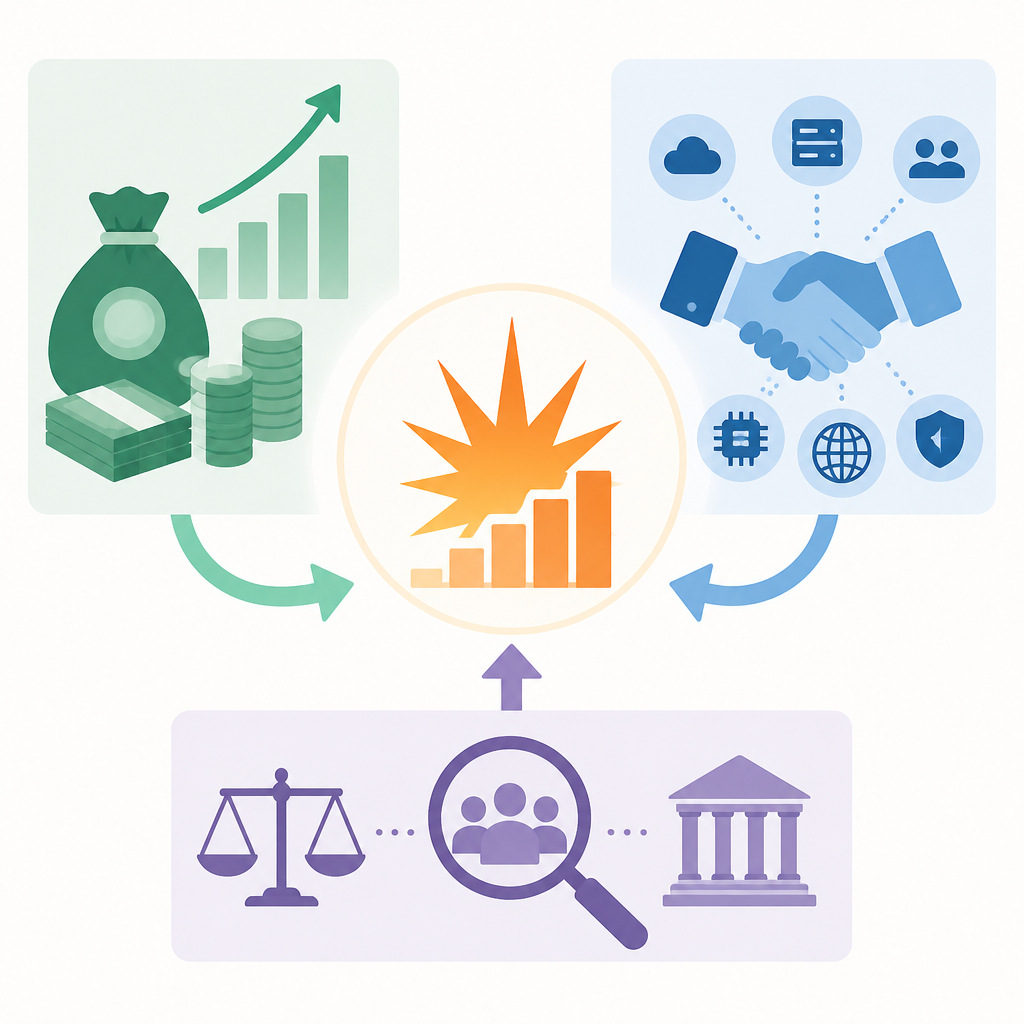
The pattern here is hard to miss: Anthropic is raising enormous capital, locking up compute, and pushing Claude into more business categories while regulators and customers ask tougher questions. That combination usually means the company is trying to turn technical momentum into durable market power.
The next thing to watch is whether the reported $30 billion round closes on the terms being discussed, and whether the company can keep turning enterprise interest into revenue without letting infrastructure costs outrun growth. If Anthropic can do that, it will set the pace for the next phase of the AI business. If it cannot, the market will quickly remind everyone how expensive this race really is.
For more context on how AI companies are changing enterprise software, see our coverage of OpenAI’s enterprise strategy and how companies are buying AI tools now.
// Related Articles
- [IND]
AMD and Microsoft push Windows ML on GPU and NPU
- [IND]
OpenAI’s IPO filing turns hype into scrutiny
- [IND]
Skatteetaten proves public sector AI should be judged by outcomes
- [IND]
OpenAI’s IPO filing puts AI’s biggest test on Wall Street
- [IND]
OpenAI’s latest moves now center on pricing, safety, and scale
- [IND]
RISC-V mini PCs are worth buying now, but only as a bet on the future