ConvexTok Reframes Tokenization as Optimization
ConvexTok turns tokeniser construction into a linear program and gets closer-to-optimal tokenization.

ConvexTok turns tokeniser construction into a linear program and gets closer-to-optimal tokenization.
- Research org: Unspecified in arXiv abstract
- Core data: Within 1% of optimal at common vocabulary sizes
- Breakthrough: Formulates tokeniser construction as a linear program
Tokenization is one of those invisible system choices that shapes everything downstream in NLP: model efficiency, context usage, training cost, and even how cleanly a model handles text. This paper argues that the usual greedy approach leaves performance on the table, and it replaces that process with a convex-optimization view that can be analyzed more directly.
For engineers, the interesting part is not just that the authors propose a new tokenizer. It is that they give a way to measure how far a tokenizer is from the best solution under a specific objective, which makes tokenization less of a black box and more of an optimization problem you can reason about.
What problem this paper is trying to fix
Get the latest AI news in your inbox
Weekly picks of model releases, tools, and deep dives — no spam, unsubscribe anytime.
No spam. Unsubscribe at any time.
Modern tokenizers like BPE and Unigram are built greedily. That means they make locally good choices one step at a time, but they do not explicitly optimize the final vocabulary as a whole. In practice, that can leave you with a tokenizer that is good enough, but not necessarily close to the best possible tokenizer under the metric you care about.

The paper treats that as a design flaw. Instead of searching through token merges or subword pieces in a heuristic way, it asks whether tokeniser construction can be expressed as a linear program and solved with convex optimization tools. That shift matters because optimization methods can provide structure, guarantees, and diagnostics that greedy algorithms usually do not.
There is an important practical distinction here: the paper is not claiming tokenization has been “solved” in some universal sense. It is working with a specific objective, and its claims are tied to that objective. That makes the result more useful for engineers who want a principled tokenizer than for anyone looking for a one-size-fits-all replacement for every existing method.
How the method works in plain English
The core idea is to turn tokenizer design into a linear program, then solve it with convex optimization tools. The authors call the resulting method ConvexTok. At a high level, the algorithm is not just picking tokens greedily as it goes; it is optimizing over the vocabulary construction problem more globally.
That global view is the key technical move. Greedy tokenizers can be fast and simple, but they optimize step-by-step. ConvexTok instead uses a formulation that lets the solver reason about the whole vocabulary under the chosen objective. In other words, it tries to find a better overall compromise rather than the best immediate next token.
The paper also emphasizes certification. Because the tokenizer is framed as an optimization problem, the method can produce a lower bound that tells you how far the current tokenizer is from optimal with respect to the objective being optimized. That is useful when you need to know whether more tuning is likely to help or whether you are already very close to the limit.
What the paper actually shows
The abstract reports three main outcomes. First, ConvexTok consistently improves intrinsic tokenization metrics. Second, it improves the bits-per-byte (BpB) achieved by language models. Third, it improves downstream task performance, although those downstream gains are less consistent than the intrinsic gains.
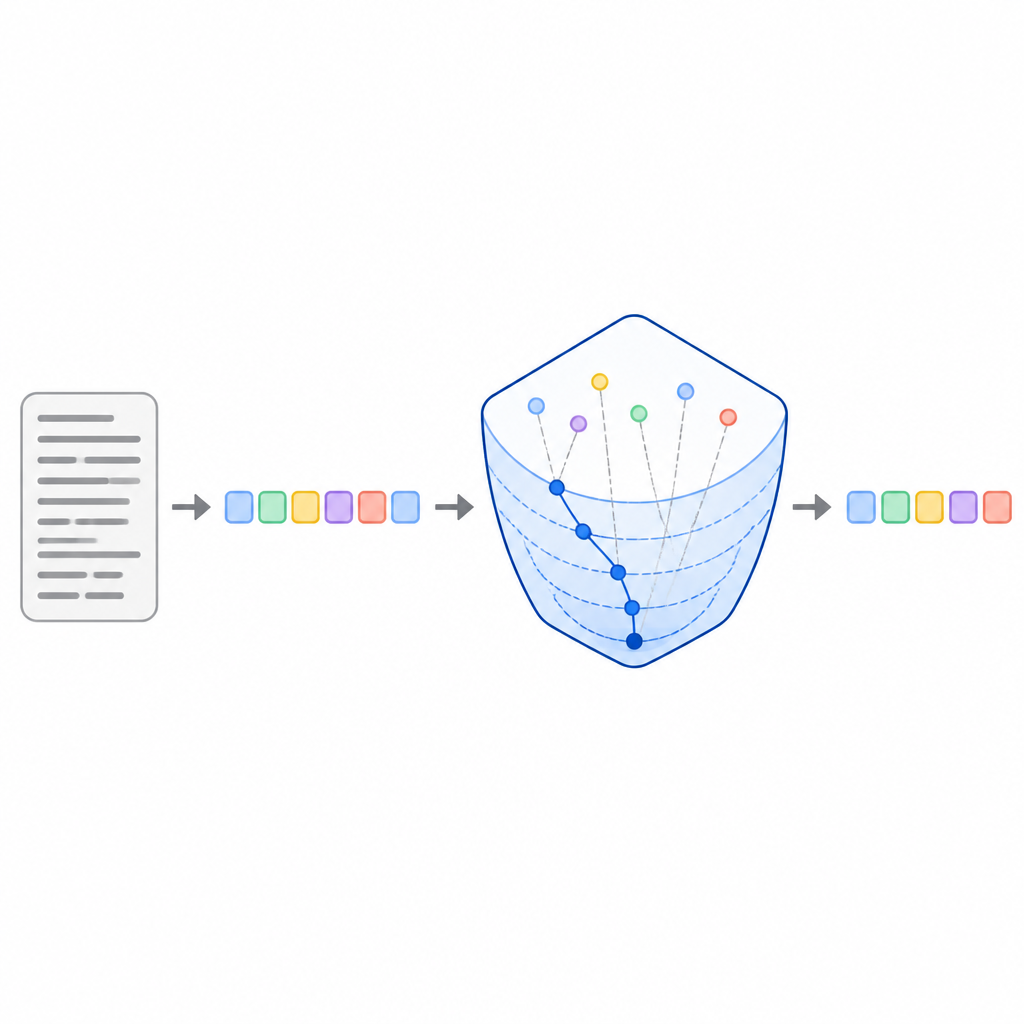
The abstract does not provide benchmark tables, dataset names, or exact scores beyond the certification result, so there are no headline numbers to compare against BPE or Unigram here. That is worth noting because the paper’s strongest claims are qualitative in the abstract, not a list of task-by-task wins.
The one concrete quantitative statement in the abstract is that ConvexTok is empirically within 1% of optimal at common vocabulary sizes. That is a meaningful result because it suggests the optimization formulation is not just elegant in theory; it can get very close to the best solution under its objective in realistic settings.
Another important detail is that the downstream performance gains are described as less consistent. That is the kind of caveat practitioners should pay attention to. A tokenizer can look better on intrinsic metrics and compression-style measures without translating into uniform improvements across every downstream workload.
Why developers should care
If you build or fine-tune language models, tokenization affects almost everything that follows. A better tokenizer can change sequence lengths, memory use, training throughput, and how much signal the model gets from each byte of text. Even small improvements in bits-per-byte can matter when you are scaling training or serving large models.
This paper is especially relevant if you care about controllability and auditability. Greedy tokenization methods are common because they are simple, but they do not tell you how close you are to the best possible vocabulary under a stated objective. ConvexTok adds a certification angle, which gives teams a way to justify that a tokenizer is near-optimal rather than merely conventional.
There is also an architectural lesson here: some pipeline components that are usually treated as heuristics may be better approached as optimization problems. That does not mean every preprocessing step should become a convex program, but it does suggest that tokenization has enough structure to justify a more rigorous treatment.
Limitations and open questions
The abstract is clear that downstream task improvements are less consistent than intrinsic metric gains. So if you are hoping for a universal downstream boost, this paper does not claim that. It shows promise, but it does not imply that every model or task will benefit equally.
Another limitation is that the abstract does not spell out the full range of computational costs, scaling behavior, or implementation complexity. Since the method relies on convex optimization tools, engineers will naturally want to know how it behaves at larger vocabularies, how expensive the solve step is, and how easy it is to integrate into existing training pipelines. Those details are not provided in the abstract.
Still, the paper makes a strong case that tokenization deserves more than heuristic treatment. If the objective is well defined, then being able to optimize it directly and certify proximity to optimal is a meaningful upgrade over purely greedy construction. For teams working on tokenizers, compression-oriented metrics, or model efficiency, that is a direction worth watching.
Bottom line
ConvexTok reframes tokenization as a solvable optimization problem instead of a greedy heuristic. The result is a tokenizer that improves intrinsic metrics, improves BpB, sometimes helps downstream tasks, and can be certified as being very close to optimal under the chosen objective.
- Tokenization can be treated as a linear program rather than a greedy search.
- The method is close to optimal at common vocabulary sizes, within 1% by the abstract’s claim.
- Downstream gains exist, but they are less consistent than the intrinsic improvements.
For developers, the main takeaway is simple: tokenization is not just a preprocessing detail, and this paper shows a path toward making it more principled, measurable, and optimizable.
// Related Articles
- [RSCH]
CRDTs keep replicas in sync without locks
- [RSCH]
Post-Deterministic Systems for Autonomous Infra
- [RSCH]
Causal methods for measuring task learnability
- [RSCH]
RL Training That Hands Off Control Gradually
- [RSCH]
OmniGameArena benchmarks VLM game agents better
- [RSCH]
TurboQuant cuts KV cache memory 6x in Google tests