Why crypto is built for AI agents, not humans
Crypto is the right financial layer for AI agents, not for human-first banking.

Crypto is the right financial layer for AI agents, not for human-first banking.
Crypto is built for AI agents, not humans, and that is exactly why it will matter.
The case is straightforward: traditional finance was optimized for human bodies and human schedules, while agents are software. Banks close at night, payments cross borders through layers of intermediaries, and identity checks assume a person can show up, sign forms, and wait. Agents do none of that. They operate continuously, they live in code, and they need to move value the same way they move data. If you accept that agents will increasingly buy, sell, route, and negotiate on their own, then crypto stops looking like a niche asset class and starts looking like the settlement layer for machine commerce.
The first argument: crypto fits the operating model of agents
Get the latest AI news in your inbox
Weekly picks of model releases, tools, and deep dives — no spam, unsubscribe anytime.
No spam. Unsubscribe at any time.
Agents do not sleep, do not travel, and do not need a branch office to approve a transfer. That matters because the current financial stack is built around human constraints. A card network or bank transfer works because it maps to a person’s life: business hours, national borders, customer support, and physical identity. An agent’s life is different. It needs instant, programmable, global execution. Crypto gives it that. A wallet can be controlled by code, funds can move 24/7, and transactions can be automated without asking a human to click through a dozen screens.

That is not a theoretical advantage. It is already visible in how developers use blockchain infrastructure. An API can create a wallet, sign a transaction, and trigger a payment in seconds. A bank account cannot be managed in the same way. The difference is not cosmetic; it is structural. When Nikil Viswanathan says crypto is the native infrastructure for a new economic actor, he is describing a system where software can hold and move money with the same ease that it calls an endpoint. That is the correct abstraction for agents, and the wrong one for humans is irrelevant.
The second argument: complexity is a feature when the user is software
Crypto has spent years trying to become friendlier to humans, but that effort often obscures the real asset. Seed phrases, private keys, smart contracts, and code-level control are barriers for people and advantages for machines. Agents do not need a polished consumer interface to understand a wallet. They need deterministic rules, machine-readable state, and direct control. In that sense, the awkwardness that frustrates retail users is exactly what makes crypto useful for autonomous systems. The machine does not want a friendly metaphor; it wants a precise protocol.
This is why the internet analogy matters. Email beat the postal system not because it copied letters more efficiently, but because it was designed for computers. Crypto follows the same logic. It is not trying to be a better checkbook. It is trying to be a better machine-native payment rail. Once you accept that distinction, the so-called friction of crypto looks less like a flaw and more like evidence that the stack was never meant to stop at human convenience. It was meant to expose control to software.
The counter-argument
The strongest objection is simple: humans still own the money, sign the agreements, and bear the risk. Even if agents can transact, they do so on behalf of people and firms that need safeguards, reversibility, compliance, and clear accountability. Traditional finance has those layers for a reason. It reduces fraud, resolves disputes, and gives institutions a way to manage liability. Crypto’s strengths can become liabilities if an agent drains a wallet, misprices a trade, or signs away funds with no practical recourse. A system built for machines can be brutal when the machine is wrong.
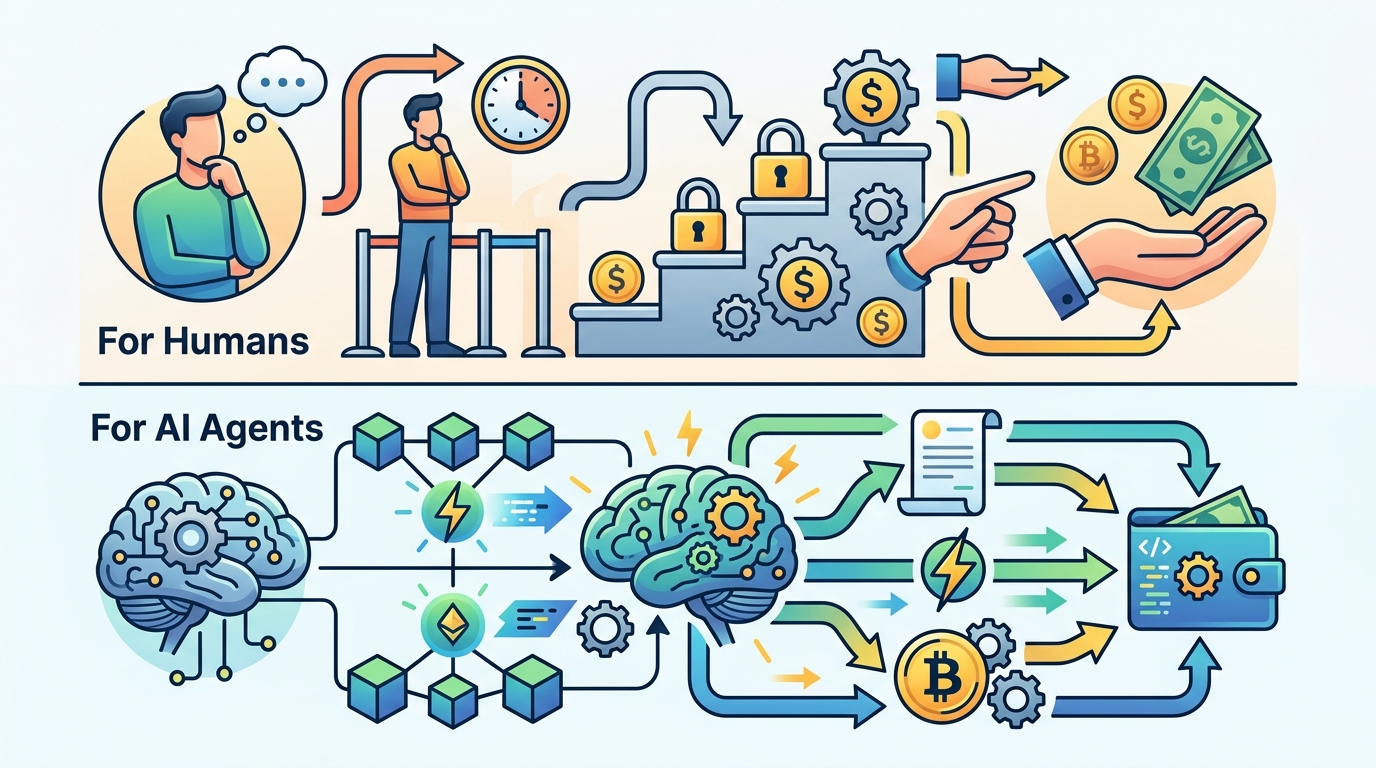
That critique lands where it should. Crypto is not a replacement for every human-facing financial workflow, and it does not need to be. The right model is layered: humans use interfaces, agents operate under policy, and crypto handles settlement underneath. The limit is real, but it does not defeat the thesis. It confirms it. The more autonomy software gets, the more valuable a programmable, always-on, borderless rail becomes. Human protections belong at the interface and governance layer, not in the base settlement layer where speed and machine readability matter most.
What to do with this
If you are an engineer, build for agent control, not just human checkout flows: wallet permissions, policy engines, audit logs, spend limits, and programmable settlement should be first-class primitives. If you are a PM, stop treating crypto as a consumer UX problem and start treating it as infrastructure for autonomous workflows. If you are a founder, design your product so the human owns the policy and the agent executes the transaction. That is the stack that will win: humans set intent, agents do the work, and crypto moves the money.
// Related Articles
- [IND]
Skatteetaten proves public sector AI should be judged by outcomes
- [IND]
OpenAI’s IPO filing puts AI’s biggest test on Wall Street
- [IND]
OpenAI’s latest moves now center on pricing, safety, and scale
- [IND]
RISC-V mini PCs are worth buying now, but only as a bet on the future
- [IND]
Fedora 44 RISC-V widens Linux board support
- [IND]
June 2026 agentic AI platform war centers on memory