Gemini Code Assist: Google details free, Standard, Enterprise
Google details Gemini Code Assist tiers for IDEs and Cloud, including free access, Standard security controls, and Enterprise codebase customization.

Google outlines Gemini Code Assist tiers for IDEs, Cloud, and enterprise code help.
Google’s Gemini Code Assist overview spells out how the product is split across three editions: a free version for individuals, Standard, and Enterprise. It covers IDE support, chat, agentic tasks, code completion, and enterprise controls for teams building in Google Cloud and local development tools.
| 項目 | 數值 |
|---|---|
| Editions | 3 |
| Free IDE support | VS Code, JetBrains IDEs, Android Studio |
| Enterprise code personalization | Private codebases |
| Cloud integrations | Apigee, Application Integration, Gemini Cloud Assist |
What changed
Get the latest AI news in your inbox
Weekly picks of model releases, tools, and deep dives — no spam, unsubscribe anytime.
No spam. Unsubscribe at any time.
The page frames Gemini Code Assist as a single product with different tiers, rather than a one-size-fits-all assistant. For individuals, Google highlights free code completion, chat, unit test generation, debugging help, and agentic workflows in supported IDEs.

For Standard and Enterprise, the differences are centered on security, compliance, and data use. Standard adds professional-grade controls and broader Google Cloud integrations, while Enterprise adds code personalization from private repositories and tighter fit for larger software teams.
- Free edition: code completion, generation, chat, agent mode, and CLI quota.
- Supported IDEs: VS Code, JetBrains IDEs such as IntelliJ and PyCharm, plus Android Studio.
- Enterprise-only: personalized suggestions from private codebases.
- Cloud coverage: Standard and Enterprise extend beyond the IDE into Google Cloud services.
Why it matters
For developers, the practical value is in how much context the assistant can see and where it can work. Google is pushing Gemini Code Assist beyond autocomplete into multi-step tasks, source citations, and project-aware help that spans local files and cloud tools.
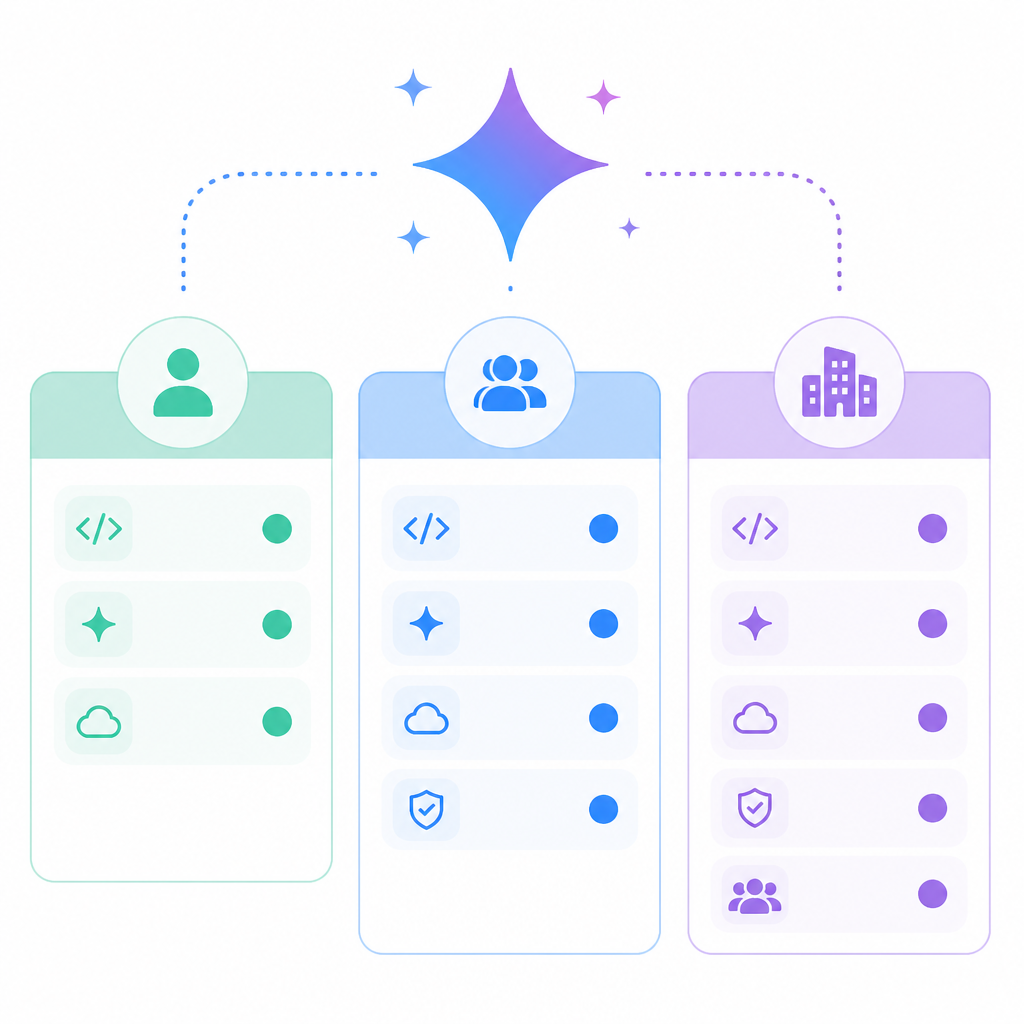
For teams, the split between Standard and Enterprise gives procurement and security leads a clearer choice: use the lighter tier for general coding help, or move up when private code, governance, and broader cloud workflows matter.
Google also warns that generated output can be wrong even when it looks plausible, so validation remains part of the workflow. That reminder matters because the product is being pitched not as a replacement for review, but as a faster layer on top of existing engineering practice.
The key question now is not whether Gemini Code Assist can write code, but which teams will trust it with their codebase context and cloud operations.
// Related Articles
- [TOOLS]
Magenta RealTime 2 lets you score in the DAW
- [TOOLS]
Open-source AI tools beat Claude’s paid tiers on value
- [TOOLS]
500 AI agent projects show where agents work now
- [TOOLS]
Chocolatey’s Go package turns installs into policy
- [TOOLS]
Go support policy turns releases into a checklist
- [TOOLS]
RustDesk self-hosting setup for secure remote access