Hail Means Ice, Praise, and a Taxi Call
Merriam-Webster’s entry for hail covers ice pellets, a greeting, and the act of summoning a taxi.

Merriam-Webster defines hail as ice pellets, praise, a greeting, and a taxi call.
At first glance, hail looks like a simple word. Merriam-Webster breaks it into five entries, with senses that stretch from weather to approval to old-fashioned greetings, and the dictionary’s own examples show why English keeps this word busy.
| Sense | Meaning | Example from Merriam-Webster | First known use |
|---|---|---|---|
| noun 1 | ice pellets from clouds | a hail of small stones | before the 12th century |
| verb 2 | greet with approval or summon | hailed the artist’s installation | 13th century |
| interjection | expression of greeting or acclaim | Hail to the Chief | 13th century |
| noun 2 | calling distance or hearing range | stay within hail | 1500 |
Five entries, one short word
Get the latest AI news in your inbox
Weekly picks of model releases, tools, and deep dives — no spam, unsubscribe anytime.
No spam. Unsubscribe at any time.
Merriam-Webster treats hail as five separate dictionary entries, which is a good reminder that English words often carry more history than their size suggests. The best-known sense is the weather noun: “precipitation in the form of small balls or lumps usually consisting of concentric layers of clear ice and compact snow.”

The entry also includes a second noun sense for “something that gives the effect of a shower of hail,” which explains phrases like “a hail of rifle fire.” That figurative use is common because the image is immediate: fast, dense, and hard to miss.
- Hail as weather is the oldest sense in the entry.
- The word’s root traces to Old English hægl.
- Merriam-Webster lists the first known use of the noun before the 12th century.
- The same spelling later picked up greeting and summoning meanings from Old Norse heill.
From ice pellets to public praise
The verb senses are where hail becomes more social than meteorological. One meaning is “to greet with enthusiastic approval,” as in a museum director praising an installation. Another is “to greet or summon by calling,” which is why people still say “hail a taxi.”
Merriam-Webster’s examples make the split feel natural. In one sentence, hail is admiration. In another, it is a practical shout across a street. The word keeps both uses because English likes verbs that can move from ceremony to street-level convenience without changing spelling.
“Hail to the Chief” is a famous example of the interjection, and Merriam-Webster cites Sir Walter Scott for that usage.
The interjection sense is older and more formal. Merriam-Webster defines it as “used to express acclamation,” with an archaic greeting sense attached. That means the word can function as a cheer, a salute, or a ceremonial call depending on who is speaking and when.
The dictionary’s etymology note is especially useful here. The weather sense comes from Old English, while the greeting sense comes from Old Norse heill, meaning healthy, related to whole. That split origin explains why one spelling now covers two very different ideas.
- Hail can mean approval, greeting, or a call for a taxi.
- The interjection sense dates to the 13th century.
- The noun for hearing distance, as in “stay within hail,” appeared around 1500.
- Merriam-Webster links the greeting sense to the idea of being healthy.
Why this word keeps showing up in news copy
Recent examples on Merriam-Webster’s page show how often hail appears in modern writing. Weather coverage uses it literally, with storms and hail often paired with lightning and gusty winds. News stories also use the verb in political, environmental, and tech criticism, where people hail a policy, a recovery, or a product launch.
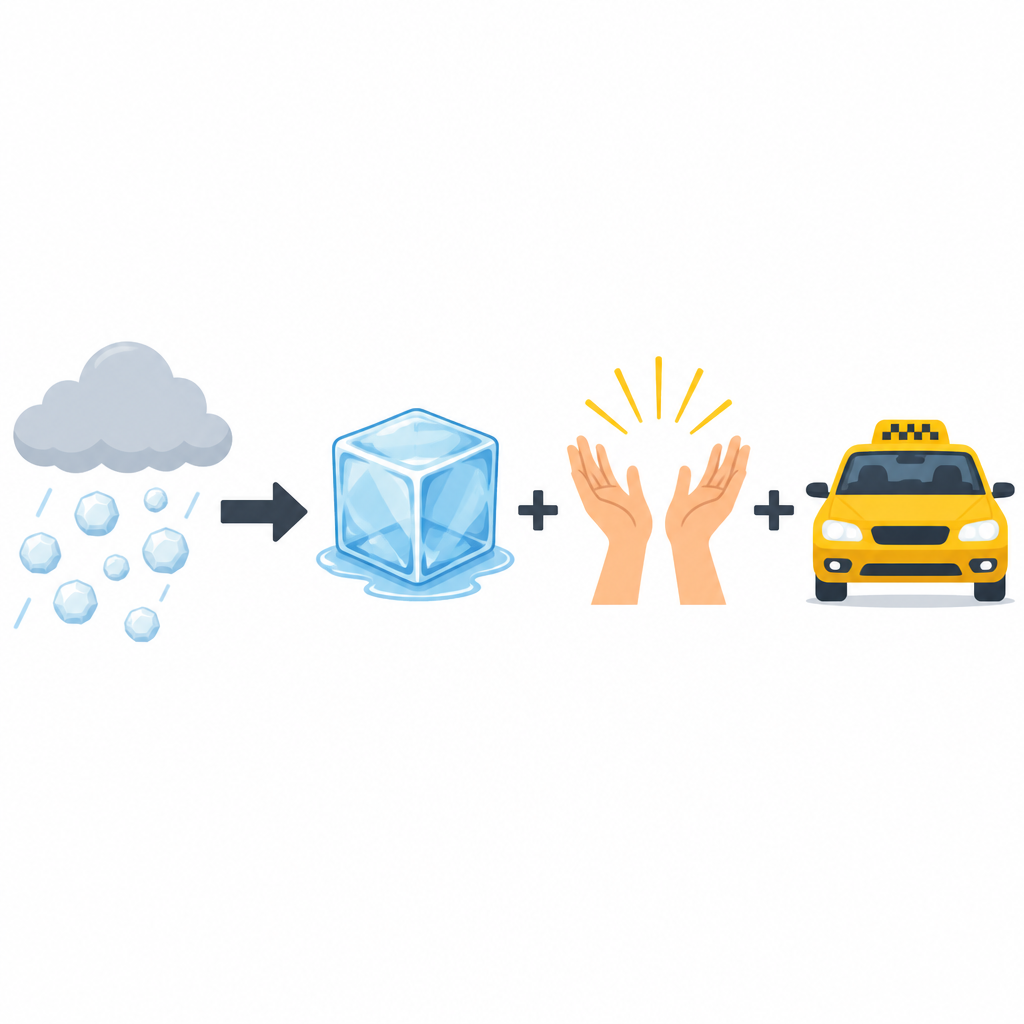
That range matters for readers and editors because context does almost all the work. A sentence about “hail” in a storm report means something physical falling from the sky. A sentence about a scientist or artist being hailed means praise. A sentence about hailing a cab means the old street-corner verb is still alive.
For writers, the safest rule is simple: read the surrounding nouns and verbs before deciding which hail you have. If the sentence includes clouds, ice, or damage, it is the weather word. If it includes applause, acclaim, or a taxi, it is the social verb. If it appears in a phrase like “within hail,” it is the distance noun.
That kind of split is exactly why dictionary entries matter. They keep one spelling from turning into a guessing game, and they show how a word can carry weather, ceremony, and city life at the same time.
What to remember next time you see it
Hail is one of those English words that rewards a second glance. It can describe frozen pellets, a burst of praise, a shouted greeting, or the distance at which someone can still hear you.
If you are reading or writing carefully, the best habit is to check the surrounding phrase before assuming the meaning. That matters in journalism, product copy, and everyday conversation, because the wrong hail can turn a weather report into a compliment. The next time you see it, ask a simple question: is this sky, street, or salute?
// Related Articles
- [IND]
OpenAI updates its Europe privacy policy
- [IND]
OpenAI is right to keep ads out of sensitive chats
- [IND]
AI bootlegs are already draining streaming royalties
- [IND]
AMD and Microsoft push Windows ML on GPU and NPU
- [IND]
OpenAI’s IPO filing turns hype into scrutiny
- [IND]
Skatteetaten proves public sector AI should be judged by outcomes