Kimi K2.5 Brings Vision, Code, and Swarm Agents
Moonshot AI's Kimi K2.5 adds native vision, 256K context, and Agent Swarm. Here's what changes for developers and teams.
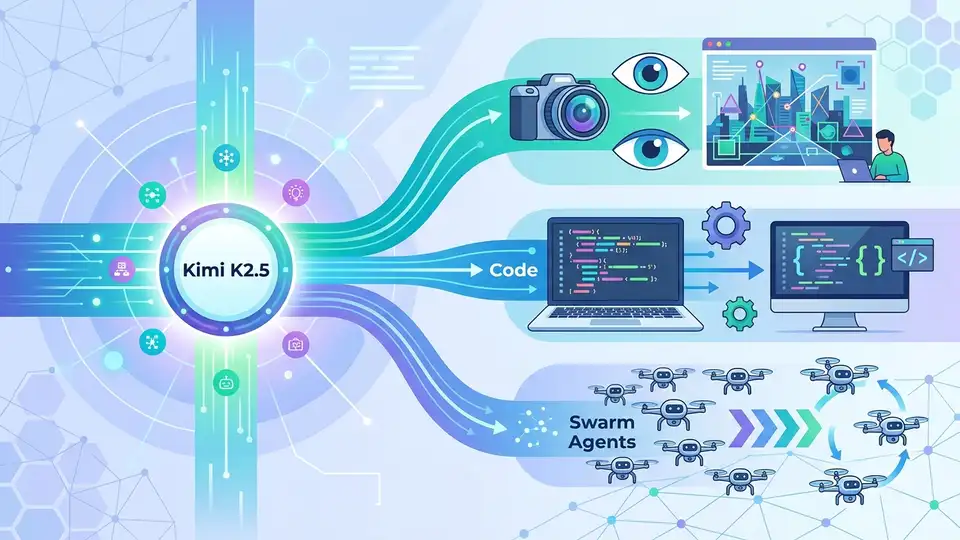
Kimi K2.5 launched on January 27, 2026, and the headline numbers are hard to ignore: 256K context, 1T total parameters, and 32B active parameters. Moonshot AI is pushing it as a single model for coding, visual reasoning, and agent-style execution.
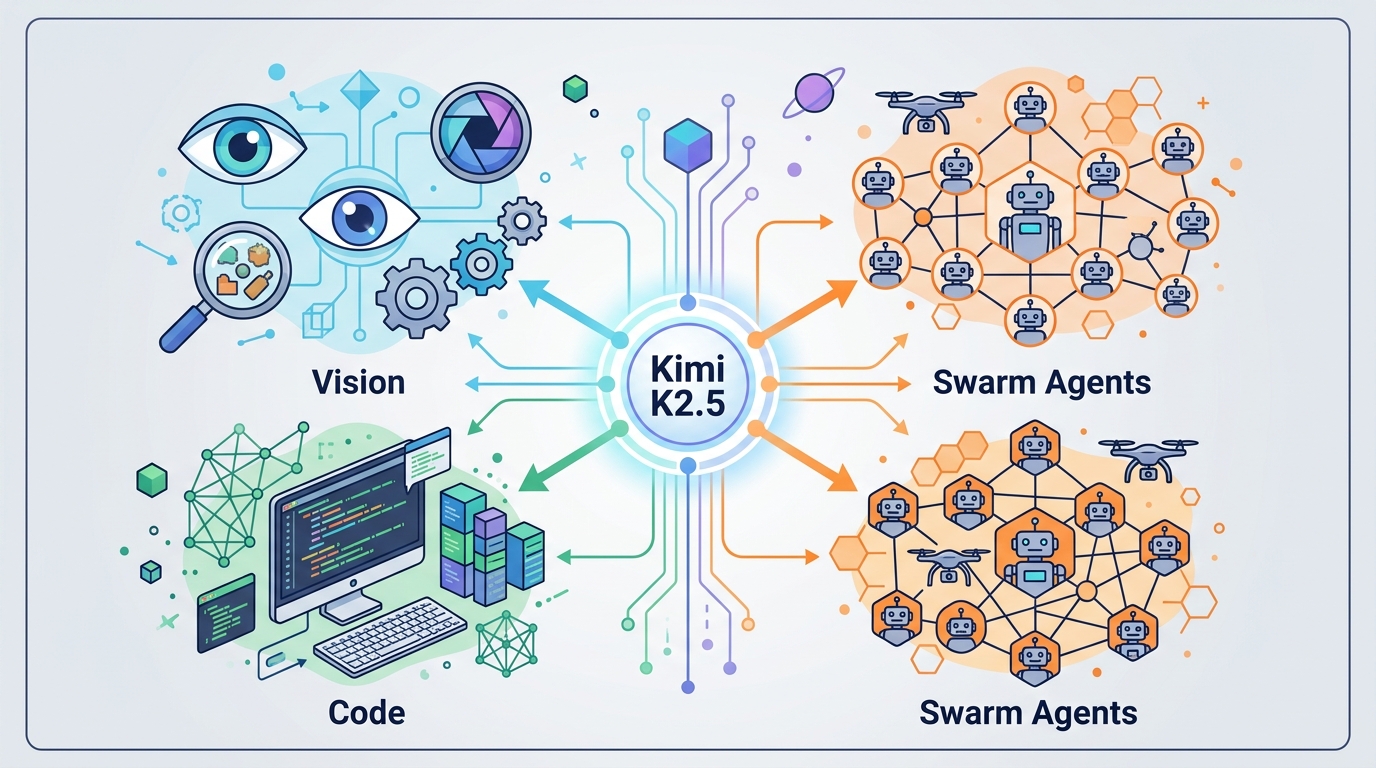
That matters because the model is not just an upgraded chat system. It can read screenshots, work across long documents, call tools, and split work into many sub-agents through its Agent Swarm mode. For teams building products or automating research, that combination changes how you think about one model doing many jobs.
What Kimi K2.5 actually is
Get the latest AI news in your inbox
Weekly picks of model releases, tools, and deep dives — no spam, unsubscribe anytime.
No spam. Unsubscribe at any time.
Moonshot AI built Kimi K2.5 as the next step after Kimi K2. The core idea is simple: keep the large sparse MoE backbone, then add native multimodality, longer context, stronger agent behavior, and a product layer that can handle real work instead of only text prompts.
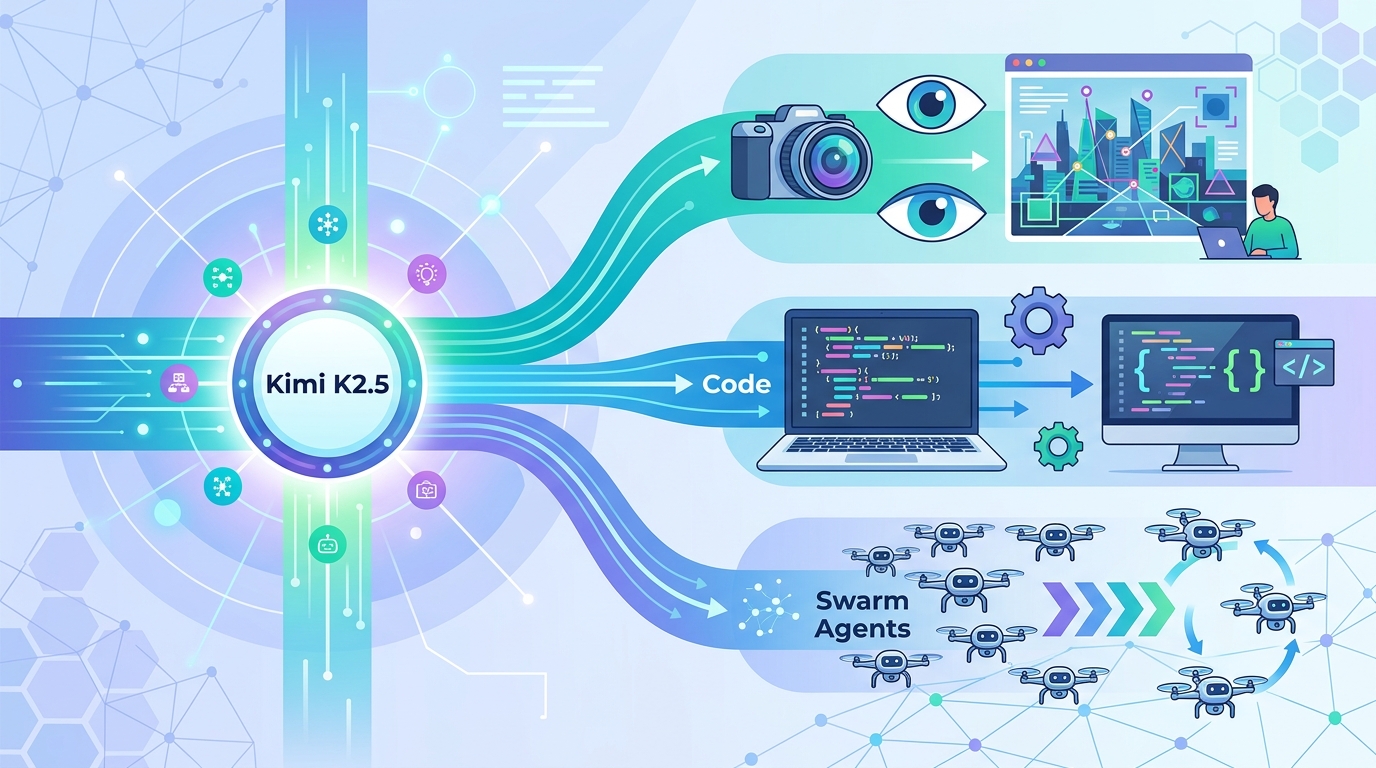
The company positions K2.5 as an open model with hosted access across web, app, API, and coding tools. On the consumer side, the modes are Instant, Thinking, Agent, and Agent Swarm. On the developer side, the model is exposed through an API that Moonshot documents as OpenAI-compatible, with Anthropic-style access patterns also mentioned in the repository docs.
What makes this version interesting is that Moonshot is treating vision as part of the base model, not a bolt-on feature. That is why K2.5 can take screenshots, images, and video references in ways that matter for front-end work, office tasks, and research workflows.
- Release date: January 27, 2026
- Architecture: Mixture-of-Experts with 1T total and 32B active parameters
- Context window: 256K tokens
- Vision encoder: MoonViT with 400M parameters
- Agent Swarm: up to 100 sub-agents and 1,500 parallel tool calls
Why the architecture matters
Kimi K2.5 uses a sparse MoE design, which means it has a very large total parameter count without activating all of it for every token. That matters for capacity and efficiency. The model can carry a lot of knowledge and behavior, while still keeping inference more practical than a dense trillion-parameter system.
The other number that matters is 256K context. That is a serious jump for people who work with long contracts, large codebases, research archives, or multi-file prompts. It also makes K2.5 more useful in agent loops, where the model has to remember prior steps, tool outputs, and intermediate reasoning without dropping state.
Then there is the vision stack. Moonshot’s own materials describe a MoonViT 400M encoder, which tells you the multimodal side is built into the system design. In practice, that means K2.5 is meant to understand charts, UI mockups, diagrams, and mixed office documents, not just extract text from images.
- 1T / 32B is a sparse model profile, not a dense one
- 256K context is useful for long prompts and multi-step tool use
- MoonViT 400M signals native visual understanding
- 61 layers, 384 experts, and 8 experts selected per token
Benchmarks tell a more practical story
The benchmark story is less about “wins everything” and more about “works well when the task mixes reasoning, tools, code, and vision.” On public numbers, K2.5 does especially well in agentic and multimodal settings, while still trailing some closed models on certain pure reasoning and coding tests.
Moonshot’s own comparison table shows Kimi K2.5 at 50.2 on HLE with tools, 96.1 on AIME 2025, 95.4 on HMMT 2025, 87.6 on GPQA-Diamond, 78.5 on MMMU-Pro, 84.2 on MathVision, 90.1 on MathVista, 76.8 on SWE-Bench Verified, and 73.0 on SWE-Bench Multilingual. Those are strong numbers for an open model with multimodal and agentic features.
“We believe that AI should be open, accessible, and beneficial to everyone.” — Yao Shunyu, Moonshot AI co-founder and CEO
That quote matters because it explains the product strategy. Moonshot is not trying to ship one model for one benchmark. It is trying to ship a model people can actually use across coding, research, and office work, then make that model available in hosted and open forms.
If you compare K2.5 to the last generation of open models, the gap is clear in one area: multimodal agent work. A text-only model can answer questions about code or math. K2.5 can also inspect a screenshot, reason over a chart, and produce an output that looks closer to a working artifact.
- HLE with tools: 50.2, a strong sign for agent workflows
- AIME 2025: 96.1, showing very strong math reasoning
- MMMU-Pro: 78.5, which matters for image-heavy tasks
- SWE-Bench Verified: 76.8, useful for real software tasks
- Moonshot still trails GPT-5.2 and Gemini 3 Pro on some public comparisons
Where Kimi K2.5 fits in real work
The best use cases are the ones where one model has to do several jobs in sequence. K2.5 is well suited to visual coding, research synthesis, document generation, and tool-heavy automation. It is also a good fit for product teams that want one model to inspect a UI, write code, and explain the changes in plain language.
For developers, the most interesting feature may be the API surface. Moonshot documents visual and text input, JSON mode, partial mode, tool calling, thinking and non-thinking modes, and official web search support. That gives builders enough control to create workflows that look more like agents than chats.
There is one catch worth knowing: Moonshot says the built-in $web_search tool is temporarily incompatible with K2.5 thinking mode. That means search-heavy workflows may need non-thinking mode in the API, which is the kind of production detail that can save a lot of debugging time.
- Visual coding: turn screenshots and mockups into front-end code
- Research workflows: split broad tasks into many sub-agents
- Office outputs: generate documents, slides, sheets, and websites
- Developer APIs: tool use, JSON mode, and long-context prompting
How to think about Kimi K2.5 now
Kimi K2.5 is best understood as an open multimodal work model, not a plain chatbot. If your job includes UI recreation, chart reading, long documents, or agent orchestration, it deserves a real look. If you only need short text answers, the model may be more than you need.
My read is that K2.5 will matter most for teams that want open weights plus hosted access in one package. The open model gives developers control, while the hosted product gives non-technical users a way to create useful outputs without building an inference stack from scratch.
The next question is whether Moonshot can keep the product layer aligned with the model layer as usage scales. If K2.5 continues to hold up in real agent workflows, it could become one of the more practical open choices for people who care about vision, code, and long-context reasoning in the same system.
For now, the takeaway is simple: if your workflow includes screenshots, long prompts, and tool calls, Kimi K2.5 belongs on your shortlist. If it is mostly plain text chat, you can probably wait and see how the hosted API matures.
Related reading: OraCore.dev news for more model releases, tools, and AI agent updates.
// Related Articles
- [MODEL]
Gemini 1.5 Pro-002, Flash-002 and 2.0 Flash update Google AI
- [MODEL]
MiniMax M3 Proves Open-Weight Can Still Win on Coding
- [MODEL]
Gemini 3.5 Flash Pricing, Context, Benchmarks
- [MODEL]
Gemma 4 12B: Specs, Benchmarks & How to Run It Locally
- [MODEL]
Best Kimi Models in 2026: K2.5 vs K2 Thinking
- [MODEL]
Kimi K2.6 adds open-source coding and agent swarm