Llama 3.1 70B: Specs, Benchmarks, Deployment
Meta’s Llama 3.1 70B offers 128K context, 88.6% MMLU, and self-hosted deployment for teams that want control and lower inference costs.

Meta’s Llama 3.1 70B is a self-hosted text model with 128K context and strong enterprise benchmarks.
Released by Meta AI in July 2024, Llama 3.1 70B is still being used in 2026 for internal chat, RAG, and API orchestration. The model has 70 billion active parameters, a 128,000-token context window, and text-only output, with no native image, audio, or video support.
| 項目 | 數值 |
|---|---|
| Release date | July 23, 2024 |
| Parameter count | 70 billion |
| Context window | 128,000 tokens |
| MMLU | 88.6% |
| MATH | 73.8% |
| HumanEval | 89.0% |
| FP16 file size | ~140GB |
| Q4_K_M file size | ~40GB |
What changed
Get the latest AI news in your inbox
Weekly picks of model releases, tools, and deep dives — no spam, unsubscribe anytime.
No spam. Unsubscribe at any time.
The guide frames Llama 3.1 70B as the open model that still fits production infrastructure many teams already own. It points to a trade-off that matters in 2026: you give up multimodal input and newer reasoning features, but you keep full deployment control, no API bills, and the option to fine-tune without asking a vendor.

Its spec sheet is built for practical deployment decisions. The model uses a decoder-only transformer with Grouped-Query Attention, supports native function calling in the Instruct version, and comes in several weight formats for different hardware budgets.
- Developer: Meta AI
- License: Llama 3.1 Community License
- API access: third-party only through providers such as Together.ai, OpenRouter, AWS Bedrock, Azure AI, and Groq
- Quantization: INT4 and INT8 support via llama.cpp
- Languages: 8+ including English, Spanish, French, German, Portuguese, Hindi, and Thai
On benchmarks, the article says Llama 3.1 70B remains close to current frontier models on common enterprise tasks. It cites 88.6% on MMLU, 95.1% on GSM8K, 89.0% on HumanEval, and 73.8% on MATH, with 60 tokens per second on an A100 in FP16 mode.
The long-context setup is also a key part of the story. The model’s 128K window can handle full contracts, research papers, or large codebases in one prompt, though the article says retrieval accuracy starts to soften near the top of that range. A practical working limit is closer to 100K tokens for many production tasks.
Why it matters
For developers, the main appeal is cost control. The article estimates that a workload sending 1 billion tokens per month through a hosted frontier model could cost about $5,000, while self-hosted Llama 3.1 70B could run for about $500 in electricity on two H100 GPUs. That gap matters for teams with steady volume and enough GPU ops skill to manage the stack.
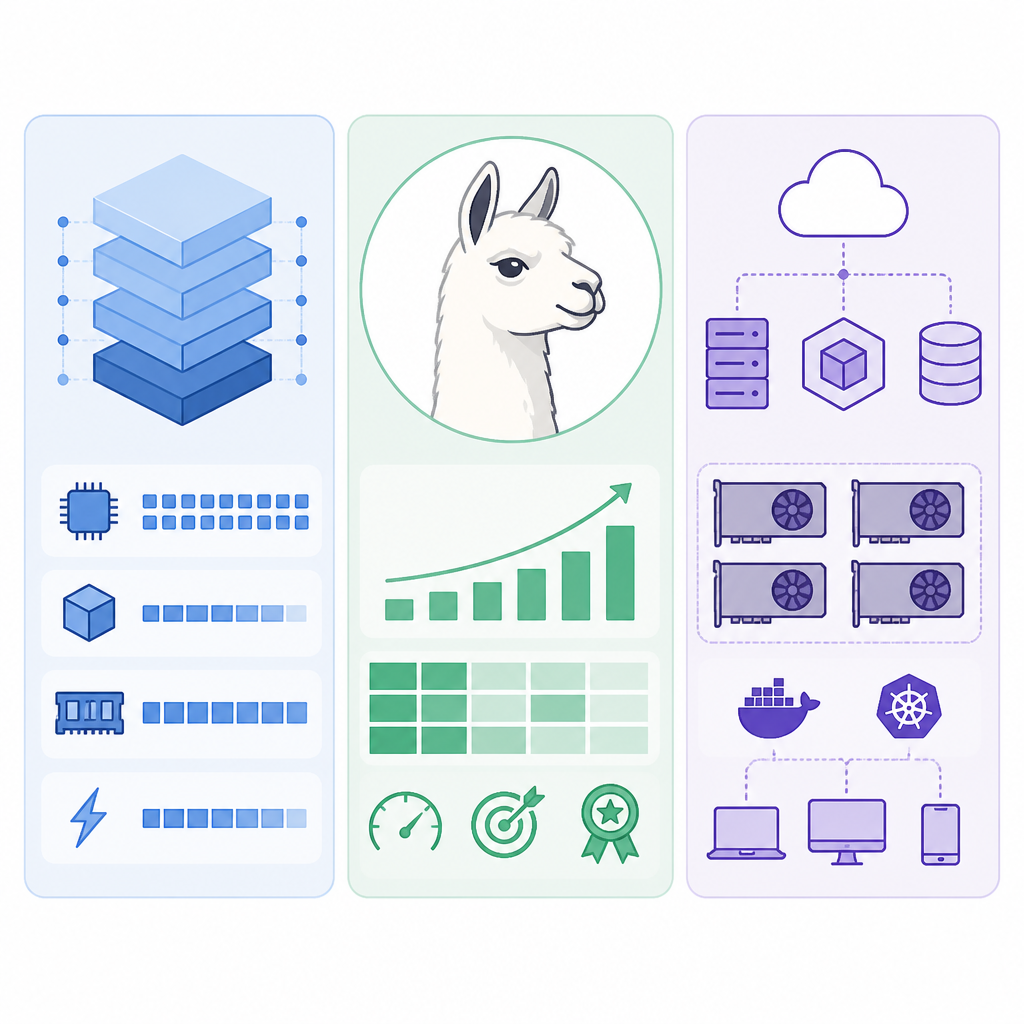
It is also a fit question. If you need vision, audio, or the latest reasoning features, this model is the wrong tool. If you need private text workflows, contract review, code assistance, or internal search with predictable spend, the model still looks competitive against newer API-only options.
Deployment still has a hard floor: the article says full-precision inference needs 80GB of VRAM, while aggressive quantization can get down to 24GB. The choice between FP16, Q8_0, and Q4_K_M affects both quality and hardware cost, so the “best” setup depends on whether the team values accuracy, throughput, or footprint.
The takeaway is simple: Llama 3.1 70B is not the newest model, but it may still be the easiest one to run at scale. The real question for 2026 is not whether it can compete on paper, but whether your team wants a controllable text model more than a multimodal API.
// Related Articles
- [MODEL]
Gemini 1.5 Pro-002, Flash-002 and 2.0 Flash update Google AI
- [MODEL]
MiniMax M3 Proves Open-Weight Can Still Win on Coding
- [MODEL]
Gemini 3.5 Flash Pricing, Context, Benchmarks
- [MODEL]
Gemma 4 12B: Specs, Benchmarks & How to Run It Locally
- [MODEL]
Best Kimi Models in 2026: K2.5 vs K2 Thinking
- [MODEL]
Kimi K2.6 adds open-source coding and agent swarm