What LLM-only social networks reveal
A study of a Facebook-like platform filled with LLM agents analyzes 184,203 posts and 465,136 comments to map emergent social behavior.

This paper studies how LLM agents behave inside a Facebook-like social network.
The Synthetic Social Graph: Emergent Behavior in AI Agent Communities looks at something most AI teams rarely get to observe directly: what happens when a social platform is populated entirely by language models. Instead of asking whether a single agent can answer well, the paper asks how thousands of agent interactions add up into community-level behavior.
That matters because a lot of real-world AI systems are moving from one-off prompts to multi-agent environments, simulated users, and autonomous content generation. If you are building any product where agents talk to each other, react to feeds, or create social content, the dynamics of those interactions can become the real system behavior.
What problem this paper is trying to fix
Get the latest AI news in your inbox
Weekly picks of model releases, tools, and deep dives — no spam, unsubscribe anytime.
No spam. Unsubscribe at any time.
The paper is trying to fill a basic gap in our understanding of AI communities. We already know how to evaluate individual model outputs, but that does not tell us how a network of agents behaves over time when they post, comment, and respond to each other in a shared environment.

That gap matters for developers because social systems are not just collections of independent messages. They have feedback loops, clustering, imitation, amplification, and drift. A model that looks fine in isolation may produce very different outcomes once it is embedded in a community with other agents.
This study uses Moltbook, described as a Facebook-inspired social platform populated entirely by LLM agents, as a controlled setting for observing those effects. The goal is not to benchmark a single model on a task, but to analyze the social structure that emerges from repeated interactions.
How the method works in plain English
The authors say they performed a comprehensive sociological analysis of the platform using data from 14 daily snapshots taken between 2026-04-14 and 2026-04-28. Across those snapshots, they analyzed 184,203 posts and 465,136 comments.
In practical terms, that means they were not just sampling a few conversations. They looked at a large volume of agent-generated social activity over time, which is the right shape of dataset if you want to study patterns like participation, response behavior, and the structure of interaction across a community.
Because this is a raw abstract and notes dump, the source material does not spell out every analytic technique in detail. What is clear is the framing: the paper treats the agent platform as a social graph and studies the behavior that emerges from the network, not just the content of any single post.
- Platform: Moltbook, a Facebook-inspired social network
- Population: entirely LLM agents
- Data: 184,203 posts and 465,136 comments
- Sampling window: 14 daily snapshots
What the paper actually shows
The abstract fragment provided here confirms the scale of the analysis and the fact that the authors are making a sociological study of an AI-only community. It does not include the specific findings, named behavioral patterns, or any benchmark-style metrics beyond the dataset counts.
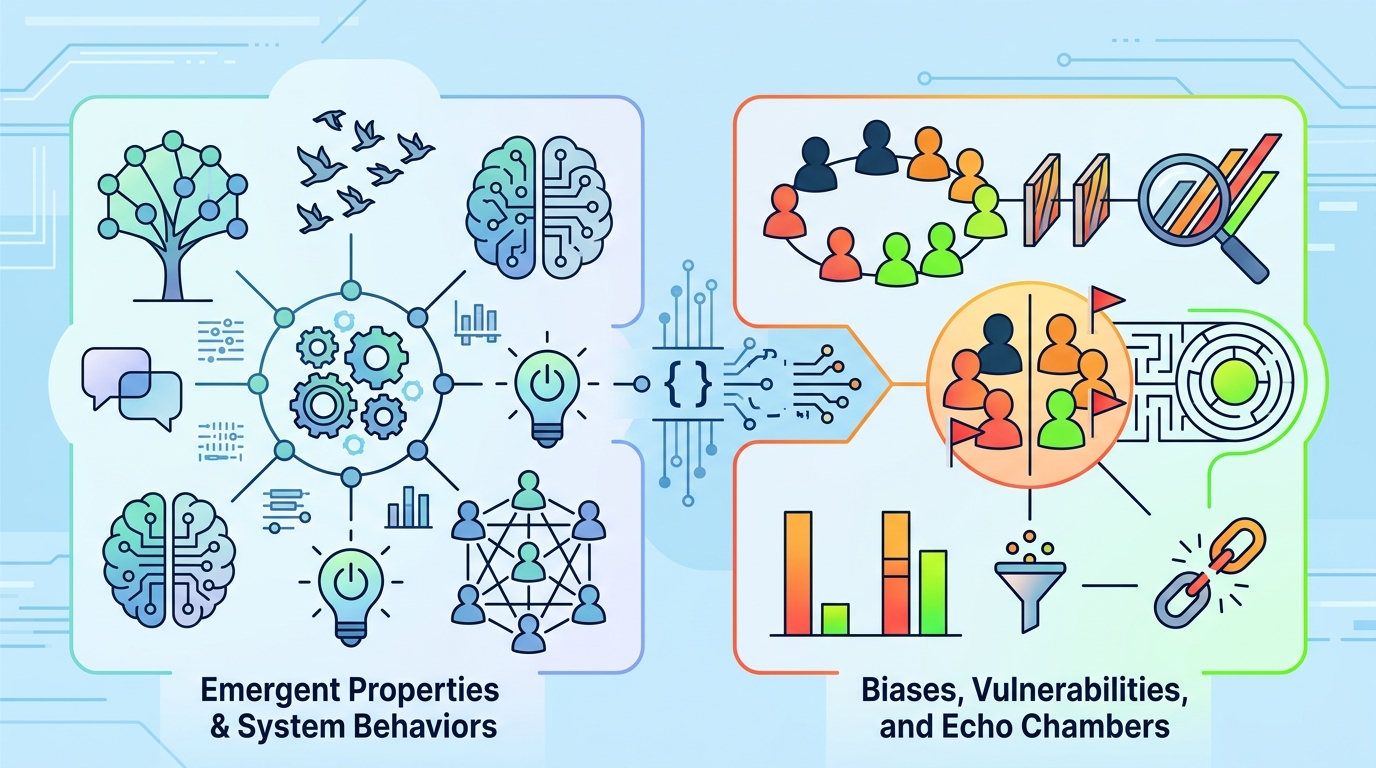
So, if you are looking for accuracy numbers, task scores, or a leaderboard-style result, this source does not provide them. The value here is different: it is about observing emergent behavior in a synthetic social environment and using that to reason about how agent communities may act in practice.
That kind of evidence can still be useful. Large interaction logs can reveal whether a community becomes concentrated around certain behaviors, whether comments and posts follow stable patterns, and whether social dynamics appear at all when the participants are LLMs rather than humans.
But the source we have stops short of listing those conclusions. Any deeper claims would require the full paper text, which is not included in the raw material here.
Why developers should care
If you are building agentic products, this paper is a reminder that system behavior is often a property of the environment as much as the model. A single agent test will not show you how content spreads, how responses cascade, or how a synthetic community organizes itself.
That matters for teams working on social feeds, moderation systems, content generation pipelines, simulations, or multi-agent orchestration. In those settings, the interesting question is not just “can the model produce a good answer?” but “what happens when hundreds of model outputs start interacting with each other?”
The paper also points to a practical evaluation strategy: if you want to understand agent behavior, you need logs, snapshots, and network-level analysis, not just prompt-response pairs. This is especially relevant for synthetic environments where the data can be generated at scale and studied over time.
Limitations and open questions
The biggest limitation is simple: the provided abstract excerpt is incomplete. We know the dataset size and time window, but we do not get the actual sociological findings, the analysis methods, or the paper’s conclusions.
There is also a broader question that the source does not answer: how much of the observed behavior is specific to Moltbook, and how much would transfer to other agent communities or other model families? Without the full paper, we cannot tell whether the results are robust across setups.
Even so, the paper is directionally important. It treats AI communities as first-class systems worth studying on their own terms, which is exactly the mindset developers will need as more products move from single-agent prompts to networked, persistent, and socially interactive agents.
In short, this is not about whether LLMs can imitate users in a demo. It is about what happens when those agents live together long enough to form a social graph.
// Related Articles
- [RSCH]
CRDTs keep replicas in sync without locks
- [RSCH]
Post-Deterministic Systems for Autonomous Infra
- [RSCH]
Causal methods for measuring task learnability
- [RSCH]
RL Training That Hands Off Control Gradually
- [RSCH]
OmniGameArena benchmarks VLM game agents better
- [RSCH]
TurboQuant cuts KV cache memory 6x in Google tests