LLM Stats makes 300+ AI benchmarks easy to compare
300+ AI and LLM benchmarks sit in one directory, with live leaderboards and verified scores for reasoning, coding, vision, and more.

LLM Stats collects 300+ AI and LLM benchmarks in one directory with live leaderboards.
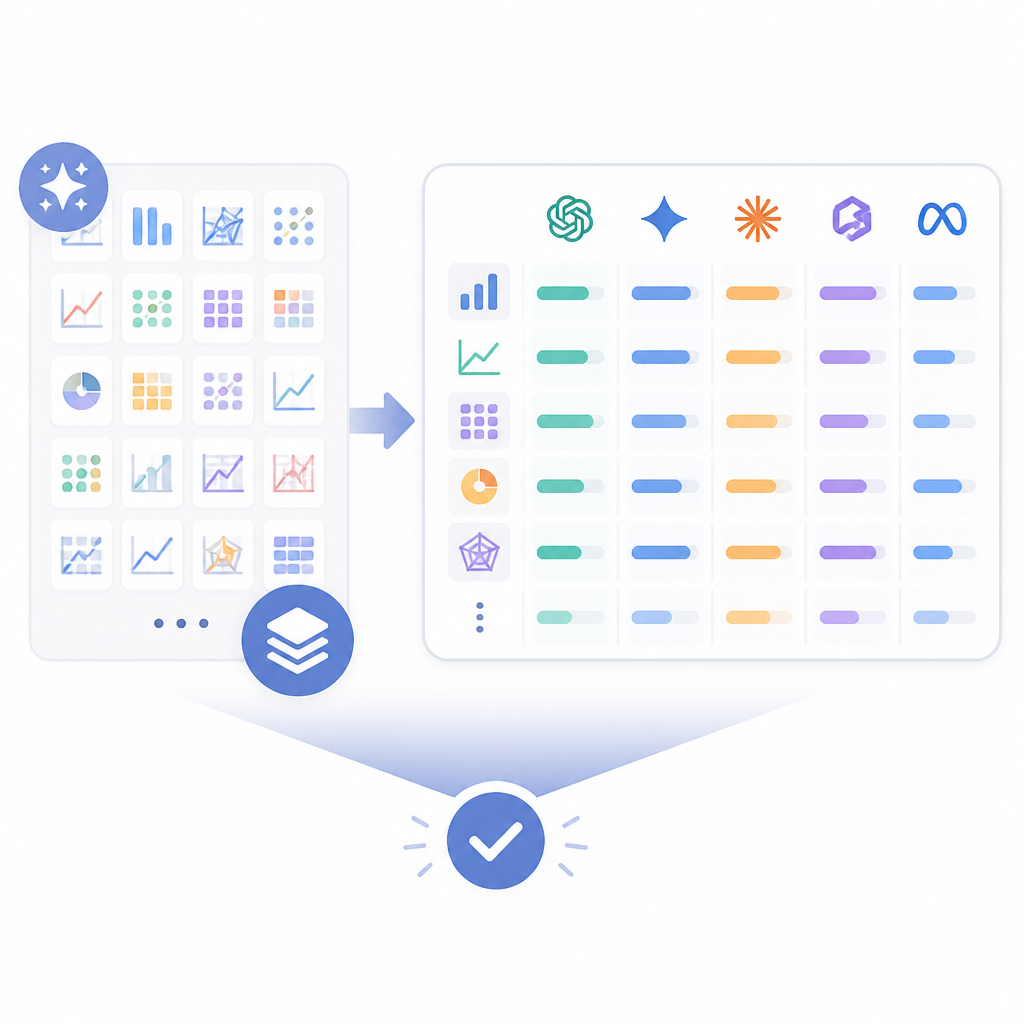
LLM Stats turns a sprawling set of tests into a browsable comparison hub, so you can check how models score across reasoning, coding, vision, tool use, and multilingual tasks. The index covers 512+ benchmarks and links each one to a live leaderboard.
| Item | Focus | Notable detail |
|---|---|---|
| IFEval | Instruction following | 25 instruction types |
| LiveCodeBench | Code generation | Contamination-limited, continuously updated |
| MMMU | Multimodal understanding | College-level subject knowledge |
| BFCL | Function calling | Executable tool-call evaluation |
| OSWorld | Agent tasks | Real computer environment |
1. IFEval
Get the latest AI news in your inbox
Weekly picks of model releases, tools, and deep dives — no spam, unsubscribe anytime.
No spam. Unsubscribe at any time.
IFEval is the cleanest place to start if you care about instruction following. It measures whether a model can obey specific, verifiable prompts rather than just produce fluent text.

The benchmark is useful for product teams that need predictable behavior in assistants, support bots, or workflow agents. It is also easy to explain to non-technical stakeholders because the task is simple: follow the instructions exactly.
- Focus: verifiable instruction following
- Good for: prompt adherence checks
- Why it matters: models can sound right and still miss constraints
2. LiveCodeBench
LiveCodeBench is the best fit when you want a coding score that changes with the real world. It continuously adds new problems, which helps reduce contamination from training data.
That makes it more useful than static coding sets when you are comparing current models for developer tools, code assistants, or agentic coding systems. The live leaderboard format also makes it easy to see how models move over time.
- Focus: coding and code generation
- Method: continuously refreshed problems
- Strength: lower risk of memorized answers
3. MMMU
MMMU checks multimodal understanding across college-level subjects, so it is a strong signal for models that need to read charts, images, and mixed-format content. It is broader than simple visual question answering.
If your use case includes documents, diagrams, or educational content, MMMU gives a more demanding view of model quality. It is especially relevant for teams evaluating vision-language models rather than text-only systems.
- Focus: multimodal reasoning
- Content: college-level subject knowledge
- Best for: vision-language model comparisons
4. BFCL
BFCL, the Berkeley Function Calling Leaderboard, measures whether a model can call tools correctly. That matters when an assistant has to produce structured outputs, hit APIs, or choose the right function in a multi-tool setup.
Unlike general chat benchmarks, BFCL looks at executable behavior. If your product depends on agent workflows, this benchmark is one of the most practical signals in the index.
Example checks:
- choose the correct function
- fill arguments in the right schema
- handle multi-step tool use
5. OSWorld
OSWorld moves beyond static prompts and into a real computer environment. It evaluates whether an agent can operate software, complete tasks, and handle execution-based workflows.
That makes it useful for automation teams and agent builders who care about end-to-end task completion, not just text output. It is also a good stress test for models that need planning, UI understanding, and action selection together.
- Focus: computer-use agents
- Environment: real desktop-style tasks
- Best for: workflow automation and agent QA
How to decide
If you want the fastest read on general assistant quality, start with IFEval and LiveCodeBench. If your product uses images or documents, MMMU is the better first stop. For tool use and agent behavior, BFCL and OSWorld give more realistic signals than text-only scores.
The larger value of LLM Stats is not one benchmark, but the ability to compare many of them in one place with live leaderboards and verified scores. That makes it easier to pick the test that matches your actual product risk.
// Related Articles
- [IND]
OpenAI’s IPO filing turns hype into scrutiny
- [IND]
Skatteetaten proves public sector AI should be judged by outcomes
- [IND]
OpenAI’s IPO filing puts AI’s biggest test on Wall Street
- [IND]
OpenAI’s latest moves now center on pricing, safety, and scale
- [IND]
RISC-V mini PCs are worth buying now, but only as a bet on the future
- [IND]
Fedora 44 RISC-V widens Linux board support