Microsoft and EY turn AI pilots into production
I break down Microsoft and EY’s $1B AI deal and the playbook for moving AI from pilots into governed enterprise production.

Microsoft and EY’s $1B deal shows how to move AI from pilots into governed production.
I've been watching enterprise AI get stuck in the same annoying place for two years: the demo looks sharp, the pilot gets applause, and then nothing real happens. The chatbot drafts a nice email, the workshop gets a glossy slide deck, and everybody nods like the hard part is done. It isn’t. The hard part is permissions, data quality, legal review, identity, audit trails, change management, and the awkward question of who owns the mess when the model is wrong.
That’s why the Microsoft and EY announcement grabbed me. Not because it’s another giant partnership press cycle. I’ve seen plenty of those. It grabbed me because it reads like a confession. Microsoft knows Copilot alone doesn’t magically rebuild a tax close or a claims process. EY knows “AI transformation” dies fast when it stays in sandbox mode. So instead of pretending the pilot problem doesn’t exist, they’re packaging the boring, expensive, necessary stuff: engineers, governance, process redesign, and executive buy-in.
The source that triggered this breakdown is a Windows Forum post by Windows Forum, which summarizes the deal and frames it as Microsoft’s next enterprise AI sales motion. I’m using that post as the starting point, then pulling apart what the partnership really means for teams trying to ship AI without creating a compliance headache.
Microsoft stopped selling AI features and started selling deployment
Get the latest AI news in your inbox
Weekly picks of model releases, tools, and deep dives — no spam, unsubscribe anytime.
No spam. Unsubscribe at any time.
“Microsoft is no longer merely shipping AI features and waiting for enterprises to discover value on their own.”
What this actually means is simple: Microsoft has figured out that enterprise AI is not a product problem, it’s a deployment problem. The feature list is no longer the bottleneck. The bottleneck is getting the feature to live inside a real company without tripping over identity, security, data governance, and process ownership.

I’ve run into this exact failure mode in internal rollouts. A team gets excited about an assistant, tries it on a few documents, and then hits the wall: the model can’t touch the right systems, the data is scattered across SharePoint and email, and nobody wants to be the person who signed off on a risky workflow. The AI is fine. The organization is not.
That’s why the Microsoft and EY pairing matters. Microsoft brings the platform and the technical muscle. EY brings the process language and the credibility to sit in front of executives who don’t care about token counts. Together, they’re selling the thing most companies actually need: a path from “cool demo” to “approved system of work.”
Microsoft’s own ecosystem makes this easier to understand. If you live in Windows, Microsoft 365, Copilot, Microsoft 365 E7, Microsoft Entra, and Microsoft Purview, then AI is not a separate app. It’s a layer across the whole control plane. That’s the pitch.
How to apply it: stop evaluating AI tools as standalone widgets. Evaluate them as part of an operating model. Ask who owns the workflow, who approves the data access, who reviews the output, and what happens when the system is wrong. If those questions don’t have answers, you don’t have a deployment plan. You have a demo.
The Forward Deployed Engineer is now the real enterprise seller
“Rather than hand customers a platform and wait for internal teams to figure it out, embed engineers close to the business problem.”
The phrase Forward Deployed Engineer comes from Palantir, and it has spread because it solves a real problem: companies do not want another generic platform they have to interpret themselves. They want someone who can sit close to the business, wire things together, and make the thing actually work.
What this actually means is that the sales motion has changed. The engineer is no longer just pre-sales support. In enterprise AI, the engineer is part architect, part translator, part therapist. They have to understand APIs, permissions, model behavior, and the politics of the customer org. That’s a lot, and honestly, it’s why so many pilots die. Nobody owns the last mile.
I’ve seen teams blame the model when the real issue was integration. The assistant couldn’t access the right document store. The workflow crossed three departments. The legal team wanted logs. Security wanted least privilege. Operations wanted proof it wouldn’t create more work. A normal SaaS rollout can skate past some of that. AI can’t. Once an agent can act, the stakes jump.
Microsoft adopting this model is not subtle. It’s an admission that enterprise AI needs a human bridge. EY can provide that bridge because it already lives in the gap between executive ambition and operational reality. Microsoft can provide the technical bridge because it owns the stack. That combination is why this deal is more than a marketing splash.
How to apply it: if you’re building internal AI, assign a real owner who sits with the business team, not just the platform team. That person needs enough technical depth to wire the system and enough organizational patience to survive the meetings. If nobody in the room can explain both the workflow and the control requirements, you’re not ready.
EY’s “Client Zero” story is the part customers will actually copy
“EY deployed Microsoft’s Copilot AI assistant to 150,000 users and saw a 15 percent productivity improvement.”
That line is the commercial bait. If EY can roll Copilot across 150,000 users and claim a 15 percent productivity improvement, then every client can imagine doing the same. I’m careful with numbers like that because productivity claims in AI announcements are usually squishy. They can mean faster drafting, less admin time, better retrieval, or a narrow workflow win that sounds bigger than it is.
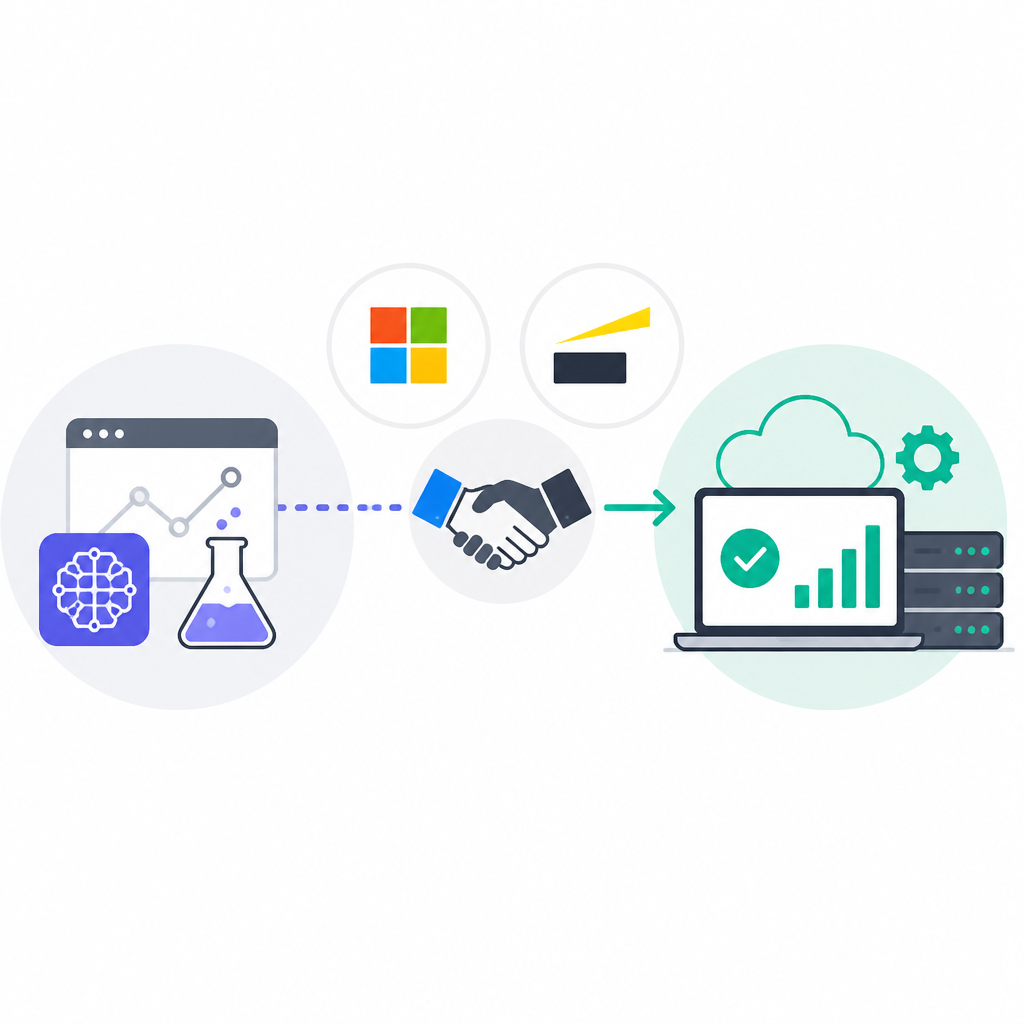
Still, the important part is not the percentage. It’s the proof-of-self-application. Consulting firms love telling clients how to transform while leaving their own house untouched. When EY says it is scaling Microsoft 365 E7: The Frontier Suite to more than 400,000 employees, it’s saying, “We’re taking our own medicine.” That matters because clients always ask the same silent question: did you do this yourself, or are you selling me a deck?
What this actually means is that adoption is becoming a credibility game. If the vendor or partner can show internal deployment, training, measurement, and governance, the buyer gets less nervous. Not calm, just less nervous. That’s about as good as enterprise technology gets.
I ran into this in a rollout where the vendor had gorgeous case studies but no internal discipline. The tool was fine, but the training was vague, the usage metrics were vanity numbers, and nobody could explain how time saved turned into business value. That’s the trap. Saved minutes are not the same as saved money. If AI reduces drafting time by 20 percent, what happens next? Do you ship faster, reduce risk, improve margins, or just create more room for meetings?
How to apply it: if you want your AI program to survive leadership scrutiny, define the business outcome before you define the model. Pick one workflow. Measure baseline time, error rate, rework, and approval delays. Then tie AI usage to one of those metrics. If you can’t connect the tool to a business result, the “productivity” claim is just wallpaper.
Microsoft 365 E7 is the real product, not just Copilot
“Microsoft wants customers to stop thinking of Copilot as an add-on and start thinking of AI as part of the enterprise control plane.”
This is the part I think a lot of people miss. The partnership is not just about getting more people to use Copilot. It’s about wrapping AI inside a higher-value enterprise bundle: Microsoft 365 E7, identity, compliance, security, and agent governance all in one story.
What this actually means is that Microsoft is trying to make AI feel like infrastructure. If your documents, identities, policies, endpoints, and compliance tools already live in Microsoft’s world, then adding AI through the same stack feels natural. Convenient, even. And convenience is powerful in enterprise buying, because nobody gets promoted for introducing unnecessary integration pain.
But I also see the catch. The more AI depends on one vendor’s control plane, the easier it is for that vendor to become the default answer to every adjacent question. That’s fine if you like the stack. It’s less fine if you care about procurement leverage.
The article’s mention of Copilot, Entra, and Purview is important because it shows how Microsoft wants to frame AI governance: identity, policy, and compliance are not separate from the AI layer. They are the AI layer. That’s a neat story, and to be fair, it solves a real administrative problem.
How to apply it: if you’re buying enterprise AI, map the dependency chain before you sign anything. Which identity system authenticates the users? Which policy engine controls access? Where are logs stored? Who can revoke an agent’s permissions? If the vendor can’t answer those cleanly, you’re buying a future headache.
Agentic AI changes the job from admin to supervision
“An assistant that drafts text is one thing; an agent that can pursue goals across systems is another.”
This is where the whole thing gets more serious. Drafting assistants are useful. Agentic systems are a different beast. Once AI can take actions across systems, IT is no longer just deploying software. It’s supervising digital labor.
What this actually means is that the questions change. Not “Can it summarize this email?” but “What can it see, what can it change, who approved it, and how do we prove it behaved correctly?” That’s a much harder problem, and I don’t think most orgs are ready for it yet.
I’ve seen teams get excited about autonomy and then freeze when the first permission issue shows up. That’s normal. The minute an agent can create a ticket, move a record, or recommend a financial action, you need boundaries. Human approval, logging, rollback, role-based access, and review loops stop being nice-to-haves. They become the product.
Microsoft’s inclusion of Agent 365 in the broader E7 story is the clue. Microsoft knows the next buyer concern is not “Can the AI write?” It’s “Can I govern the thing before it starts behaving like an overconfident intern with API access?” That’s the actual enterprise fear.
- Define the agent’s scope in plain English before you let it touch systems.
- Require logging for every action, not just every prompt.
- Keep a human approval step for anything that changes money, access, or compliance status.
How to apply it: treat agents like employees with very narrow job descriptions. If you wouldn’t let a new hire make that decision on day one, don’t let an agent do it either. Start with read-only tasks, then move to recommendations, then to constrained actions with approval. That sequence saves a lot of pain.
The pilot problem is mostly a governance problem wearing a tech costume
“The enterprise AI market is crowded with proof-of-concepts that impressed executives in controlled demos and then stalled when exposed to real business systems.”
This is the sentence I’d put on a wall in every AI steering committee meeting. The pilot problem sounds technical, but it’s usually organizational. The model isn’t the main issue. The org is.
What this actually means is that pilots fail because nobody decides what happens after the demo. Who owns the workflow change? Who trains users? Who updates policy? Who signs off on risk? Who pays for the production version? If those answers are fuzzy, the pilot becomes theater.
The Windows Forum piece is right to emphasize that Microsoft and EY are selling “adoption, governance, and business redesign as a package.” That’s the missing piece in a lot of AI programs. Companies buy a tool, but what they need is a change program. Those are not the same thing, and pretending they are is how budgets disappear.
I’ve been in rooms where the pilot got celebrated because it looked impressive, while the people who would actually run it in production were never asked what they needed. Then everyone acted surprised when the thing stalled. I wasn’t surprised. I was annoyed, but not surprised.
How to apply it: before approving a pilot, require a production checklist. Include data access, security review, training plan, success metrics, rollback plan, owner, and budget source. If a pilot cannot name the team that will own it after the demo, it is not a pilot. It’s a presentation.
The template you can copy
# Enterprise AI pilot-to-production playbook

## 1) Define the workflow
- Name one business process, not a vague department goal.
- Write the before/after steps in plain language.
- Identify the systems the AI will read from and write to.

## 2) Set the guardrails
- List the data the AI can access.
- List the actions it can take without approval.
- List the actions that always need human review.
- Define logging, retention, and audit requirements.

## 3) Assign ownership
- Business owner:
- Technical owner:
- Security owner:
- Compliance owner:
- Training owner:

## 4) Measure the baseline
- Time spent per task:
- Error rate:
- Rework rate:
- Approval delay:
- User adoption:

## 5) Run the pilot
- Start with read-only or recommendation mode.
- Limit the user group.
- Review outputs daily at first.
- Track failures and exceptions.

## 6) Decide whether it graduates
- Does it save time?
- Does it reduce risk?
- Does it improve quality?
- Can the org support it in production?
- Is there a budget and owner for rollout?

## 7) Production checklist
- Identity and access controls verified
- Data sources approved
- Logs enabled
- Human approval flow documented
- Training complete
- Support process defined
- Rollback plan tested

## 8) Copy-paste governance note
We are approving this AI workflow only for the scope below:

Scope:
[describe the exact task]

Allowed inputs:
[describe approved data sources]

Allowed outputs:
[describe approved actions]

Human approval required for:
[describe exceptions]

Owner:
[name]

Review cadence:
[weekly/monthly]

Audit log location:
[link]

Rollback plan:
[describe how to disable or revert]
This is not original to Microsoft or EY. It’s my distilled version of the operating pattern their announcement is pointing at: move from pilot to governed production by pairing technical integration with business ownership and control.
Source attribution: the original article is the Windows Forum thread at https://windowsforum.com/threads/microsoft-and-ey-1b-ai-partnership-from-pilots-to-governed-production.419180/. Everything above is my breakdown of that source, plus my own production checklist and template.
// Related Articles
- [IND]
OpenAI’s IPO filing turns hype into scrutiny
- [IND]
Skatteetaten proves public sector AI should be judged by outcomes
- [IND]
OpenAI’s IPO filing puts AI’s biggest test on Wall Street
- [IND]
OpenAI’s latest moves now center on pricing, safety, and scale
- [IND]
RISC-V mini PCs are worth buying now, but only as a bet on the future
- [IND]
Fedora 44 RISC-V widens Linux board support