Why Mistral’s industrial push is the right way to challenge OpenAI
Mistral AI is right to pivot toward industrial AI and its own data center footprint instead of trying to beat OpenAI on consumer chat alone.

Mistral is right to bet on industrial AI and its own data center footprint.
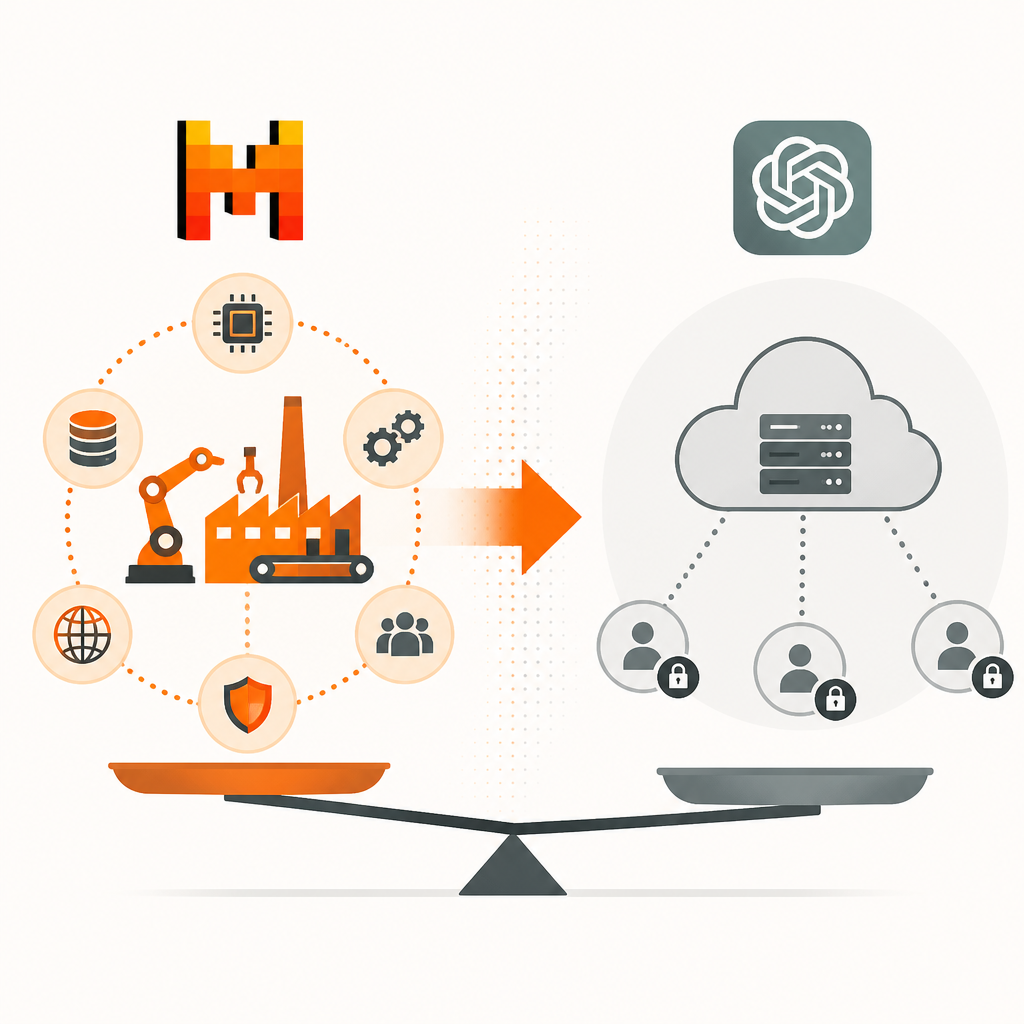
Mistral AI’s announcement is not a side quest or a branding exercise; it is the clearest sign yet that the company understands where it can win. By expanding into industrial manufacturing, building an inference data center south of Paris, and reworking its consumer assistant into Vibe, Mistral is choosing control, specificity, and distribution over the fantasy of being a generic chatbot clone. That is the correct move because the consumer assistant market is already dominated by entrenched players, while industrial AI rewards domain depth, deployment trust, and infrastructure ownership.
Industrial AI is where European startups can build real advantage
Get the latest AI news in your inbox
Weekly picks of model releases, tools, and deep dives — no spam, unsubscribe anytime.
No spam. Unsubscribe at any time.
Mistral’s move into industrial manufacturing is smart because factories are not asking for novelty, they are asking for reliability, integration, and measurable output. In industrial settings, an AI system that reduces downtime, improves inspection, or speeds up maintenance planning has a direct business case. That is a much stronger wedge than a consumer assistant fighting for daily habit share against ChatGPT, Gemini, and Claude.

There is also a structural reason this matters now. Manufacturing buyers care about sovereignty, data residency, and vendor accountability, especially in Europe. A company that can position itself as a serious industrial partner, not just a model provider, gets closer to procurement budgets and longer contracts. Those are the kinds of relationships that create durable revenue and make a platform harder to dislodge.
Owning infrastructure is not vanity, it is leverage
The planned inference data center south of Paris is one of the most important parts of the announcement because it changes Mistral from a model vendor into an operator. Inference is where products meet users, and controlling that layer gives the company more predictable latency, better economics, and more room to tune performance for enterprise workloads. If you want to compete on trust and service quality, you need infrastructure you can actually control.
That matters even more in a market where model access is increasingly commoditized. Anyone can rent compute from a cloud provider and call an API, but not everyone can offer a compelling data-residency story or optimize deployment around local customers. Mistral’s data center push says it wants to own part of the stack that determines whether industrial customers stay or leave. That is how you build bargaining power, not just brand awareness.
Rebranding the assistant is the least important part, and that is fine
The rebranding of Mistral’s consumer assistant to Vibe should be read as a cleanup step, not the headline. Consumer AI assistants are becoming a crowded interface layer, and the branding alone will not decide the outcome. What matters is whether the assistant supports the company’s broader strategy by serving as a lightweight front door to its models, tools, and enterprise relationships.
Vibe can still matter if it becomes a credible showcase for Mistral’s speed and product polish, but it should not be mistaken for the core business. The consumer app is useful as a proving ground and a distribution asset. It is not the moat. The moat comes from industrial use cases, infrastructure, and the ability to meet regulated buyers where they are.
The counter-argument
The best argument against Mistral’s strategy is that it risks fragmentation. By spreading across consumer assistants, industrial AI, and data center operations, Mistral could dilute focus and spend heavily before proving that any one vertical scales. OpenAI still benefits from a massive lead in mindshare, developer adoption, and product breadth, so trying to outmaneuver it in specialized markets may look like an admission that the company cannot win the main contest.
There is also a capital intensity problem. Building infrastructure and selling into manufacturing are both slower and more operationally demanding than shipping software features. That can create a long feedback loop, and investors often prefer faster growth signals than factory deployments or data center milestones.
That critique is real, but it misses the point: Mistral does not need to beat OpenAI at being OpenAI. It needs a business where product quality, deployment control, and regional trust matter more than scale alone. Industrial AI and owned inference capacity fit that definition. The risk is not that Mistral is choosing the wrong arena; the risk is that it fails to execute with discipline. But the strategic direction is still right.
What to do with this
If you are an engineer, PM, or founder, treat Mistral’s announcement as a reminder that AI strategy is now a stack decision, not just a model decision. Pick a domain where the customer pays for outcomes, not demos. Build around the constraints that matter in that market, including latency, compliance, data residency, and integration depth. If you are competing in AI, stop chasing generic assistant parity and start choosing a wedge that lets you own the workflow, the infrastructure, or both.
// Related Articles
- [IND]
OpenAI’s IPO filing turns hype into scrutiny
- [IND]
Skatteetaten proves public sector AI should be judged by outcomes
- [IND]
OpenAI’s IPO filing puts AI’s biggest test on Wall Street
- [IND]
OpenAI’s latest moves now center on pricing, safety, and scale
- [IND]
RISC-V mini PCs are worth buying now, but only as a bet on the future
- [IND]
Fedora 44 RISC-V widens Linux board support