MLOps in 2026: Why Production Still Breaks
MLOps is now the discipline that keeps ML and LLM systems versioned, monitored, and retrained after deployment.
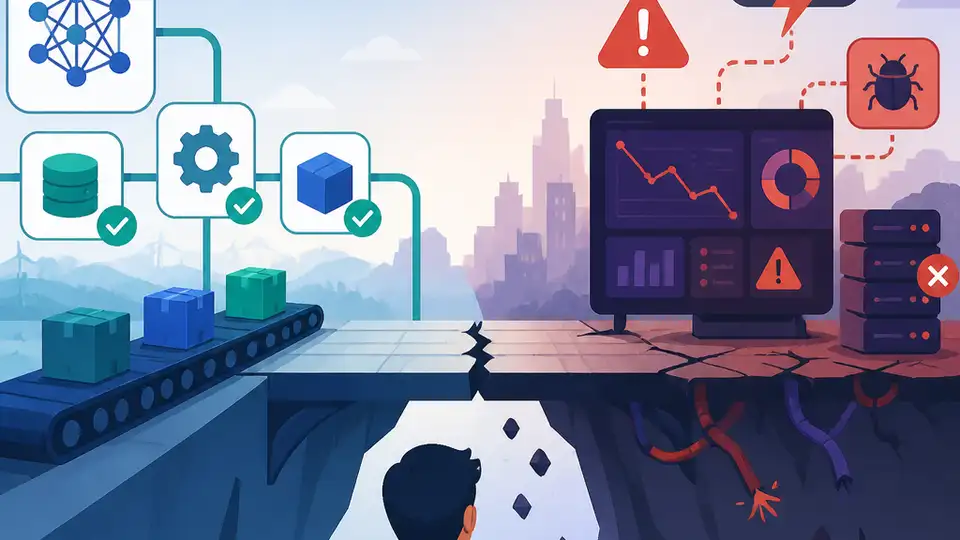
MLOps keeps machine learning and LLM systems working after deployment.
Building a model is the easy part. Keeping it accurate, observable, and cheap once real users hit it is where teams lose weeks, budgets, and trust.
That is the core message of Business Analytics Review's May 27, 2026 issue on MLOps, and the timing matters: the newsletter says it reaches 670k+ AI enthusiasts, while its framing reflects how production AI has shifted from classic ML into LLMOps-style operations for generative systems.
| Metric | Value | Why it matters |
|---|---|---|
| Newsletter edition | #298 | Shows the topic is part of an ongoing production-AI series |
| Publication date | 27 May 2026 | Places the article in the current wave of LLMOps adoption |
| Audience size | 670k+ | Signals broad interest in practical AI operations |
| Claimed ML failure rate | 80-90% | Explains why production discipline matters |
| Reported logistics gain | 18% | Shows what better monitoring and retraining can unlock |
Why MLOps matters more once a model leaves the lab
Get the latest AI news in your inbox
Weekly picks of model releases, tools, and deep dives — no spam, unsubscribe anytime.
No spam. Unsubscribe at any time.
The article makes a blunt point: many teams spend months perfecting a model, then watch it degrade after deployment. That failure is usually not about model quality in isolation. It is about changing data, shifting user behavior, scaling pain, and the absence of a process for keeping the system healthy.
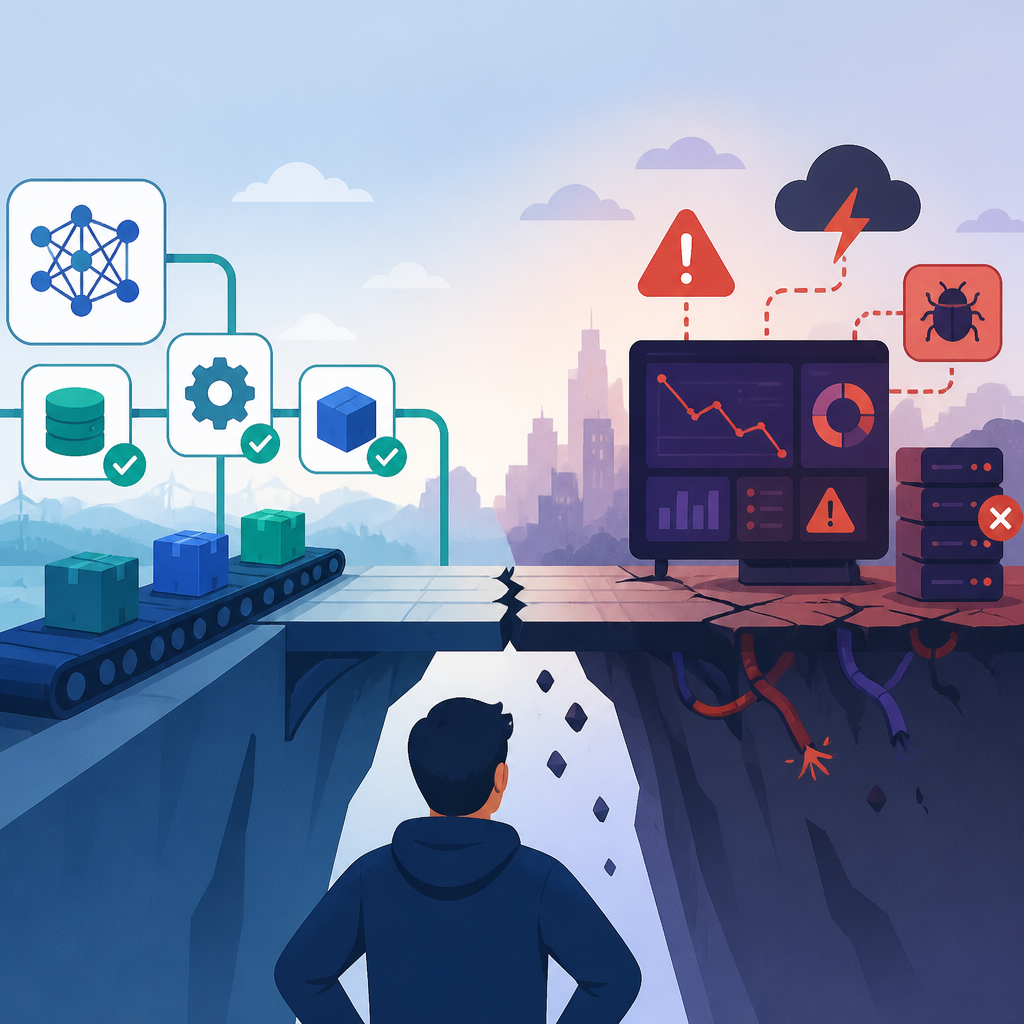
The newsletter cites industry surveys that put the share of ML initiatives that struggle to reach production or lose effectiveness quickly at 80-90%. Even if you treat that range as directional rather than exact, it explains why MLOps moved from a nice-to-have process to a default operating model for serious AI teams.
At its simplest, MLOps means treating the full ML lifecycle as an engineered system. Data prep, experimentation, deployment, monitoring, and retraining all need repeatable workflows. That is very different from the old pattern of shipping a notebook, crossing your fingers, and hoping the model survives contact with reality.
- Code, data, features, hyperparameters, and models all need versioning.
- Deployment should include canary, shadow, and blue-green rollout patterns.
- Monitoring has to cover accuracy, latency, drift, bias, and cost.
- Retraining should trigger from data changes, drift, or performance drops.
The MLOps stack is really a control system
The article’s strongest section is the one that breaks MLOps into operational layers. Version control is the first layer, but not the only one. In machine learning, the data itself changes, the features change, and the model behavior changes, so reproducibility needs to extend far beyond source code.
That is why tools such as DVC, lakeFS, and MLflow keep coming up in production discussions. They help teams track experiments, register models, and recreate a run when something goes wrong. If a model starts producing biased results or drifting on a new data slice, versioning is what keeps the diagnosis from turning into archaeology.
“MLOps is the natural evolution of DevOps, tailored specifically for the unique complexities of machine learning.”
The quote above captures the article’s main argument well. MLOps borrows the discipline of software operations, then adds the extra messiness of data dependency, statistical behavior, and model decay. That is why the stack usually includes containerization with Docker and orchestration with Kubernetes, especially when teams need repeatable environments across development, staging, and production.
One subtle but important point: MLOps is also a cultural change. The article is right to stress that models are living products. They need owners, service-level expectations, and a shared understanding between data science, engineering, and business teams. Without that, monitoring dashboards become decoration.
How the article frames modern deployment and monitoring
The deployment section is practical rather than theoretical. It favors blue-green releases, canary rollouts, and shadow testing because machine learning systems can fail in ways that normal applications do not. A model can be technically live and still be wrong for a specific segment, a seasonal pattern, or a sudden shift in demand.
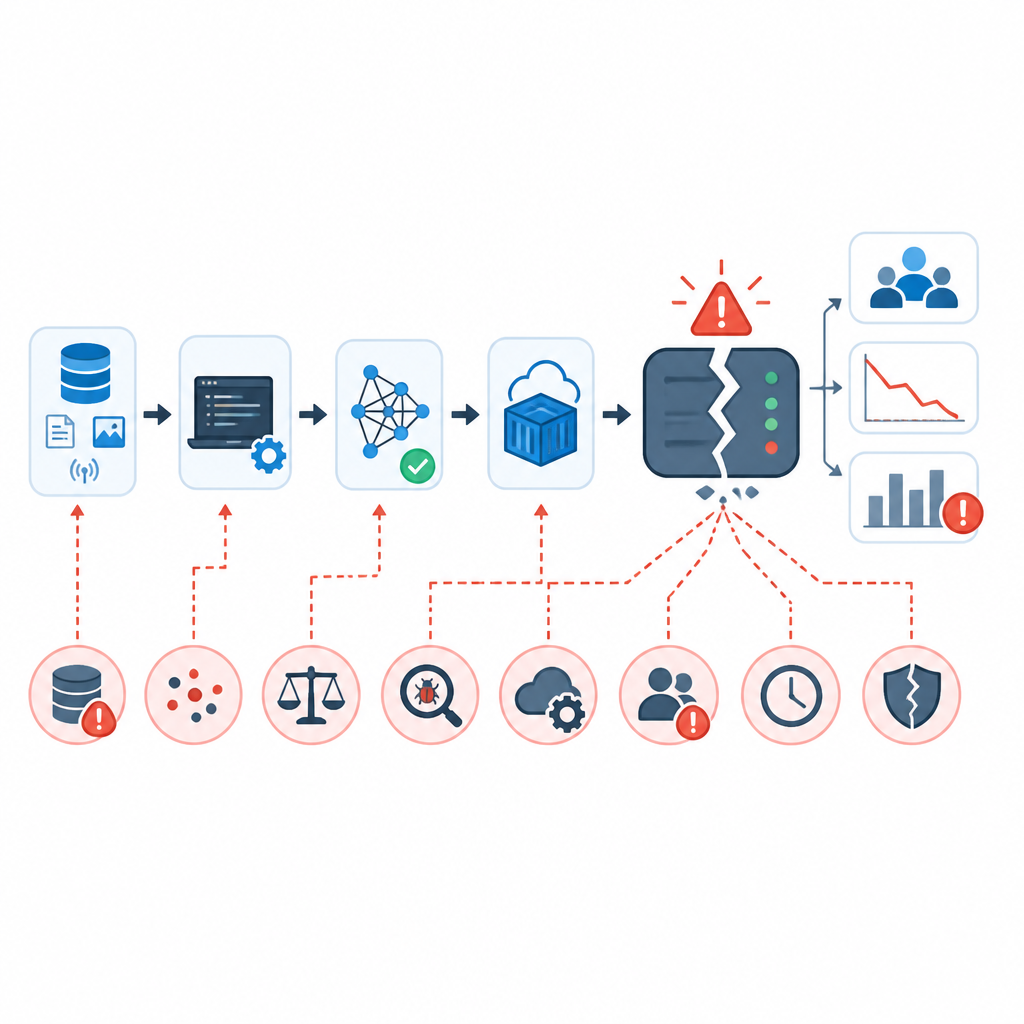
That is exactly what the logistics anecdote illustrates. A route optimization model worked in development, then broke during peak festival periods because traffic and demand changed too quickly. After the team added automated pipelines, versioning, and real-time monitoring, delivery efficiency improved by over 18%. That number matters because it ties MLOps directly to business output, not just engineering hygiene.
The article also highlights observability as the place where long-term success often gets decided. Good monitoring does more than log server errors. It tracks model accuracy, precision, latency, drift, fairness, resource use, and cost. In regulated areas like finance and healthcare, it also provides audit trails that can survive internal review and external scrutiny.
- Blue-green deployment reduces rollout risk by switching traffic between two environments.
- Canary releases expose a new model to a small slice of traffic before full rollout.
- Shadow testing lets teams compare outputs without affecting live users.
- Real-time drift alerts can trigger retraining before performance drops hard.
LLMOps is where MLOps is heading next
The article’s forward-looking point is the one most teams should pay attention to: MLOps is already expanding into LLMOps. Once you add large language models, prompt chains, safety filters, and agentic workflows, the old checklist is no longer enough. Prompt management becomes versioned state. Safety guardrails become part of deployment. Evaluation has to measure generated output quality, not just classification accuracy.
That shift changes the tools and the questions. A classic model might fail because of drift. A generative system can fail because the prompt changed, the retrieval layer changed, or the safety policy blocked a useful answer. Teams need evaluation suites that test factuality, refusal behavior, latency, and cost per request alongside standard reliability metrics.
If you want a practical takeaway, it is this: start with the smallest MLOps loop that gives you visibility. Add experiment tracking, model registry discipline, and basic drift monitoring before you chase a fully automated retraining pipeline. Teams that do this well will ship AI systems that survive contact with production traffic, while teams that skip it will keep rediscovering the same failure in slightly different forms.
For a related read on production AI workflows, see OraCore.dev coverage of AI operations, deployment, and model tooling. The next question for most organizations is no longer whether they need MLOps, but how fast they can turn it into a default part of every AI project.
// Related Articles
- [IND]
AMD and Microsoft push Windows ML on GPU and NPU
- [IND]
OpenAI’s IPO filing turns hype into scrutiny
- [IND]
Skatteetaten proves public sector AI should be judged by outcomes
- [IND]
OpenAI’s IPO filing puts AI’s biggest test on Wall Street
- [IND]
OpenAI’s latest moves now center on pricing, safety, and scale
- [IND]
RISC-V mini PCs are worth buying now, but only as a bet on the future