MoneyGram, Pairpoint, eToro Join Midnight as Node Operators
MoneyGram, Pairpoint, and eToro are joining Midnight’s founding node set, signaling privacy-first blockchain infrastructure is moving into payments, IoT, and fintech.

Three very different companies just made the same bet: privacy-preserving blockchain infrastructure is ready for real business use. MoneyGram, Pairpoint by Vodafone, and eToro are joining the Midnight network as founding node operators, giving the project a mix of payments, telecom, and regulated fintech muscle from day one.
The detail that matters is simple: Midnight is starting with 10 federated nodes, and these three companies take a seat in that early operator set before the network moves to community-driven block production later in 2026. That is a strong signal that the pitch for privacy, compliance, and verifiable execution is getting traction outside crypto-native circles.
Midnight comes from the Midnight Foundation and is built around zero-knowledge architecture for what it calls rational privacy. In plain English, it tries to let applications prove things without exposing everything behind the proof. For developers building payments, identity, IoT, or regulated finance products, that matters a lot more than another chain promising faster blocks.
Why these three operators matter
Get the latest AI news in your inbox
Weekly picks of model releases, tools, and deep dives — no spam, unsubscribe anytime.
No spam. Unsubscribe at any time.
This is not a random logo parade. MoneyGram handles cross-border money movement at global scale. Pairpoint is building an Economy of Things platform around connected devices. eToro runs a regulated investment business with a large retail user base. Each one brings a different reason to care about privacy-preserving infrastructure, and each one has a different pressure point that Midnight is trying to address.

Midnight’s initial node set already included names such as Google Cloud, Blockdaemon, Shielded Technologies, and Telegram-linked AlphaTON Capital. Adding MoneyGram, Pairpoint, and eToro shifts the story from “interesting blockchain project” to “institutional testbed with real operators.”
- MoneyGram operates in more than 200 countries and territories.
- eToro says it serves over 35 million users.
- Midnight starts with 10 federated nodes before moving to community block production in 2026.
- Pairpoint is focused on connected devices transacting across global networks.
- Midnight’s pitch centers on selective disclosure and confidential smart contracts.
The network design matters because early blockchains often fail in boring ways: downtime, inconsistent operator quality, and weak incentives for reliability. Midnight is trying to avoid that by seeding the network with companies that already run always-on systems at scale. That may sound unglamorous, but infrastructure wins or loses on unglamorous things.
What the companies are actually getting
For MoneyGram, the attraction is easy to see. The company has already spent years pushing into digital assets and cross-border crypto services, and Midnight gives it a path to test blockchain rails without giving up compliance or customer privacy. In payments, the hardest problem is often proving that a transaction is legitimate without exposing more user data than necessary. Midnight’s architecture is aimed right at that tension.
“In a network’s early stages, operational reliability matters as much as protocol design. By launching with operators that already maintain large-scale, always-on systems, we’re ensuring our community has a stable environment to build and deploy against.” — Fahmi Syed, President of the Midnight Foundation
Pairpoint’s angle is different. The company wants connected devices to transact autonomously, and that means identity, authentication, and trust become first-class requirements. David Palmer, Pairpoint’s Chief Innovation Officer, said Midnight’s zero-knowledge architecture is key to trusted IoT device identity and authentication as the world moves toward what he called an IoT AI economy.
eToro adds a useful signal for the market. This is a publicly traded, globally regulated fintech that already works in the Cardano ecosystem and has said it was among the first institutions to build and run an in-house staking operation for Cardano during the Shelley era. Its decision to run a Midnight node suggests the company sees value in programmable data protection, selective disclosure, and on-chain infrastructure that can satisfy regulators without exposing every user interaction.
How Midnight compares with other blockchain bets
Plenty of chains talk about privacy. Fewer can show a mix of operators that includes a payments giant, a telecom-backed IoT platform, and a regulated investment app. That mix is what makes this announcement interesting. It is also why Midnight feels closer to infrastructure for enterprise adoption than to a typical token-first launch.
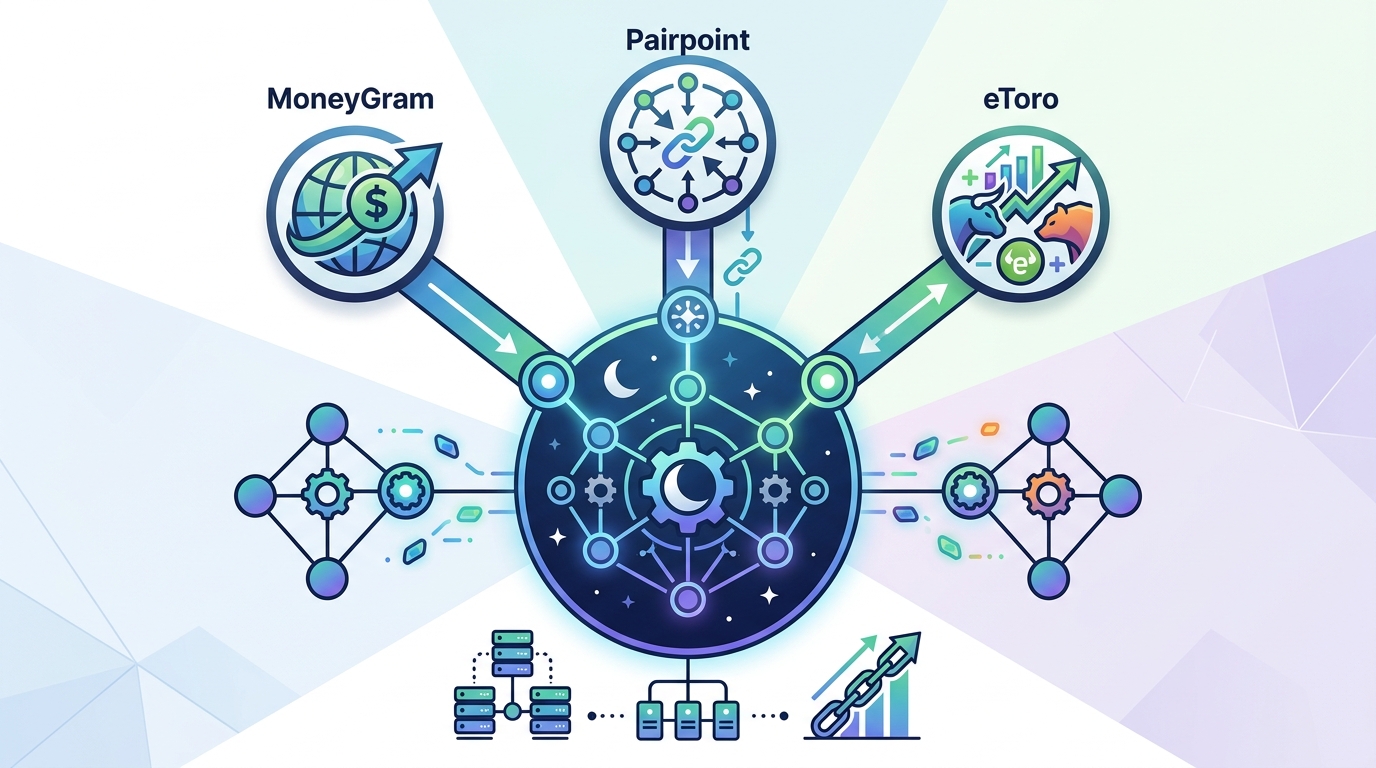
Here is the practical comparison:
- MoneyGram: over 200 countries and territories, with a direct need for compliant settlement and privacy-preserving transfers.
- eToro: over 35 million users, which makes data control and selective disclosure relevant at consumer scale.
- Pairpoint: built around machine-to-machine transactions, where identity and trust need to work without human intervention.
- Midnight: starts with 10 federated nodes, then shifts toward community block production later in 2026.
That last point is important because it shows the network is being staged carefully. Midnight is not pretending decentralization appears on day one. It is using a federated model first, then planning a broader handoff later. That approach is more practical than many launches that promise instant decentralization and then spend the next year patching operational gaps.
If you want more background on how privacy-first infrastructure is being positioned across Web3, see our related coverage on Cardano’s enterprise privacy push and zero-knowledge tools for enterprise adoption.
What this says about the next phase of blockchain adoption
The biggest takeaway is that blockchain adoption is getting more selective. The market is no longer impressed by a chain that can simply exist. It wants systems that can handle compliance, privacy, uptime, and real data constraints without forcing businesses to choose one at the expense of the others.
Midnight’s node operator lineup suggests that the next wave of adoption may come from infrastructure that hides less data from the user and more from the public ledger. That sounds counterintuitive until you look at regulated finance, connected devices, and cross-border payments. In those areas, the winning design is the one that reveals only what needs to be revealed.
My read: if Midnight can keep adding operators with real operational scale, the project could become a reference point for how privacy-preserving blockchains enter mainstream deployment. The question now is whether the next partners come from banking, cloud infrastructure, or identity, because that will tell us which use case gets to production first.
For now, the signal is clear. MoneyGram, Pairpoint, and eToro are not joining Midnight for branding. They are joining because private, verifiable blockchain infrastructure is moving from theory into procurement decisions, and the companies that move first may end up defining what compliant on-chain systems look like in 2026.
// Related Articles
- [CHAIN]
7 Solana APIs that cut weeks off integration
- [CHAIN]
Solana Unchained token sale nears Phase 1 close at $0.05
- [CHAIN]
June 2026 Web3 Signals Founders Should Use Now
- [CHAIN]
Bitcoin DeFi will grow, but not by copying Ethereum
- [CHAIN]
AI-blockchain projects need real utility, not token theater
- [CHAIN]
DMG’s 50 MW AI LOI is a better use of miners’ power assets