NVIDIA’s site shows its full AI stack
NVIDIA’s homepage bundles its AI, data center, gaming, and robotics products into one dense product map.
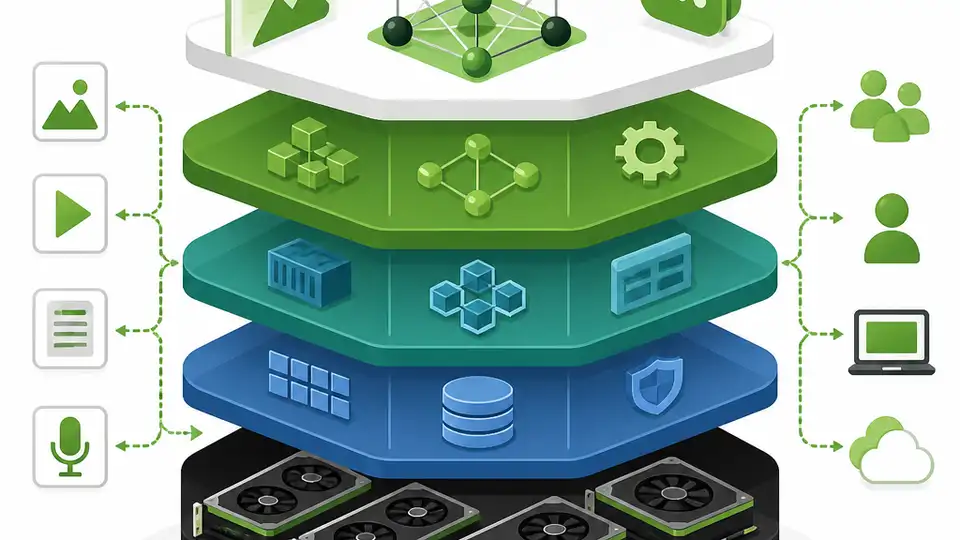
NVIDIA’s homepage is a dense map of its AI, gaming, and data center products.
NVIDIA’s main site is less a landing page and more a catalog of the company’s current strategy. In one scroll, it points to NVIDIA products for data centers, robotics, automotive, gaming, creator tools, and enterprise software, with regional links for markets from the United States to Taiwan.
The page also makes NVIDIA’s priorities obvious: AI infrastructure, developer tools, and hardware built around its latest architectures. If you want a quick read on where the company is pushing hardest, the homepage is a useful shorthand.
| Item | What the homepage highlights | Why it matters |
|---|---|---|
| Geographic reach | 20+ regional site links | Shows NVIDIA is selling the same stack through local channels |
| Product families | Data center, gaming, robotics, automotive, software | Signals a broad platform business, not a single-chip story |
| Named platforms | DGX Cloud, NVIDIA NGC, Jetson, DRIVE AGX, Omniverse | These are the building blocks of NVIDIA’s developer and enterprise push |
| Architectures | Blackwell, Hopper, Ada Lovelace, Grace | These names anchor the company’s current generation of compute products |
NVIDIA’s homepage is a product map, not a brochure
Get the latest AI news in your inbox
Weekly picks of model releases, tools, and deep dives — no spam, unsubscribe anytime.
No spam. Unsubscribe at any time.
Most company homepages try to sell a mood. NVIDIA’s tries to sell an ecosystem. The top-level navigation alone covers products, cloud services, software tools, solutions, industries, and support, which tells you the company wants visitors to think in terms of platforms rather than individual GPUs.
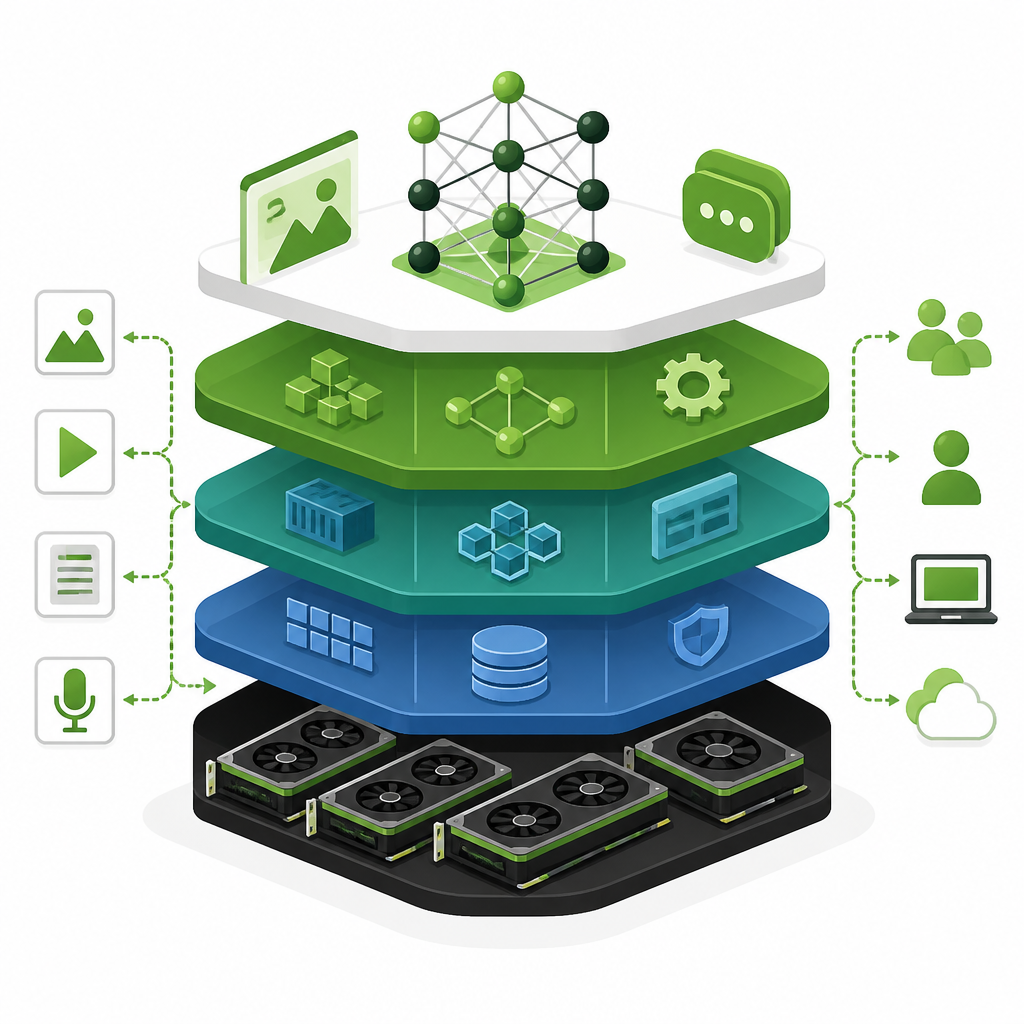
That matters because NVIDIA has spent years moving from a chip vendor into a full-stack computing company. The homepage reflects that shift with links to Data Center, Artificial Intelligence, Robotics, and Autonomous Vehicles. The company is clearly trying to make its software and systems as visible as its silicon.
- Data center products include DGX Platform, HGX Platform, Grace CPU, and OVX Systems.
- Developer software includes NVIDIA NIM, NeMo, CUDA-X, and the API Catalog.
- Consumer-facing offerings still matter, with GeForce, RTX AI PCs, and GeForce NOW on the menu.
- Industry pages cover healthcare, manufacturing, telecom, retail, and higher education.
The software layer is doing more of the talking
What jumps out on this page is how often NVIDIA leads with software. The company highlights AI data, agentic AI, inference, and conversational AI before many of the hardware details. That is a subtle but important signal: NVIDIA wants developers and IT buyers to see its stack as something they build on, not just something they install.
This is also where products like NVIDIA NIM and NeMo matter. NIM packages models as microservices, while NeMo is aimed at training and customizing AI systems. Together with NVIDIA App and DLSS, they show how NVIDIA is trying to make AI useful across enterprise, creator, and gaming workflows.
“Software is really the key to unlock the power of the GPU,” Jensen Huang said during a keynote at GTC.
That quote fits the homepage almost too well. NVIDIA is not hiding the hardware, but it is clearly asking visitors to notice the software around it first.
The numbers tell the story better than the slogans
NVIDIA’s site uses a lot of product names, but the real comparison is between the different layers of the stack. The homepage gives you enough to see how the company is grouping its offerings around workloads, from model development to deployment to edge inference.
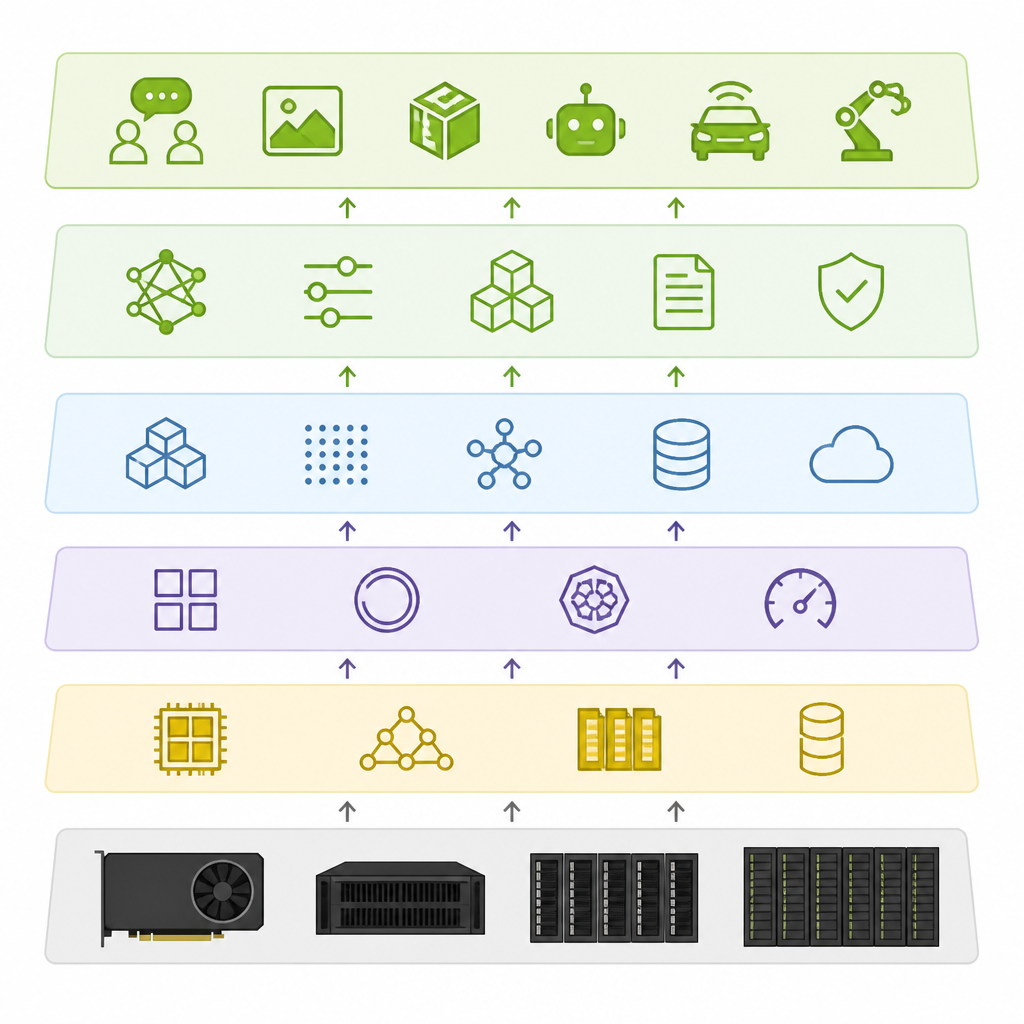
Here is the clearest way to read it:
- DGX Cloud is pitched as an AI factory in the cloud, while DGX Platform targets enterprise model development and deployment.
- Jetson focuses on autonomous machines and embedded applications, while DRIVE AGX targets in-vehicle AI systems.
- Blackwell is framed as the engine of a new industrial era, while Hopper is positioned for data center scale and security.
- GeForce RTX still anchors consumer GPU sales, but RTX AI PCs tie that hardware to productivity and development use cases.
That spread is important because it shows NVIDIA is selling the same basic idea in different forms: accelerated computing for every kind of workload. A gamer, a robotics team, and an enterprise AI group may buy different products, but the pitch underneath is the same.
The homepage also reflects how broad the company’s software and industry reach has become. It links into life sciences with Clara, industrial simulation with Omniverse, and data science with RAPIDS. That breadth is one reason the page feels crowded: NVIDIA is trying to speak to builders in many markets at once.
What this means for developers and buyers
If you are a developer, the homepage is a reminder that NVIDIA wants you inside its software stack early. If you are an IT buyer, it is a signal that the company is selling infrastructure, management tools, and deployment services alongside chips. If you are just trying to understand NVIDIA’s business, the page makes one thing plain: the company no longer thinks of itself as a graphics vendor with an AI side project.
That shift is visible in the way the site groups products and solutions. Data center, cloud, robotics, automotive, and gaming are all presented as connected parts of one strategy. The homepage does not explain every product in depth, but it does show how NVIDIA wants the market to read its priorities.
For a more focused look at how AI platforms are being packaged for builders, see our related coverage of AI coding tools and enterprise AI infrastructure.
What to watch next
The most useful thing about NVIDIA’s homepage is that it changes with the company’s strategy. If the top navigation starts emphasizing a new model family, a new deployment layer, or a new AI workstation line, that is usually a sign that the company is pushing harder in that direction.
For now, the page says NVIDIA is betting on a simple idea: the next wave of AI will be built on a stack that includes hardware, networking, software, and services. The question is which layer will matter most to buyers over the next 12 months, because that answer will shape where NVIDIA spends its energy next.
// Related Articles
- [IND]
OpenAI’s IPO filing turns hype into scrutiny
- [IND]
Skatteetaten proves public sector AI should be judged by outcomes
- [IND]
OpenAI’s IPO filing puts AI’s biggest test on Wall Street
- [IND]
OpenAI’s latest moves now center on pricing, safety, and scale
- [IND]
RISC-V mini PCs are worth buying now, but only as a bet on the future
- [IND]
Fedora 44 RISC-V widens Linux board support