Why Nvidia’s “new era of PC” is really an AI platform play
Nvidia is not reinventing the PC so much as turning it into an AI platform controlled by its chips and partners.

Nvidia’s new PC pitch is really a bid to make AI the default operating system for personal computing.
Nvidia is not reinventing the PC so much as turning it into an AI platform controlled by its chips and partners. Jensen Huang’s GTC message was clear: the company wants the next generation of desktops, laptops, and workstations to ship with AI agents, creator tools, and gaming workloads baked into the hardware stack, with Microsoft as the marquee ally. That is not a product tweak. It is an attempt to move the center of gravity in computing from the app layer back down into silicon, where Nvidia already has the strongest leverage.
First argument: the “AI PC” is a distribution strategy, not just a device category
Get the latest AI news in your inbox
Weekly picks of model releases, tools, and deep dives — no spam, unsubscribe anytime.
No spam. Unsubscribe at any time.
The most important line from GTC was not the phrase “new era of PC,” but the partnership with Microsoft. Nvidia is using a familiar consumer form factor to normalize its AI stack in the place where people already work, create, and play. If the company can make AI feel native on a laptop or desktop, it does not need to convince users to adopt a new interface from scratch. It can simply slide AI into the machine they already buy.

That matters because platform shifts are won through defaults. Apple did not win the smartphone era by selling phones alone; it won by making the phone the gateway to an ecosystem. Nvidia is trying to do the same thing for AI computing by tying RTX Spark, Microsoft software, and Adobe workflows into one hardware story. Once that bundle becomes the expected setup for creators and professionals, the “PC” label stops describing a computer and starts describing a controlled AI environment.
Second argument: Nvidia is racing to own the economics of everyday AI
Huang’s comments about an AI supercomputer in the home were not science fiction for its own sake. They were an economic claim. If AI agents become persistent, local, and useful, then the value moves from occasional cloud queries to continuous device-level inference. That is a much better market for Nvidia, because it creates demand for high-margin hardware, not just rented cloud access.
The company has already built the proof point. RTX Spark is positioned as a portable superchip that combines AI agents, content creation, and gaming on one device, and Adobe is reportedly rebuilding Photoshop and Premiere Pro around that architecture. That is how Nvidia expands from selling accelerators to selling the reference design for modern work. The economics are obvious: if every serious creative and technical workflow needs AI acceleration, Nvidia gets paid every time the workflow starts.
Third argument: the real target is the software stack, not the hardware box
Huang spent time talking about AI agents because agents are the wedge that makes the hardware story stick. A chip is only as valuable as the software that needs it, and Nvidia knows that a generic “faster PC” pitch is weak. But a PC that runs autonomous assistants, builds content, and handles gaming on one portable system sounds like a new computing model. That is why the company keeps pairing chips with workflows instead of selling raw performance numbers alone.
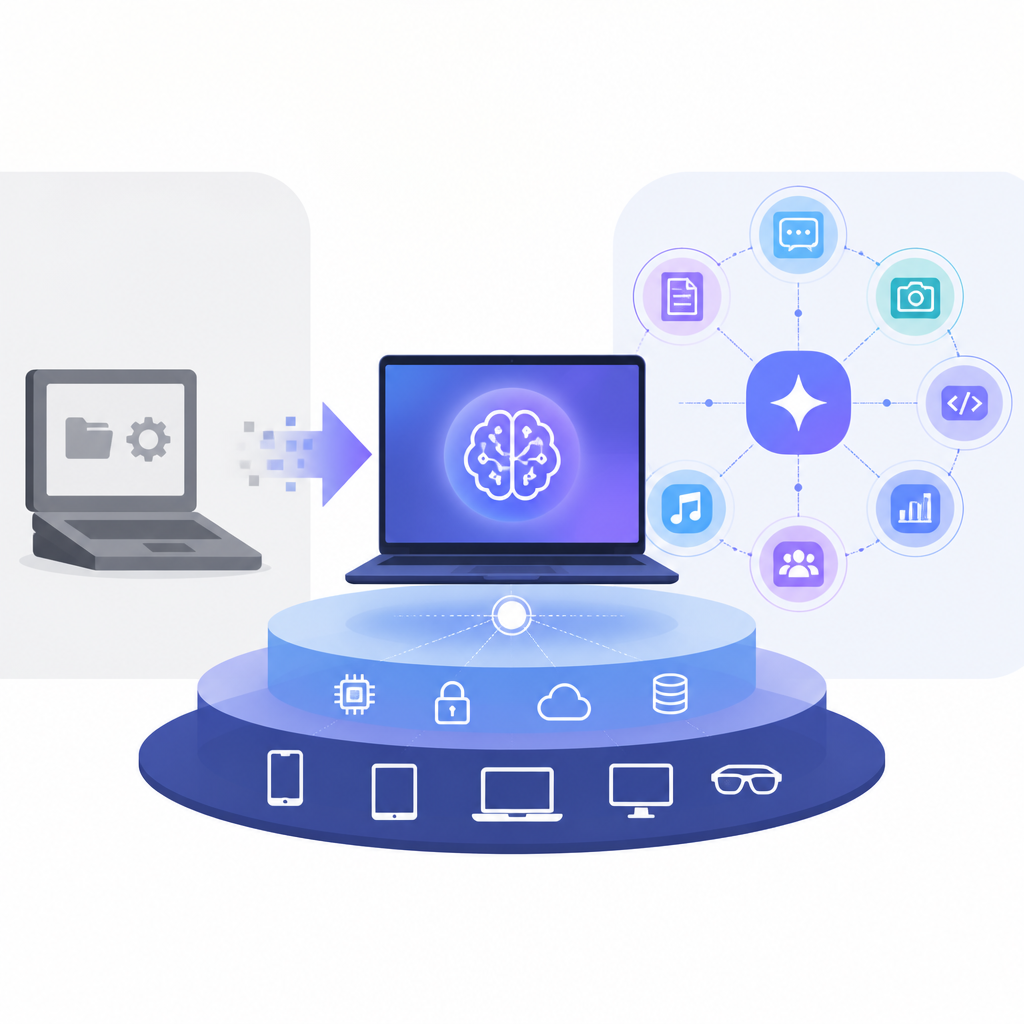
This is also why the Microsoft tie-up is strategically sharper than it first appears. Microsoft brings enterprise trust, desktop reach, and software distribution. Nvidia brings compute and developer momentum. Together, they can define what “AI-ready” means before rivals can. The danger for everyone else is that the standard starts to look less like an open market and more like a stack: Nvidia silicon at the bottom, Microsoft software in the middle, and third-party apps adjusted to fit.
The counter-argument
There is a strong case that this is just another overhyped hardware cycle dressed up in AI language. Consumers do not upgrade because a company says a device is “reinvented.” They upgrade when the benefits are immediate, visible, and worth the price. AI agents are still brittle, local AI systems are expensive, and many users are perfectly happy with the laptops they already own. From that angle, Nvidia’s pitch looks like a premium niche for developers and creators, not a mass-market reset.
That skepticism is reasonable, and it exposes the biggest limit in Huang’s vision: adoption will lag until the software becomes indispensable. But that does not weaken the strategy. It clarifies it. Nvidia does not need every household to buy an AI PC this year. It needs the most influential users, the ones who shape buying behavior inside companies and creative teams, to treat AI-native hardware as the new baseline. Once those users move, procurement follows.
What to do with this
If you are an engineer, PM, or founder, stop treating Nvidia’s pitch as a consumer gadget story and start treating it as a platform signal. Build for the workflows that become more valuable when AI runs locally, continuously, and with lower latency. Design products that assume the device itself will do more of the work, not just call the cloud. And if you are choosing a stack, pay attention to who controls the default path from hardware to software to distribution, because that is where the next lock-in will happen.
// Related Articles
- [IND]
OpenAI updates its Europe privacy policy
- [IND]
OpenAI is right to keep ads out of sensitive chats
- [IND]
AI bootlegs are already draining streaming royalties
- [IND]
AMD and Microsoft push Windows ML on GPU and NPU
- [IND]
OpenAI’s IPO filing turns hype into scrutiny
- [IND]
Skatteetaten proves public sector AI should be judged by outcomes