Qlik and Starburst Join Forces on Governed AI Data
Qlik and Starburst announced a partnership to help enterprises unify fragmented data into governed, AI-ready intelligence.

Qlik and Starburst announced a partnership to turn fragmented enterprise data into governed AI-ready intelligence.
Qlik and Starburst have teamed up around a simple enterprise problem: data is scattered, and AI is only as useful as the data underneath it. The companies framed the partnership as a way to help organizations move from disconnected systems to governed data that can actually support analytics and AI workloads.
The press release does not spell out a product bundle or a pricing model, but it does make the strategic intent clear. Qlik wants to connect its data integration and analytics stack with Starburst’s query and lakehouse access layer, so teams can work with data across clouds and systems without turning governance into an afterthought.
| Item | What the release says |
|---|---|
| Announcement | Strategic partnership between Qlik and Starburst |
| Goal | Turn fragmented enterprise data into governed, AI-ready intelligence |
| Use case | Analytics and AI workloads across distributed data |
| Company focus | Qlik data integration, analytics, and AI tooling |
| Company focus | Starburst query access for data across environments |
Why this partnership matters now
Get the latest AI news in your inbox
Weekly picks of model releases, tools, and deep dives — no spam, unsubscribe anytime.
No spam. Unsubscribe at any time.
Enterprise AI projects keep running into the same wall: the data is spread across warehouses, lakes, SaaS apps, and legacy systems, while governance lives in separate tools and separate teams. That creates slow approvals, inconsistent definitions, and a lot of manual cleanup before any model or dashboard can be trusted.

Qlik’s pitch is that its data integration and analytics products can help create a trusted foundation for AI. Starburst’s pitch is that its engine can query data where it lives, which reduces the need to copy everything into one giant store before work can begin. Put together, the partnership is aimed at a very practical buyer pain point: getting data access, control, and usability into the same workflow.
- Qlik has long sold data integration, analytics, and governance tools through Qlik Cloud Analytics and Qlik Talend Cloud.
- Starburst focuses on distributed SQL and lakehouse access through Starburst Galaxy and related offerings.
- The announcement is about governed access, not a consumer-facing AI app.
- The language in the release centers on enterprise data readiness, not model training hype.
What Qlik is really trying to sell
Qlik has spent the last few years pushing harder into data integration, governance, and AI. Its own site now talks about “data foundation for AI,” which is a more grounded message than the usual vendor promise that AI will fix bad data. This partnership fits that storyline: if Qlik can help enterprises clean, move, and govern data, then its analytics and AI products become easier to justify.
That matters because enterprise buyers are getting more selective. They do want AI features, but they also want lineage, access controls, and definitions they can defend in front of security, compliance, and finance teams. A partnership with Starburst gives Qlik a cleaner story for customers who already have data spread across multiple environments and do not want another copy of everything just to run analytics.
“Data is the new oil, and analytics is the combustion engine.” — Lars Björk, former Qlik CEO
That quote is old, but it still captures the commercial logic behind this move. Qlik is betting that the companies willing to pay for AI are the same ones willing to pay for data plumbing, especially when the plumbing reduces risk instead of adding another layer of sprawl.
How this compares with the broader market
This partnership also reflects where the enterprise data market has been heading. Vendors are no longer trying to win by promising a single warehouse, a single catalog, or a single AI layer. They are trying to make mixed environments usable. That shift matters because most large companies already have multiple clouds, multiple storage systems, and multiple teams with different rules.
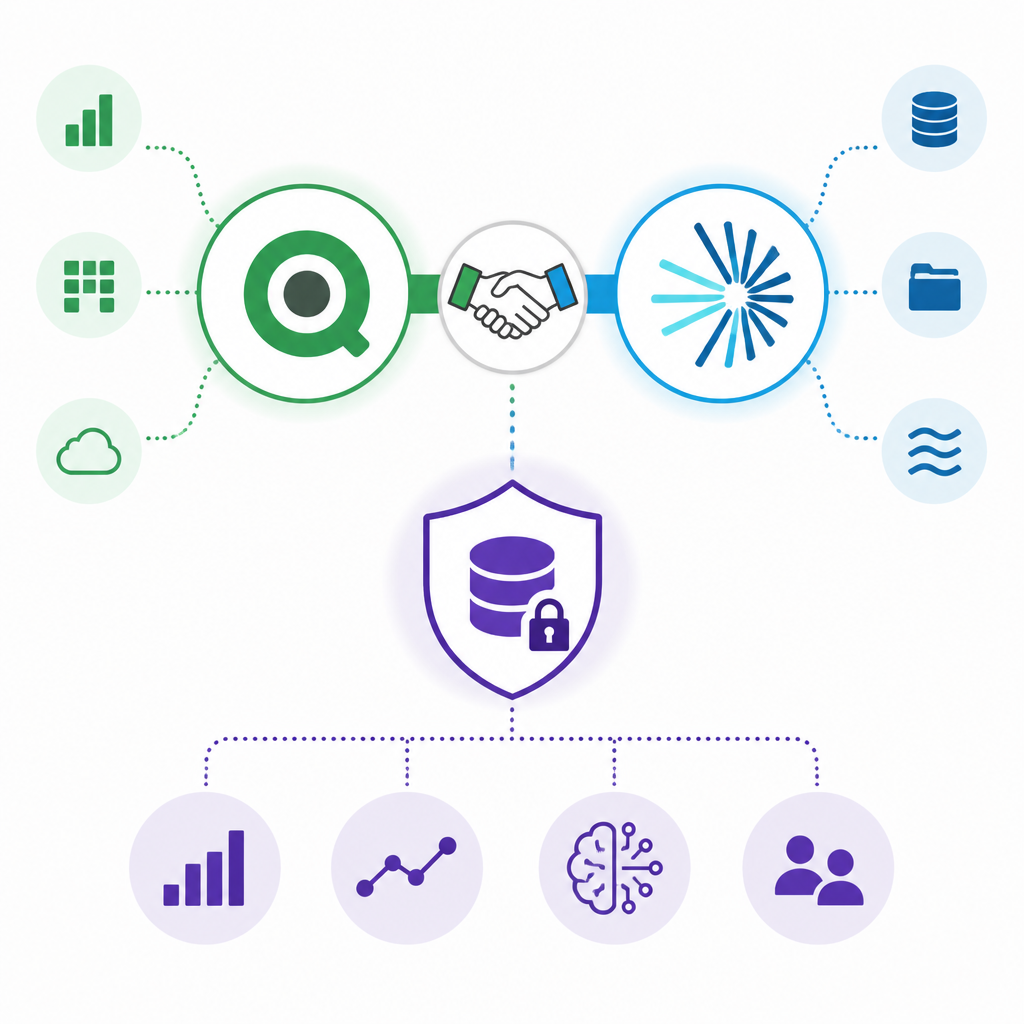
Starburst has built its brand around querying distributed data without forcing a full migration. Qlik has built its brand around integration, transformation, and analytics. The overlap is obvious: one side helps move and govern data, the other helps query it across systems. That combination is more believable than a generic “AI platform” pitch because it matches how enterprises actually operate.
- Starburst is positioned around distributed data access.
- Qlik is positioned around integration, analytics, and governance.
- Databricks pushes a lakehouse-first model.
- Snowflake pushes a cloud data platform centered on shared data access.
The real comparison is not about who has the flashiest AI demo. It is about who can reduce the friction between raw data and trusted decision-making. On that score, partnerships like this are more credible than vendors trying to bolt generative AI onto a messy backend and calling it strategy.
What to watch next
The biggest question is whether Qlik and Starburst will ship a tightly packaged joint offering or keep the partnership mostly at the go-to-market level. If they make the integration easy to adopt, the deal could matter for customers that already use one product and want a cleaner path to the other. If it stays vague, it will read like a standard partner announcement with decent branding and limited operational impact.
For enterprise teams, the takeaway is straightforward: AI readiness is becoming a data architecture problem again, not a model problem. If your company cannot explain where data comes from, who can touch it, and how it is governed, then another AI layer will only make the confusion more expensive. Watch for follow-up details on integration depth, joint customers, and whether the companies publish concrete deployment examples in the next few quarters.
If they do, this partnership could become a useful template for vendors trying to sell AI without pretending the hard parts disappeared.
// Related Articles
- [IND]
AMD and Microsoft push Windows ML on GPU and NPU
- [IND]
OpenAI’s IPO filing turns hype into scrutiny
- [IND]
Skatteetaten proves public sector AI should be judged by outcomes
- [IND]
OpenAI’s IPO filing puts AI’s biggest test on Wall Street
- [IND]
OpenAI’s latest moves now center on pricing, safety, and scale
- [IND]
RISC-V mini PCs are worth buying now, but only as a bet on the future