Rust memes turn compiler pain into jokes
I break down ProgrammerHumor.io’s Rust meme about FFmpeg, safety, and the joke that “blazingly fast” can become painfully slow.

I break down a Rust meme that turns safety zeal into a painfully slow FFmpeg joke.
I've been around enough Rust threads to know the pattern. Someone posts a memory-safety win, somebody else replies with a benchmark, and then the whole thing mutates into a moral argument about whether undefined behavior is a feature or a crime. This meme from ProgrammerHumor.io hits because it takes that argument and cranks it until it squeaks. I’ve had the same feeling in real projects: the code is safer, the compiler is happier, and somehow the team is still staring at a build that takes forever while video output turns into green sludge. That’s the joke, but it’s also the frustration. We love “safer” until it costs us the thing users actually wanted.
What got me here was the FFmpeg punchline in the meme body itself: a supposedly battle-tested C codebase “rewriting in Rust” because C is an “unacceptable violation of safety.” The meme author is not trying to be subtle. They’re poking at the way Rust gets treated like a purity test, especially when people talk about replacing mature C or C++ systems that already do one job very well. The source is a single post on ProgrammerHumor.io, and I’m treating it like a little case study in developer culture, not a news item.
What the joke is actually attacking
Get the latest AI news in your inbox
Weekly picks of model releases, tools, and deep dives — no spam, unsubscribe anytime.
No spam. Unsubscribe at any time.
“FFmpeg, one of the most battle-tested and optimized pieces of software ever written in C, announces it's rewriting in Rust because C is an ‘unacceptable violation of safety.’”
What this actually means is: the meme is mocking the impulse to treat Rust as the answer before you’ve admitted what problem you’re solving. FFmpeg is the perfect target because it’s famous for being fast, ugly in places, and relentlessly practical. So when the joke says “rewrite it in Rust,” it’s really saying, “sure, let’s replace a working system with a cleaner story and pretend the tradeoff doesn’t matter.”

I’ve seen this exact argument in code review. Someone wants to rewrite a hot path because the language feels nicer, or because the error handling story is better, or because they’re tired of footguns. All reasonable. But the meme is pointing at the part where people stop talking about costs. Rewrites are never just syntax migrations. They’re performance budgets, ecosystem gaps, maintenance debt, and a long period where the new thing is worse before it’s better.
How to apply it: if you’re pitching a Rust rewrite, don’t start with “safety.” Start with the bug class you’re eliminating, the runtime cost you can tolerate, and the exact module boundary you’ll replace first. If you can’t name those three things, you’re doing ideology, not engineering.
“Blazingly fast” is a marketing phrase, not a law of physics
The meme leans hard on the irony of Rust’s speed reputation. Rust people love saying “blazingly fast.” The joke flips that into “blazingly slow” once the rewrite happens. That’s not a dig at Rust itself so much as a dig at the way we talk about it. Language choice does not erase algorithmic cost, bad abstractions, cache misses, or a rewrite that’s still half-finished.
I’ve been burned by this in real life. A team swaps in a new implementation because the language is supposed to be faster, then discovers that the first version is slower for boring reasons: immature libraries, extra allocations, awkward interop, or a developer who had to fight the compiler instead of shaping the data model. The meme’s green-video gag is the same complaint in visual form. Safe code that doesn’t produce the right output is not a win. It’s just a different kind of failure.
There’s a useful distinction here:
- Rust can reduce entire categories of memory bugs.
- Rust does not automatically make a system faster.
- A rewrite can improve safety while making product behavior worse.
How to apply it: benchmark the current system, then benchmark the replacement on the same workload, on the same hardware, with the same inputs. Not synthetic microbenchmarks. Real workloads. If the speed story is fuzzy, your “blazingly fast” claim is just a meme waiting to happen.
The meme is really about developer identity
One reason this lands is that Rust has become more than a language choice. It’s a personality marker. The meme text treats “Rust evangelists” as people who will rewrite anything if it lets them say “memory safety” with a straight face. That’s funny because it’s recognizable. We all know the dev who falls in love with the idea of a tool and starts seeing every problem through that one lens.
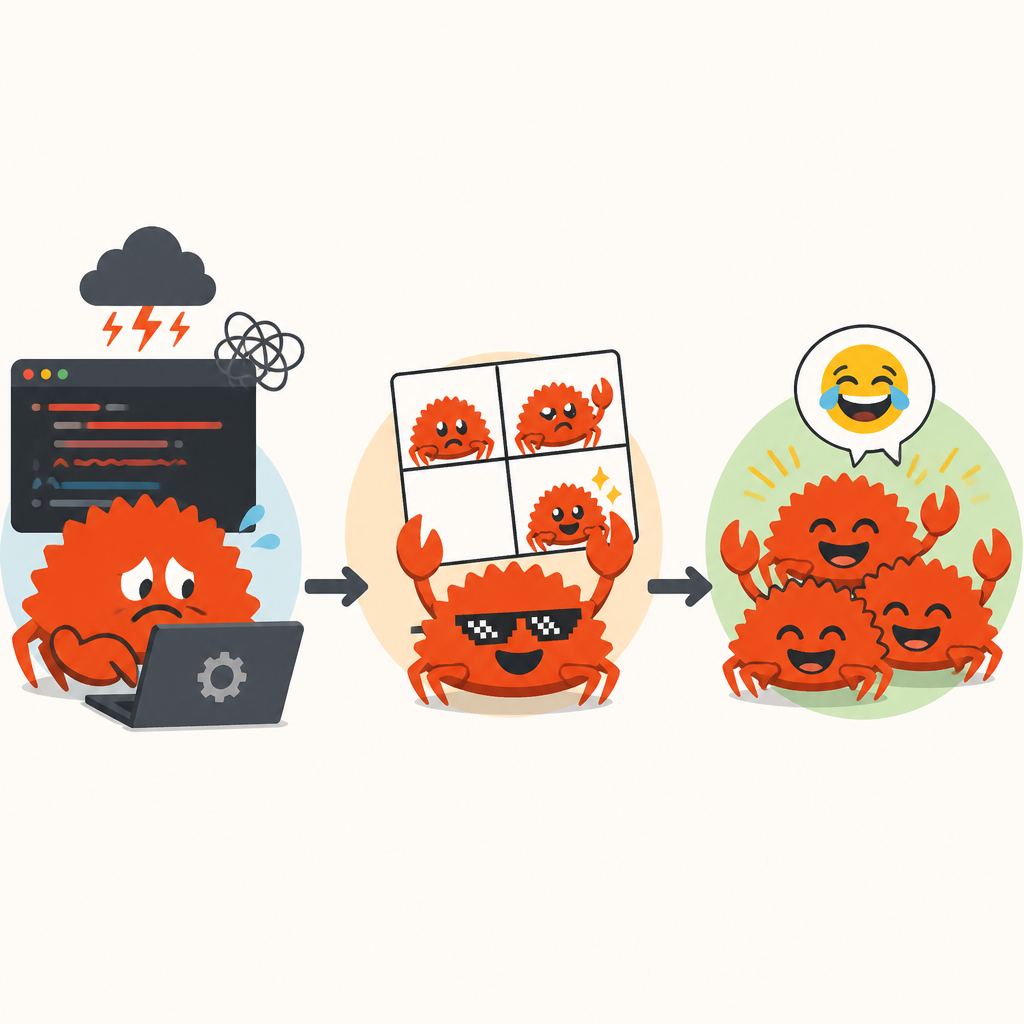
I’m not above it. I’ve done the “new tool, new worldview” thing myself. You pick up a language that gives you better guarantees, then suddenly every old system looks morally suspect. C becomes a liability. Java becomes bureaucracy. JavaScript becomes a crime scene. The meme is poking at that exact phase where enthusiasm turns into certainty and certainty turns into bad architecture.
There’s a second joke buried in the FFmpeg setup: the implied smugness of being “safe” while ignoring a working system’s constraints. That’s why the meme feels more like a roast than a simple punchline. It’s not anti-Rust. It’s anti-convert behavior.
How to apply it: when you’re evaluating a rewrite proposal, separate the technical case from the identity case. Ask, “What bug goes away?” not “What language feels cleaner?” If the answer is mostly vibes, you’re probably about to create a very expensive hobby project.
FFmpeg is the perfect victim because it already won
The meme works because FFmpeg is not some fragile demo app. It’s one of those pieces of software that quietly sits under half the internet and does the ugly work. That matters. A rewrite joke hits harder when the target is already proven in production. If you pick a toy project, nobody cares. If you pick FFmpeg, you’re picking a tool with years of scar tissue and a track record that makes “just rewrite it” sound absurd.
That’s what the meme author is exploiting. Mature infrastructure is full of compromises that were made on purpose. Some code is old because it has already survived the worst cases. Some code is messy because the team optimized for throughput, compatibility, or deployment simplicity. Rewriting that in the name of purity can be smart, but it can also be a very polished way to delete institutional knowledge.
I’ve had to inherit systems like this. The code looked cursed. The tests were weird. The build scripts were embarrassing. But under the mess was a set of decisions that had already been paid for. Throwing that away because a newer language feels cleaner is how teams end up rediscovering the same edge cases with a prettier syntax.
How to apply it: before replacing a mature system, write down what the old code handles that you haven’t fully modeled yet. Codec edge cases, platform quirks, weird input streams, deployment constraints. If the rewrite plan doesn’t account for those, you’re not modernizing. You’re starting over with better fonts.
The borrow checker joke is the real engine here
The meme never says “borrow checker,” but it doesn’t need to. Rust humor always has that shadow in the background: the compiler is strict, the errors are verbose, and the first few weeks can feel like being corrected by a very confident teacher who refuses to move on until you understand ownership.
That’s part of why the joke works. People don’t just associate Rust with safety. They associate it with friction. The meme takes that friction and imagines it applied to a system where the tradeoff looks ridiculous. If the result is “green videos,” then the compiler’s strictness becomes a liability instead of a feature. Not because strictness is bad, but because strictness has to serve the product.
I’ve run into this when teams adopt Rust for a subsystem and then act shocked that the compiler slows down iteration. The first instinct is to blame the language. Usually the real issue is that nobody budgeted for learning curves, refactors, or the extra design work that ownership forces on you. Rust makes you model data flow more explicitly. That’s good. It’s also annoying. Both can be true.
- Strictness catches bugs earlier.
- Strictness also raises the cost of experimentation.
- Good teams plan for both.
How to apply it: if you’re adopting Rust, pick a part of the codebase where correctness matters more than rapid churn. Parsers, schedulers, internal tooling, risky concurrency code. Don’t start with the hottest path unless you’re ready to measure and pay for the learning tax.
How I’d actually use this meme in a team conversation
If I were using this meme in a meeting, I wouldn’t bring it in as a joke and move on. I’d use it as a diagnostic. It tells me what kind of argument is happening in the room. Are people talking about safety because they’ve seen real bugs? Or are they using safety as a way to avoid discussing performance, migration cost, or ownership of the current mess?
That distinction matters. A good rewrite proposal can survive hard questions. A bad one hides behind language superiority and hopes nobody asks about throughput, compatibility, or staffing. The meme is funny precisely because it makes that dodge look childish. “We’re rewriting FFmpeg in Rust because C is unsafe” sounds noble until you remember the thing already runs the world.
Here’s the practical filter I’d use:
- What exact failure mode are we removing?
- What do we lose in latency, memory, or compatibility?
- Can we isolate the rewrite to one boundary first?
- Do we have benchmarks and rollback plans?
If the answers are hand-wavy, I’d stop. Not forever. Just until the proposal becomes an engineering plan instead of a slogan.
The template you can copy
## Rewrite Proposal Checkpoint

**Target:** [system/module name]

**Why change it:**
- Current bug class we want to remove: [exact bug or failure mode]
- Current pain we want to reduce: [maintenance, safety, latency, deploy risk]

**What we are not claiming:**
- We are not assuming the new language is faster by default.
- We are not assuming the rewrite will be simpler.
- We are not assuming safety automatically improves product quality.

**Success criteria:**
- [ ] Benchmark current implementation on real workloads
- [ ] Benchmark proposed implementation on the same workloads
- [ ] Define acceptable regression limits for latency, memory, and throughput
- [ ] Identify compatibility risks and edge cases
- [ ] Write rollback plan before first merge

**Migration plan:**
1. Pick one narrow boundary to rewrite first
2. Keep the old implementation behind a switch or adapter
3. Run both versions in parallel if possible
4. Compare outputs on real inputs
5. Merge only when the new path proves itself

**Decision rule:**
- If the rewrite removes a proven bug class and stays within budget, continue.
- If the rewrite improves taste but breaks performance or compatibility, stop.
- If the pitch is mostly “Rust is safer,” ask for the actual failure data.

**Team note:**
This is a product decision, not a language loyalty test.
The nice thing about this template is that it forces the conversation out of meme territory and into actual tradeoffs. I’ve used versions of this format when people wanted to swap core libraries, storage layers, or concurrency primitives. It keeps everyone honest.
If you want the meme’s lesson in one sentence, it’s this: don’t confuse a good reason to adopt Rust with a good reason to rewrite everything in Rust. Those are not the same thing, and pretending they are is how you end up encoding videos in green.
Source attribution: original meme and text on ProgrammerHumor.io. My breakdown is original commentary built from that post, not a reproduction of the site’s full page.
// Related Articles
- [TOOLS]
Magenta RealTime 2 lets you score in the DAW
- [TOOLS]
Open-source AI tools beat Claude’s paid tiers on value
- [TOOLS]
500 AI agent projects show where agents work now
- [TOOLS]
Chocolatey’s Go package turns installs into policy
- [TOOLS]
Go support policy turns releases into a checklist
- [TOOLS]
RustDesk self-hosting setup for secure remote access