Rust’s Spring Clean Adds a Ladder Hatch and Water Wheel
Rust’s April update adds an Armoured Ladder Hatch, a Water Wheel, tech-tree bulk unlocks, and major server and rendering gains.

Rust shipped a busy April update on 02 April 2026, and the headline numbers are hard to miss: two new items, a tech tree overhaul, and server-side changes that save about 600MB of runtime memory plus 2.7GB on disk. The patch also trims draw calls by roughly 1,000 in one terrain test, which is exactly the kind of boring-sounding work that keeps large multiplayer worlds feeling alive.
If you only care about the toys, the new Armoured Ladder Hatch and Water Wheel are the stars. If you run servers or care about frame times, the deeper changes may matter more than the cosmetics.
Two new items, one defensive and one practical
Get the latest AI news in your inbox
Weekly picks of model releases, tools, and deep dives — no spam, unsubscribe anytime.
No spam. Unsubscribe at any time.
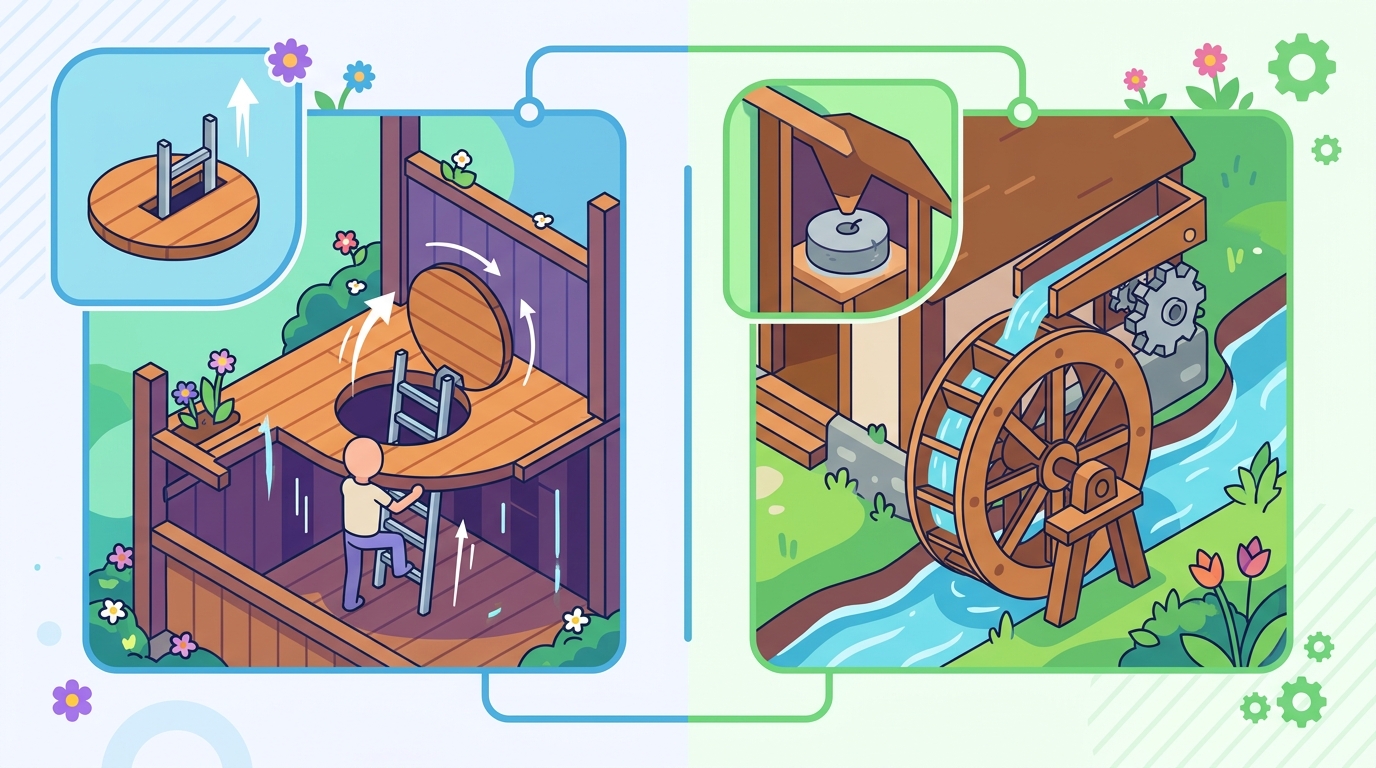
The Armoured Ladder Hatch is the kind of addition Rust players expect late in the wipe cycle: a direct upgrade from the Metal Ladder Hatch, locked behind Tier 3, and available in square and triangle variants. It drops straight into existing frames, so base builders do not need to redesign their vertical access points just to get the extra durability.

The Water Wheel is more interesting because it pushes Rust’s power systems further into self-sufficiency. Place it in a river and it passively generates electricity from flowing water. Put it in the ocean and it still produces power, though the output is less consistent because tides interfere with the flow.
Facepunch also leaned into the joke side of the item. The wheel can be used as a giant hamster wheel, and handcuffed players can be forced into it. That detail says a lot about Rust’s design philosophy: utility and cruelty often arrive in the same patch note.
- Armoured Ladder Hatch: Tier 3 unlock, square and triangle variants
- Water Wheel: river power generation, partial ocean output
- Both items slot into existing base designs without major rebuilds
- The wheel depends on unobstructed water flow at its base
Tech tree unlocking finally gets less annoying
The biggest quality-of-life win in this update may be the new tech tree multi-unlocking flow. Before this patch, moving down the tree meant selecting and unlocking each node one at a time. Now you can click the item you want, preview the path to it, and unlock the whole route in one go.
That sounds minor until you remember how often Rust forces players to repeat small actions under pressure. The patch also adds new sound effects, improves the unlock animation, and centers the tree while zooming. Those are small touches, but they matter because the tech tree is one of the game’s most repeated interfaces.
Facepunch’s own notes make clear that this is about reducing friction, not adding more choices. The new path preview also hints at a UI system that can handle more complex nested menus later, which is why the new coloured buttons matter more than they first appear.
“We saw a cool community concept for coloured buttons and decided to implement it as a part of this patch.” — octo
That quote captures a familiar Rust pattern: community ideas often become real features once they fit the game’s systems. The new coloured buttons use a wire-like color set, with red as the default to match older behavior, and they are the first buttons in the game to support nested radial menus.
The balance changes are aimed at familiar pain points
This patch also tweaks several systems that had started to drift into annoying territory. Plants now stay in their ripe stage for 24 hours instead of 14, which is a welcome change for anyone who cannot log in every day just to harvest crops. Flowers remain unchanged at 28 hours, so the update keeps the existing distinction between the two plant types.
Shields got a more targeted fix too. Facepunch says the shield meta had become too popular, so the hitbox now changes depending on whether the shield is actively raised. Idle shields use a smaller square hitbox, while raised shields keep the larger one. The team also fixed a recoil bug that was applying extra recoil when shooting at shields, even though that penalty was only meant for melee attacks.
Fishing got a nudge toward actual fishing instead of base-side automation. If too many fish are caught in one area over a short period, that zone becomes overfished and only junk comes up from cast lines until the area refreshes. Deep sea fishing gets the opposite treatment: herrings and anchovies are removed from that loot pool, which concentrates the rewards toward better catches.
- Ripe plants: 24 hours, up from 14
- Shield hitbox now depends on whether it is raised
- Overfished zones return junk until they refresh
- Deep sea fishing drops herrings and anchovies from the catch pool
Performance work is the part server admins will notice first
The performance section is the most technical part of the update, but it is also where the biggest long-term wins live. Facepunch has moved UsePlayerUpdateJobs 2 to the default server setting after rolling it out across its own servers. The studio says that the deployment went well overall, though it exposed a few demo-system bugs that have already been fixed.
There is also a new experimental UsePlayerUpdateJobs 3 mode. The interesting part here is the explanation, because it reads like a real engineer’s postmortem: serial code in antihack and player streaming was creating bottlenecks, and the team is now replacing C# Tasks with UniTask to cut allocations. More of antihack has moved to Burst Jobs, and player network streaming is being parallelized further.
That matters because Rust servers do not fail in one dramatic blow. They bog down as the world ages, the player count rises, and small costs start stacking up. The new job system is an attempt to keep that stack from getting too tall.
- UsePlayerUpdateJobs 2 is now the default
- UsePlayerUpdateJobs 3 is public for testing
- UniTask replaces C# Tasks in the new pipeline
- More antihack code now runs in Burst Jobs
Rendering got a similar treatment. Facepunch is moving away from Unity’s terrain system and using its own GPU-driven terrain renderer. In one example, draw calls dropped from 2.71k to 1.07k, shadowcaster count fell by about 550, and the CPU main thread gained roughly 0.65ms in median performance. GPU cost stayed about the same in tests, which is the best kind of tradeoff for a game that already asks a lot from both client and server hardware.
The server build also got leaner. Meshes are being stripped from dedicated server builds unless a collider needs them, which cuts memory use and disk size without affecting rendering, because servers do not render in the first place. That kind of cleanup rarely makes headlines, but it is the sort of thing that keeps a live service game from slowly bloating itself into trouble.
Rust is trimming friction where players feel it most
This update is a good example of how Rust improves over time: a flashy item or two, then a pile of fixes that make the game easier to live with. The new ladder hatch and water wheel will get the screenshots, but the real story is the tech tree batch unlock, the longer plant window, the shield adjustment, and the server work that saves memory and CPU time.
If you run a Rust server, the practical takeaway is simple: check your mods, especially anything that hooks into player update loops, because Facepunch has already said older modes will disappear. If you are a regular player, the more immediate change is that base management and progression just got a little less fiddly.
My prediction: the next few Rust updates will keep targeting hidden friction rather than adding huge new systems. The question is whether server operators will move to the new job modes quickly enough for Facepunch to retire the older code paths without breaking community setups.
// Related Articles
- [IND]
Skatteetaten proves public sector AI should be judged by outcomes
- [IND]
OpenAI’s IPO filing puts AI’s biggest test on Wall Street
- [IND]
OpenAI’s latest moves now center on pricing, safety, and scale
- [IND]
RISC-V mini PCs are worth buying now, but only as a bet on the future
- [IND]
Fedora 44 RISC-V widens Linux board support
- [IND]
June 2026 agentic AI platform war centers on memory