Skatteetaten proves public sector AI should be judged by outcomes
Skatteetaten’s win shows public sector AI should be judged by measurable outcomes, not novelty.

Skatteetaten’s win shows public sector AI should be judged by measurable outcomes, not novelty.
Skatteetaten deserved the Nordic DAIR award because its AI program proves that public sector innovation is only real when it saves time, improves compliance, and keeps trust intact.
First, the agency has turned AI into visible public value
Get the latest AI news in your inbox
Weekly picks of model releases, tools, and deep dives — no spam, unsubscribe anytime.
No spam. Unsubscribe at any time.
The strongest case for Skatteetaten is not the word “AI” itself but the scale of the results. Its deductibles and secondary housing models are said to deliver more than 3 billion NOK in annual value, while the real estate sales model adds about 1 billion NOK a year by improving valuation accuracy and compliance. That is not experimentation; it is public infrastructure producing measurable economic impact.

The same pattern shows up in service delivery. Digital tax declaration and return services improve predictability and user satisfaction, with benefits above 200 million NOK per year, while automated tax calculations speed refunds so taxpayers receive money only weeks after settlement. In a public system, speed without accuracy is reckless, but speed with accuracy is a genuine civic gain.
Second, the agency has proven that scale depends on governance, not hype
Many public institutions pilot models and stop there. Skatteetaten has gone further by pairing models with modern IT platforms, strong governance structures, and professional MLOps practices. That matters because the hard part of public AI is not building one model, but operating dozens of them under legal, operational, and reputational pressure.
The agency’s own example makes the point sharply: automobile export processing reportedly fell from 60 days with 30 case handlers to 6 hours with 4 employees. That kind of change only happens when AI is embedded into workflows, not bolted on as a demo. It also shows why governance is not a brake on innovation but the mechanism that lets it scale safely.
Third, trust is the real competitive advantage in government AI
Skatteetaten’s approach to responsible AI is the part other agencies should copy most aggressively. The article describes legal assessments, a formal AI policy, an ethics committee, and continuous monitoring for drift, fairness, robustness, and explainability. In other words, the agency treats risk as a design input, not a post-launch cleanup task.
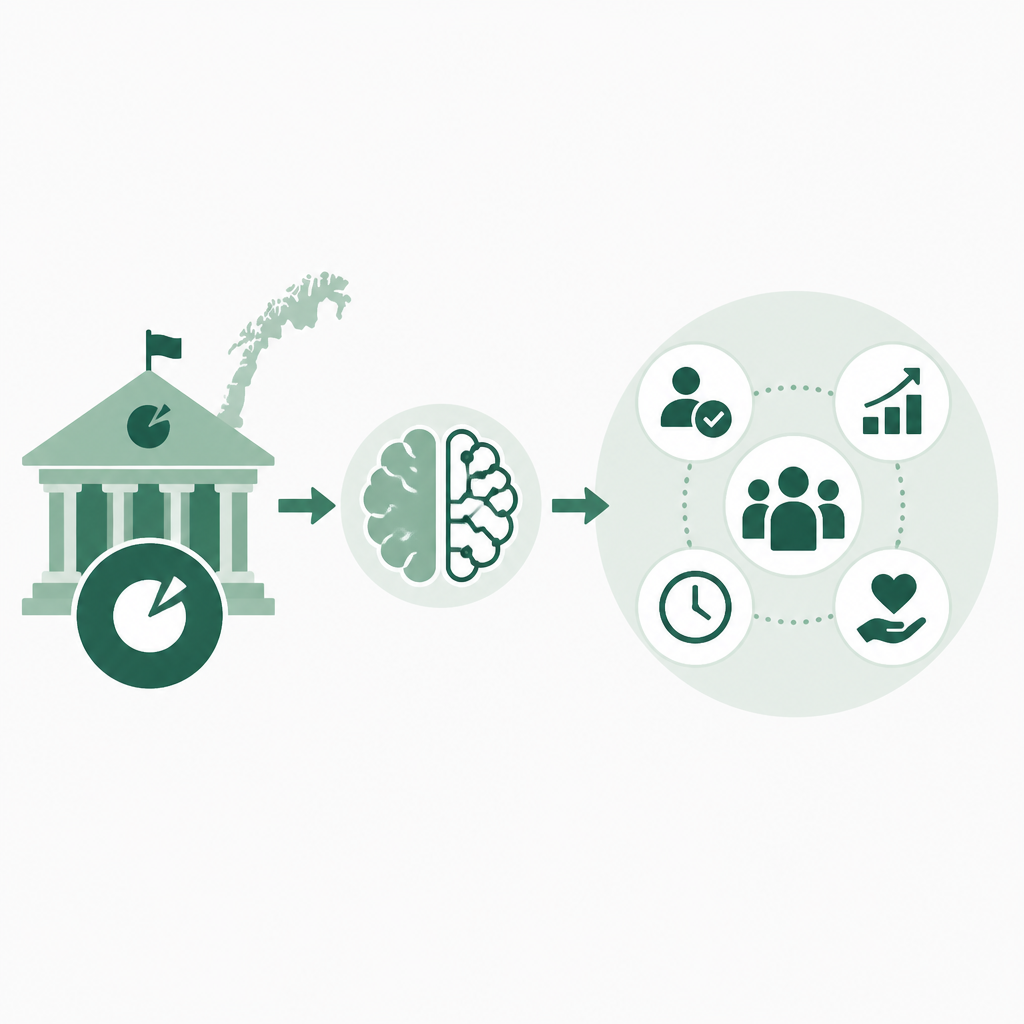
That discipline is not cosmetic. A tax authority has no room for opaque automation that treats citizens inconsistently or hides the basis for decisions. By keeping humans in control of final decisions, integrating legal and technical review, and building transparency into digital services, Skatteetaten protects the one asset every public institution lives or dies on: legitimacy.
The counter-argument
The strongest objection is that this is a privileged case. Tax agencies have rich administrative data, clear rules, and direct financial incentives, so their success does not automatically translate to hospitals, welfare systems, or local government. Critics can also argue that efficiency gains are easy to celebrate while the harder question, whether citizens fully understand or can challenge automated decisions, remains unresolved.
That criticism is fair, but it does not weaken the core lesson. Skatteetaten is not proof that every agency can copy its models one to one. It is proof that public AI works when it is tied to concrete outcomes, governed tightly, and built around human accountability. Those are transferable principles, even when the underlying use case is not.
What to do with this
If you are an engineer, PM, or founder working in public sector AI, stop pitching models and start pitching measurable service outcomes, legal safeguards, and operating discipline. Build for one workflow, one outcome, and one accountable owner. If you cannot show time saved, money recovered, or citizen value created, you do not have a transformation story, only a prototype.
// Related Articles
- [IND]
OpenAI’s IPO filing turns hype into scrutiny
- [IND]
OpenAI’s IPO filing puts AI’s biggest test on Wall Street
- [IND]
OpenAI’s latest moves now center on pricing, safety, and scale
- [IND]
RISC-V mini PCs are worth buying now, but only as a bet on the future
- [IND]
Fedora 44 RISC-V widens Linux board support
- [IND]
June 2026 agentic AI platform war centers on memory