Tokenization Is Moving From Idea to Infrastructure
Consensus 2026 shows tokenized assets, stablecoins, and prediction markets moving from crypto theory into institutional finance.

Tokenization is moving from crypto theory into institutional finance.
Consensus 2026 lands in Miami on May 5–7 with a very different mood from the early crypto conferences: the debate is no longer about whether tokenization can work, but how fast it can spread. CoinDesk says 20,000 attendees are expected, and the speaker list now includes names that used to treat crypto as a side quest.
| Signal | Detail |
|---|---|
| Event | Consensus 2026 |
| Dates | May 5–7, 2026 |
| Expected attendance | 20,000+ |
| Location | Miami Beach Convention Center |
| Market theme | Tokenized assets, stablecoins, prediction markets |
Wall Street is no longer watching from the sidelines
Get the latest AI news in your inbox
Weekly picks of model releases, tools, and deep dives — no spam, unsubscribe anytime.
No spam. Unsubscribe at any time.
The most important change in this story is not a new product launch. It is the roster. Morgan Stanley, Nasdaq, NYSE, DTCC, SWIFT, and Franklin Templeton are all showing up in Miami with senior people, not observers.

That matters because crypto conferences used to be split into two camps: builders talking to builders, and financiers pretending to be curious. This year, the line is blurred. The event’s sponsor list also includes JPMorgan, Fidelity, Coinbase, Google, Bridge by Stripe, Broadridge, Circle, and Grayscale.
That mix tells you what stage the market is in. These firms are not buying booth space to “learn about crypto.” They are placing bets on where settlement, custody, and distribution are going next.
“Consensus brings every pillar of the industry together for the largest crypto trade conference in North America,” says a Coinbase spokesperson. “That’s exactly where we want to be in order to move the needle.”
Stablecoins are becoming the plumbing
Stablecoins used to be described as a bridge between crypto and fiat. That framing is too small now. They are becoming the settlement layer for cross-border payments, onchain commerce, and dollar movement in markets that do not pause for banking hours.
CoinDesk frames the shift clearly: the old question was whether stablecoins could support crypto trading. The current question is whether they can support global commerce. That is a much bigger test, because it pulls in payment networks, treasury operations, compliance teams, and the systems that move money behind the scenes.
Two protocol names in the article point to where the next fight is headed: x402 and Tempo’s Machine Payments Protocol. Both point toward programmable money that can move with the same speed and automation as data.
- Stablecoins now sit at the center of cross-border settlement conversations.
- Programmable payment protocols are trying to remove manual steps from money movement.
- Institutional speakers include Cloudflare, Robinhood, Ondo Finance, and Tether.
Tokenized assets are moving into real portfolios
Tokenized treasuries, onchain private credit, and fractional real estate used to sound like lab experiments. Now they are live products with real assets under management, and the article points to institutions like Franklin Templeton and T. Rowe Price building on public blockchains.
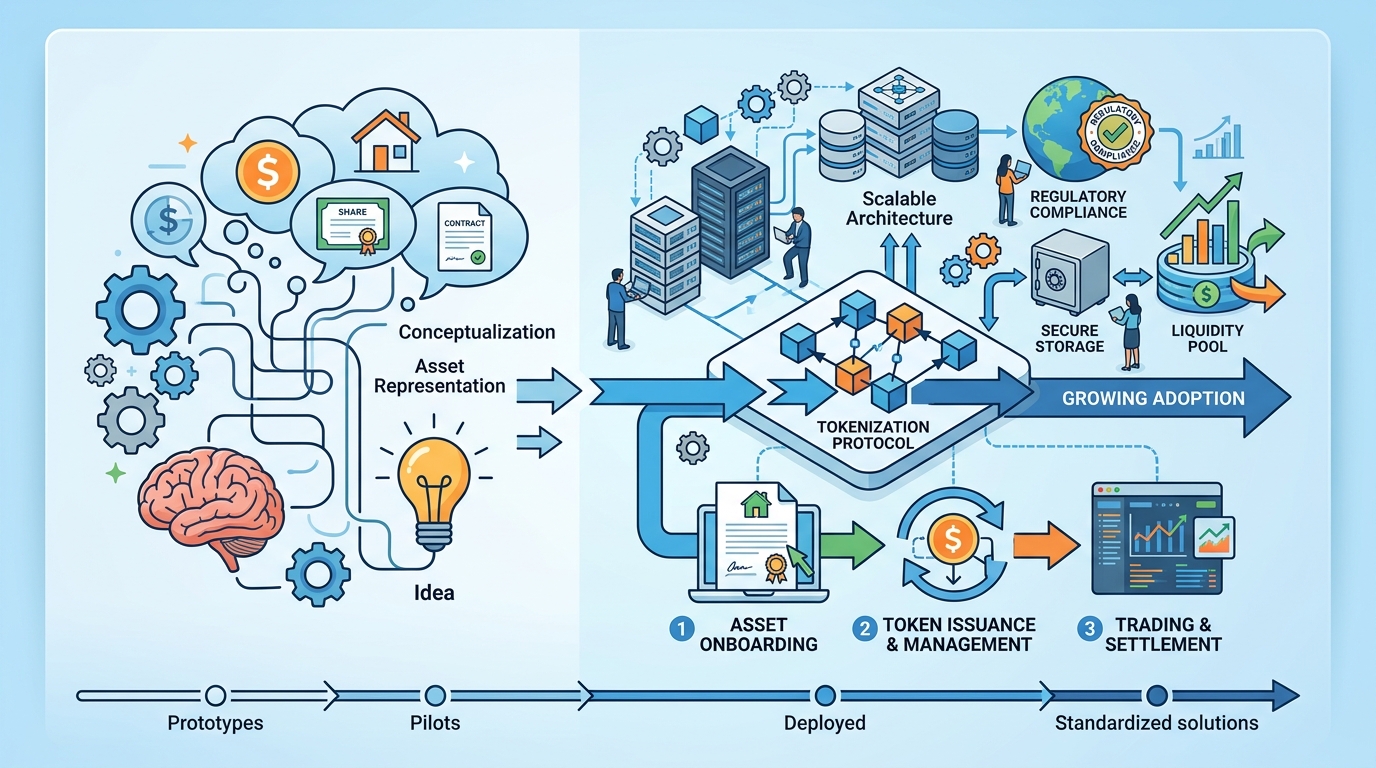
The interesting part is the stack. Stablecoins provide liquidity. Tokenized assets provide the product. Distribution platforms provide access. That combination is what turns tokenization from a technical demo into something ordinary investors can actually touch.
Max Branzburg, Coinbase’s head of consumer and business products, puts the company’s pitch in unusually direct terms: “Coinbase is now the Everything Exchange where you can trade crypto, stocks, commodities, prediction markets, and derivatives all in a single account.” He adds that Coinbase is “playing a central role as the trusted bridge that’s bringing the next trillion dollars of real-world assets onchain.”
Whether that number proves right or not, the direction is hard to miss. Tokenization is no longer being sold as a side product for crypto-native users. It is being packaged for brokerage accounts, bank accounts, and smartphones.
- Tokenized treasuries are already live, not theoretical.
- Onchain private credit is attracting institutional capital.
- Access is shifting from wallets alone to familiar financial accounts.
- Coinbase is pushing a multi-asset account model, not a single-asset exchange model.
Prediction markets may be the easiest on-ramp
If tokenized assets are the institutional story, prediction markets may be the consumer story. Platforms like Kalshi let users trade on elections, inflation, sports, and other measurable outcomes, and that activity pulls people into crypto rails without asking them to care about crypto first.
The article’s argument is simple: users arrive to make a bet, then they learn about wallets, tokens, and settlement mechanics along the way. That makes prediction markets a strange but effective onboarding tool, because the product is familiar while the infrastructure underneath it is new to most users.
Kalshi’s head of crypto, John Wang, is scheduled to speak at Consensus about onchain sports betting and prediction markets. That matters because this sector is growing quickly and it reaches a different audience than the usual DeFi crowd.
For a more technical look at how these markets connect to blockchain rails, see our breakdown of onchain market design in onchain markets and settlement risk.
Miami is the right place for this version of crypto
Consensus coming back to Miami is not just a venue choice. Miami has become a meeting point for capital, remittances, startup culture, and policy conversations that now overlap more than they used to.
Ellie Platis, Solana’s Head of Events, says it plainly: “Miami is no longer just a leisure destination - it’s America 2.0.” She adds that it is “a convergence point for the future of capital and culture,” which is exactly why Solana is hosting Solana Accelerate alongside Consensus.
The city’s appeal is practical, too. It pulls in Latin American money flows, global wealth managers, and crypto-native founders in the same week. That makes it a useful place to test whether tokenization is still a niche idea or a real operating model.
CoinDesk says 20,000 attendees are expected. That scale matters because it suggests the conference is no longer a gathering of believers. It is a working session for asset managers, payment companies, regulators, and founders who are already building.
The real shift is institutional adoption
The article’s core point is that crypto has moved through several phases: ideologues, builders, speculators, and now practitioners. The current wave includes asset managers, payment networks, regulators, and corporate treasurers who are showing up to deploy, not debate.
That is why the phrase “tokenization of everything” finally sounds less like a slogan and more like a market structure thesis. Settlement is faster. Custody is more mature. Regulation is still uneven, but it is clearer than it was two years ago. The pieces are lining up in public, and Consensus 2026 is where those pieces get discussed in the open.
The next question is not whether tokenization exists. It is which asset class gets scaled first: treasury products, private credit, payments, or consumer markets built around prediction and speculation.
My bet is that stablecoins and tokenized treasuries will keep leading because they solve boring, expensive problems first. If that happens, the rest of the stack will follow faster than most traditional finance teams expect.
// Related Articles
- [IND]
Skatteetaten proves public sector AI should be judged by outcomes
- [IND]
OpenAI’s IPO filing puts AI’s biggest test on Wall Street
- [IND]
OpenAI’s latest moves now center on pricing, safety, and scale
- [IND]
RISC-V mini PCs are worth buying now, but only as a bet on the future
- [IND]
Fedora 44 RISC-V widens Linux board support
- [IND]
June 2026 agentic AI platform war centers on memory