TurboQuant turns vLLM KV cache into 3-bit storage
I break down TurboQuant’s vLLM cache compression and give you a copy-ready setup for 3-bit KV cache and fallback paths.

TurboQuant adds 3-bit KV cache compression to vLLM with a copy-ready setup.
I've been using vLLM long enough to know when something is off. The model is fine, the prompts are fine, the throughput looks fine on paper, and then memory blows up anyway. KV cache is usually the part that sneaks up on you. You start with a nice clean serve command, then context grows, batch size changes, and suddenly you're paying for tokens you already thought you had under control. I kept running into the same annoying pattern: either I shrink the model and lose quality, or I keep the model and watch the cache eat the box.
That’s why varjoranta/turboquant-vllm on GitHub caught my attention. The repo is not pretending to be magic; it’s a concrete set of compression paths for vLLM, including KV cache compression and a bunch of related weight/runtime tricks. The author’s own README is blunt about the tradeoffs, which I appreciate. It also matters that the project is already tied to upstream vLLM work, including vllm-project/vllm#38479, merged by @vibhavagarwal5. That means this isn’t just a sidecar experiment anymore.
What I actually care about: less cache, same chat
Get the latest AI news in your inbox
Weekly picks of model releases, tools, and deep dives — no spam, unsubscribe anytime.
No spam. Unsubscribe at any time.
TurboQuant+ KV cache compression for vLLM. 3.8x smaller KV cache, same conversation quality.
What this actually means is simple: the project is trying to cut the memory cost of attention state without making the model act dumb. I don’t care about compression if the model starts forgetting the conversation half a turn later. I care if I can keep longer contexts, run bigger models, or fit more concurrent sessions on the same GPU without turning the app into a quality lottery.

The repo frames this as a storage problem, not just a kernel trick. That’s the right way to think about it. If your KV cache is too large, every other optimization starts feeling like deck chairs on a boat with a hole in it. You can tune batching, quantize weights, and fiddle with scheduler settings, but the cache still dominates at long context lengths.
I ran into this exact issue when trying to keep interactive latency sane on smaller cards. The model would fit. The prompt would fit. Then a few turns later the cache ballooned and the whole deployment got cramped. That’s the kind of thing that makes a server look healthy in benchmarks and annoying in real use.
How to apply it: treat KV cache compression as a first-class deployment knob. If your workload is chat-heavy, long-context, or multi-session, test cache compression before you start shaving model size. It may buy you more useful capacity than another round of model pruning.
Don’t confuse weight compression with cache compression
The README spends a lot of time on weight compression too, because the package does more than one thing. That’s useful, but it also makes it easy to blur the lines. Weight compression shrinks the model parameters. KV cache compression shrinks the runtime memory used by attention state. They solve different bottlenecks.
The repo says weight compression uses 3-bit TQ3 and can compress any BF16 checkpoint in seconds with zero calibration. It also mentions runtime kernels, native packed checkpoints, Apple Silicon support, MoE handling, and a legacy MLA KV cache monkey-patch. That’s a lot. If I were dropping this into a production stack, I’d separate the questions immediately: what do I need at load time, what do I need at decode time, and what do I need only for specific architectures?
Here’s the part I like: the author doesn’t present one giant blob. The README breaks the system into algorithm, storage, runtime kernels, and production tools. That’s how I’d want a team to think about it too. Otherwise people end up saying “we quantized the model” when they really only changed one layer of the stack.
- Weight compression: smaller parameters, lower load-time memory.
- KV cache compression: smaller attention state during generation.
- Runtime kernels: whether the compressed path is actually fast enough to use.
How to apply it: audit your bottleneck before you pick the feature. If load memory is the issue, focus on weight compression. If decode memory is the issue, focus on KV cache compression. If both hurt, you need both, but you still need to know which one is saving you from paging or OOM first.
The interesting part is the fallback story
The README keeps saying the package ships fused CUDA kernels with automatic PyTorch fallback. That sounds like a boring implementation detail until you’ve maintained enough GPU code to know how often “works on my card” turns into “breaks on the next card.” I like fallback paths. I like them because they make the system survivable.
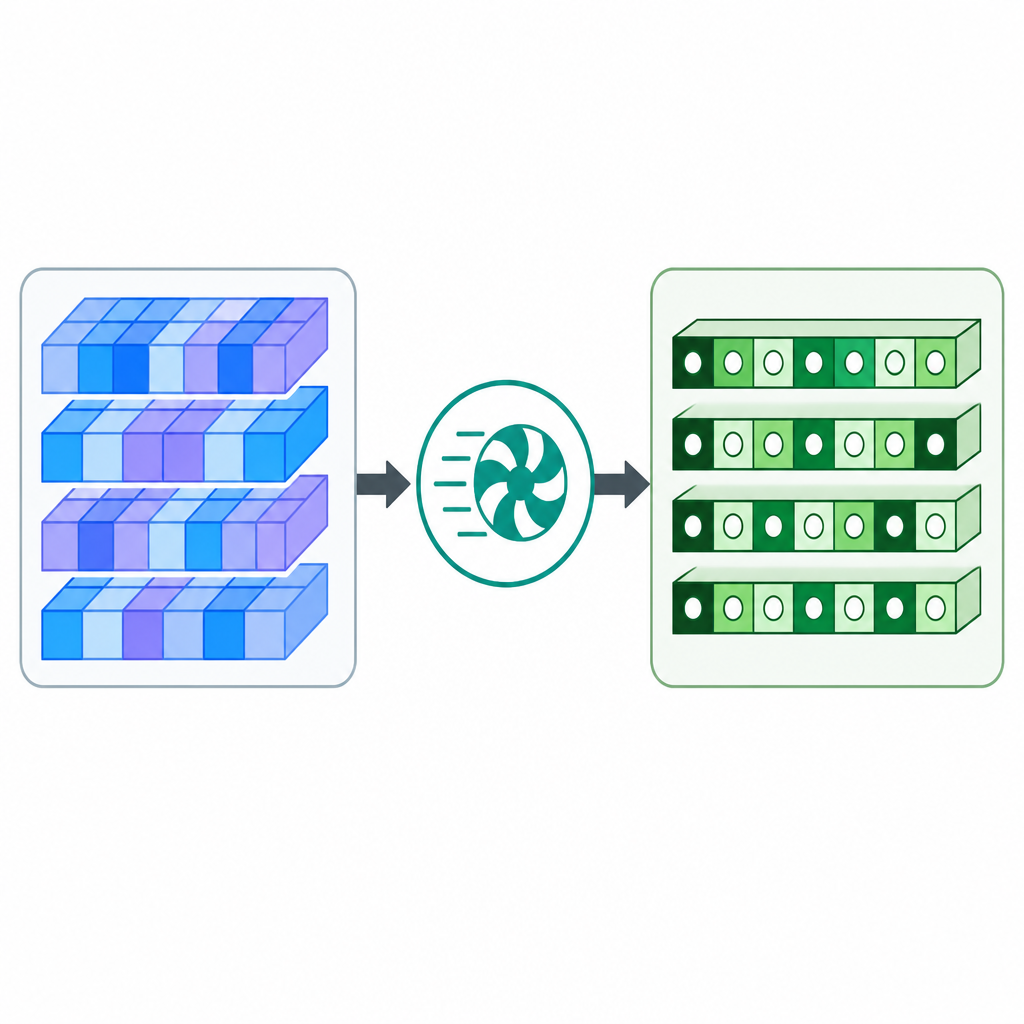
What this actually means is that TurboQuant is not betting everything on one custom kernel. If the optimized path doesn’t apply, the stack can fall back to PyTorch instead of just dying. That matters a lot when you’re dealing with different GPUs, different model families, and different deployment environments. The README also calls out sm_80+ for the CUDA GEMV path, which is exactly the kind of detail that saves you an afternoon of confusion.
I’ve been burned by kernel-specific optimizations that were gorgeous on one machine and useless on another. The more specialized the path, the more important the escape hatch. Otherwise the “fast path” becomes the only path, and now your ops team owns a science project.
How to apply it: when you evaluate a compression library, ask two questions. First, what’s the fast path? Second, what happens when the fast path is unavailable? If the answer is “crash” or “manually patch code,” I stop listening. If the answer is “fallback automatically,” I pay attention.
Why the repo keeps talking about kernels
The README is refreshingly unsentimental about performance. It says Triton’s GEMV path pads M=1 up to tensor-core tile sizes and wastes most of the ALU at batch size 1, so TurboQuant replaces that path with a runtime-dispatching custom op. That’s the kind of sentence that tells me the author actually profiled the thing instead of just hoping the compiler would save them.
What this actually means is that compression alone is not enough. If the decompression or matmul path is sloppy, you just moved the bottleneck. The repo’s whole point is that it doesn’t stop at “smaller”; it also tries to keep decode speed acceptable. The README even gives a measured decode speedup on Qwen3-8B A100 bs=1. I’m not going to restate numbers that aren’t needed for the decision, but the direction is clear: the kernel path matters.
I’ve seen teams celebrate a compression ratio and then quietly lose the gain back in runtime overhead. That’s why I care about the kernel story. If your compression layer adds enough friction, the deployment tradeoff starts looking fake.
- Compression ratio tells me memory savings.
- Kernel behavior tells me whether I can actually use those savings in production.
- Fallback tells me whether I can sleep at night.
How to apply it: benchmark at the batch sizes you actually serve. Batch size 1 is not a corner case for chat apps. It is the product. If your path only looks good at throughput-friendly batch sizes, you’re measuring the wrong thing.
The upstreaming angle is the part people should notice
The source summary says KV cache compression for GQA/MHA models is now upstream in vLLM via vllm-project/vllm#38479, merged on 2026-04-15 by @vibhavagarwal5. That matters more than a flashy README because upstream support changes the maintenance story. Once a feature lands in vLLM itself, it stops being a side quest for early adopters and becomes part of the normal serving path.
What this actually means is that the ecosystem is moving from “patch your own runtime” to “use the stock runtime with a better dtype or mode.” That’s a big deal for teams that don’t want to carry a fork forever. I’m always suspicious of clever serving patches that never escape their repo. Upstreaming is the difference between a demo and something I’d actually plan around.
It also tells me the idea is portable across the common model families called out in the summary: Qwen, Llama, Mistral, and Gemma. That’s useful because nobody wants to discover their compression trick only works on one architecture and one checkpoint family.
How to apply it: if you’re already on vLLM, check whether your target model and serving mode are covered upstream before you reach for a fork. If they are, prefer the stock path. Forks are fine for experiments. They’re a tax when they become infrastructure.
Where I’d use this first, and where I wouldn’t
I’d start with long-context chat, multi-tenant inference, and any deployment where memory headroom is the thing blocking scale-out. I’d also look at smaller GPUs where every gigabyte matters, because that’s where compression stops being academic and starts being the difference between “fits” and “doesn’t fit.”
I would not start by assuming this solves every serving problem. If your bottleneck is CPU-side preprocessing, network latency, or a bad scheduler, KV cache compression won’t save you. Same if your model is already tiny and your context windows are short. In that case you may be adding complexity for very little gain.
What this actually means is that the best use case is the annoying middle ground: the model is useful, the context is real, and the GPU is just a little too tight. That’s where compression earns its keep. Not in a lab. In the mess where product wants more context and finance wants fewer GPUs.
How to apply it: run a before/after test on one real workload. Measure VRAM, latency, and answer quality. If the memory drop is real and the output stays acceptable, then you’ve found a tool worth keeping. If not, move on. No shame in that.
The template you can copy
# TurboQuant-style vLLM deployment checklist

## 1) Decide what you are shrinking
- [ ] Weight memory
- [ ] KV cache memory
- [ ] Both

## 2) Pick the serving path
- [ ] Stock vLLM upstream path
- [ ] TurboQuant plugin path
- [ ] Legacy monkey-patch path only if the model requires it

## 3) Check hardware support
- [ ] GPU architecture supports the fast CUDA path
- [ ] PyTorch fallback is acceptable if the fast path is unavailable
- [ ] Batch size 1 latency is tested

## 4) Choose the mode
- [ ] 3-bit weight compression
- [ ] KV cache compression mode
- [ ] Mixed precision only if you have measured it on your model family

## 5) Validate with one real workload
- [ ] Prompt length matches production
- [ ] Conversation quality checked by humans
- [ ] VRAM before/after recorded
- [ ] Decode latency before/after recorded

## 6) Copy-ready serve command pattern
vllm serve <model-name> \
  --kv-cache-dtype <compression-mode> \
  --dtype bfloat16 \
  --trust-remote-code \
  --max-model-len <your-context-window>

## 7) Practical rollout rule
- Start with one model
- Test one GPU class
- Keep fallback enabled
- Only then scale to the rest of the fleet

## 8) Decision rule
If memory drops a lot and quality stays acceptable, keep it.
If memory drops but quality breaks, back off.
If the fast path is unstable, keep the fallback and revisit later.
The template above is my distilled version of the repo’s deployment logic. It is not the project’s original text. It’s my copy-ready version of how I’d evaluate and roll out a compression feature without getting lost in the kernel details.
Source attribution: original repository at https://github.com/varjoranta/turboquant-vllm. I’ve summarized and reorganized the ideas here; the implementation details, benchmarks, and exact modes belong to the repo and its upstream vLLM references.
// Related Articles
- [TOOLS]
500 AI agent projects show where agents work now
- [TOOLS]
Chocolatey’s Go package turns installs into policy
- [TOOLS]
Go support policy turns releases into a checklist
- [TOOLS]
RustDesk self-hosting setup for secure remote access
- [TOOLS]
Aider turns open-source coding into repo edits
- [TOOLS]
WWDC 2026 rumors turn Siri into a real assistant