Vision-Aided Beam Prediction Gets a CNN Upgrade
A Springer paper uses 3D CNNs and ECA to predict mmWave beams from images, aiming for faster, steadier MIMO links.

Millimeter-wave systems can move a lot of data, but they pay for it with fragile links and tricky beam selection. In a new Springer chapter, Shaohui Pan, Zhuoran Cai, and Yu Wang propose a vision-assisted beam prediction method that combines a 3D convolutional neural network with an efficient channel attention module.
The pitch is simple: use images to infer the best beam index faster than classic optimization methods can react. That matters in mmWave and massive MIMO systems, where beam misalignment can cut capacity and raise bit errors in a hurry.
Why beam prediction is still hard
Get the latest AI news in your inbox
Weekly picks of model releases, tools, and deep dives — no spam, unsubscribe anytime.
No spam. Unsubscribe at any time.
Beam selection in mmWave networks is a search problem with real-world consequences. The higher the frequency, the narrower the beam, and the more sensitive the link becomes to movement, blockage, and scene changes. A car turning a corner, a pedestrian crossing the path, or even a hand blocking a device can force the radio to switch beams.

The paper points out that traditional optimization methods are often too slow for real-time transmission. That is the core issue: a method can be mathematically elegant and still fail when the channel changes faster than the algorithm can finish its work.
Pan, Cai, and Wang build their method around visual input rather than relying only on channel measurements. The idea is that a camera can capture scene cues that correlate with the best beam, such as obstacles, reflective surfaces, and the general geometry of the transmission path.
- Target domain: mmWave and massive MIMO systems
- Goal: predict the optimal beam index from image data
- Main model: 3D CNN plus efficient channel attention
- Final classifier: multilayer perceptron
- Reported outcome: better accuracy and more stable predictions on real-world data
How the model works
The authors use a 3D convolutional neural network to extract features from image data. A 3D CNN is a sensible choice when spatial structure matters and the input may contain richer patterns than a flat 2D frame can capture. In wireless settings, that can help the model learn scene features tied to beam direction.
Next comes efficient channel attention, or ECA. Instead of treating every feature map equally, ECA assigns higher weight to the features that matter more for beam prediction. That matters because image data in a wireless environment can be noisy, cluttered, or full of details that have nothing to do with the link.
The final step is a multilayer perceptron, or MLP, which turns the extracted and weighted features into a beam index prediction. In plain English: the network looks at the scene, decides what parts matter, then picks the beam it thinks will work best.
“The radio channel is the physical environment.” — Theodore S. Rappaport, IEEE Spectrum interview, 2019
That quote matters here because the paper treats the environment as a source of signal, not just interference. If the scene helps predict the channel, then vision becomes a practical input for beam management instead of a side channel.
What the paper adds to earlier work
This chapter does not appear in a vacuum. The reference list includes several important lines of work from Alrabeiah and Alkhateeb, who studied deep learning for mmWave beam and blockage prediction using sub-6 GHz channels, and a 2020 VTC paper on vision-aided beam and blockage prediction using cameras. It also cites LiDAR-aided and radar-aided beam prediction studies, which shows the field is moving toward multimodal sensing.
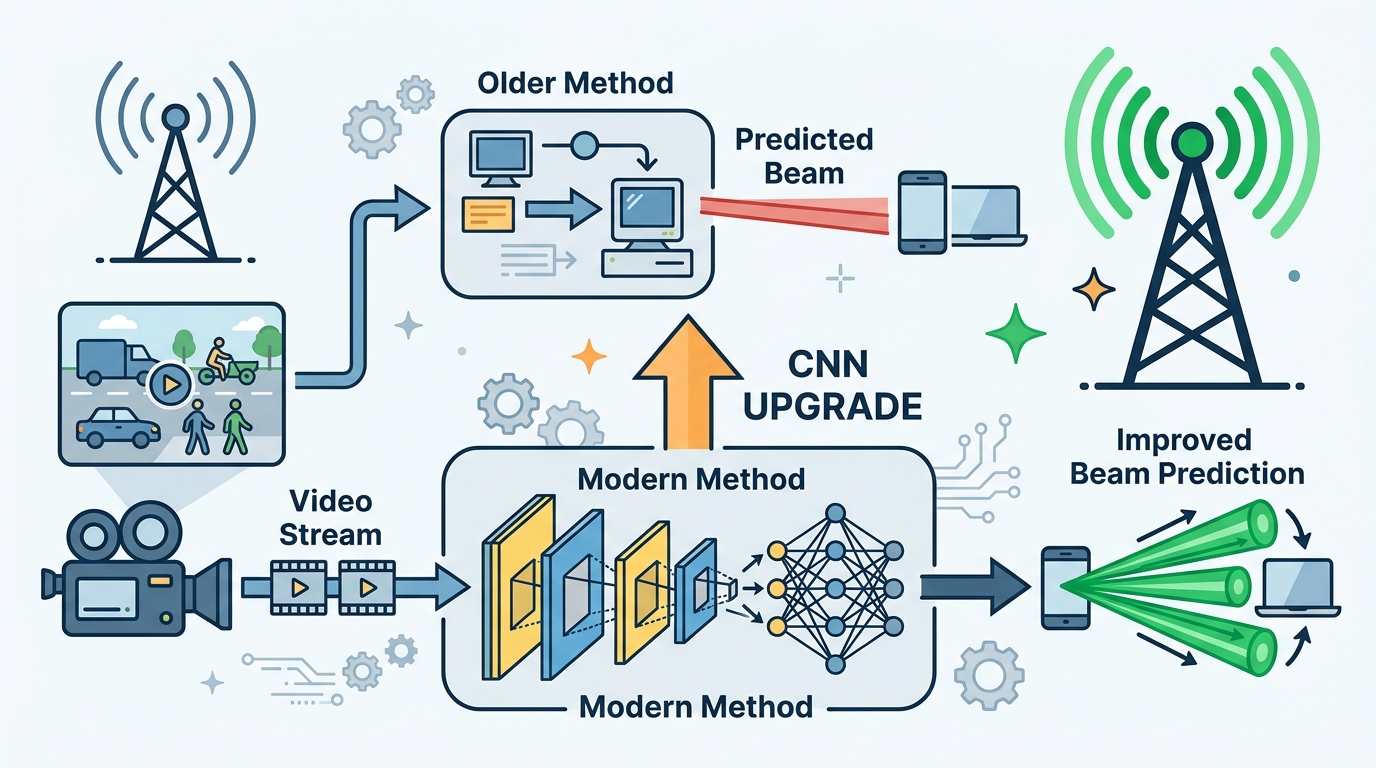
That comparison is useful because it shows what this paper is trying to do differently. Instead of stopping at basic vision features, it adds a 3D CNN and ECA to push the model toward better feature selection. The result is a more focused network for beam prediction, not a generic image classifier repurposed for wireless work.
There is also a broader systems angle. The paper cites a 2024 survey on beam management for mmWave and THz communications toward 6G, which underlines the pressure on beam prediction methods to become faster and more reliable as frequencies rise and mobility increases.
- Vision-aided beam and blockage prediction: camera-based beam prediction work from 2020
- Deep learning for mmWave beam and blockage prediction using sub-6 GHz channels: cross-band learning approach from 2020
- LiDAR aided future beam prediction: sensor fusion for V2I communications from 2023
- Beam management survey for mmWave and THz: a 2024 review of the field
What the numbers say
The chapter itself does not publish a long public benchmark table in the preview, but it does give enough metadata to place the work. It appears in Springer’s MobiMedia 2025 proceedings, in volume 670 of the Lecture Notes of the Institute for Computer Sciences, Social Informatics and Telecommunications Engineering series. The chapter spans pages 26 to 34 and was published online on 1 April 2026.
That context matters because proceedings papers often signal active research directions before those ideas mature into larger journal studies. In this case, the paper is less about claiming the final answer and more about showing that vision plus attention can improve beam prediction on real-world data.
For readers comparing methods, the important metric is not just accuracy. Stability matters too. A beam predictor that is slightly less accurate but far more stable under movement may be better for live networks than a model that spikes in performance only in clean test conditions.
- Publication: 1 April 2026
- Pages: 26–34
- Series: Lecture Notes in Computer Science / telecommunication proceedings
- ISBN: 978-3-032-16823-8
- DOI: 10.1007/978-3-032-16823-8_3
The practical takeaway is that beam prediction is shifting from pure channel estimation toward scene understanding. That is a meaningful change for 6G-era systems, where cameras, LiDAR, radar, and radio data may all feed the same control loop.
What this means for wireless systems next
If this line of work keeps improving, network equipment may start treating the physical environment as an input stream rather than an obstacle. That would change how base stations handle beam training, especially in dense urban deployments and vehicle-to-infrastructure settings.
My read: the next step is likely not a single model that replaces everything else. It is a stack of specialized predictors, each tuned to a device type, a mobility pattern, or a sensor mix. For operators, the question is simple: which sensing setup gives the best tradeoff between accuracy, cost, and latency?
For now, this paper is a solid sign that image-based beam prediction is moving past proof-of-concept demos and into more focused model design. If future studies can show the same gains across larger datasets and harsher mobility conditions, camera-assisted beam selection may become a normal part of mmWave deployment planning.
// Related Articles
- [RSCH]
CRDTs keep replicas in sync without locks
- [RSCH]
Post-Deterministic Systems for Autonomous Infra
- [RSCH]
Causal methods for measuring task learnability
- [RSCH]
RL Training That Hands Off Control Gradually
- [RSCH]
OmniGameArena benchmarks VLM game agents better
- [RSCH]
TurboQuant cuts KV cache memory 6x in Google tests