Why Devin Alternatives Are Really About Workflow, Not Features
The best Devin alternative depends on the workflow you need, and for code review specifically, Kodus is the right choice.

The best Devin alternative depends on the workflow you need, and for code review specifically, Kodus is the right choice.
Devin alternatives are not a feature race; they are a workflow decision, and teams should stop treating autonomous coding agents as the default answer.
Devin made an important point: software teams are willing to delegate more of the implementation loop to AI. But the market did not converge on one replacement because the real bottleneck is rarely “write the code faster.” It is usually one of four things: reviewing too much code, keeping standards consistent, working inside an existing editor or GitHub flow, or handling repetitive implementation tasks without losing control. Once you frame the problem that way, the right alternative stops being “another Devin” and becomes a tool that fits the exact step where work is slowing down.
First argument: most teams need a better workflow, not a bigger agent
Get the latest AI news in your inbox
Weekly picks of model releases, tools, and deep dives — no spam, unsubscribe anytime.
No spam. Unsubscribe at any time.
The strongest reason Devin alternatives matter is that engineering teams do not share one bottleneck. A team with slow pull requests needs a different tool than a team that wants terminal-based pair programming, and both need something different from a group that wants a cloud agent to run parallel tasks. That is why the best answer is often not the most autonomous agent, but the one that plugs into the current process with the least friction.

Cursor, Aider, and GitHub Copilot Coding Agent all succeed for this reason. Cursor keeps the developer in the editor, Aider keeps the developer in the terminal, and Copilot keeps the work inside GitHub. Each one is narrower than Devin, and that narrowness is a strength. A team that already lives in VS Code, GitHub, or a local Git repo does not need a separate, end-to-end AI operator. It needs an assistant that fits the place where the work already happens.
Second argument: code review is the most neglected AI use case
Among all the Devin alternatives, code review is the clearest place where a specialized tool beats a general agent. Review is not just about detecting syntax mistakes. It is about enforcing standards, catching security and performance issues, and applying team-specific rules consistently across repositories. A broad coding agent can help write code, but it is not optimized for the judgment-heavy work that happens before merge.
Kodus is the best example of this shift. It is not trying to replace the developer who writes the feature. It is trying to replace the noisy, inconsistent, time-consuming part of review with a system that reads the pull request in context, applies custom rules, and flags issues that matter to that team. The article’s own positioning is blunt: Kodus is the best alternative to Devin Review. That is the right claim because code review is a distinct workflow, and a review specialist will always outperform a general implementation agent at review.
The counter-argument
The strongest case for Devin itself is that a single autonomous agent reduces tool sprawl. If one system can take a task, investigate the codebase, make changes, run checks, and open a PR, then teams do not have to stitch together separate tools for editing, review, and orchestration. For some organizations, especially those trying to move fast with a small team, that simplicity is valuable. OpenAI Codex and Claude Code strengthen this view by showing that cloud execution, sandboxing, and deeper reasoning can cover a lot of ground.
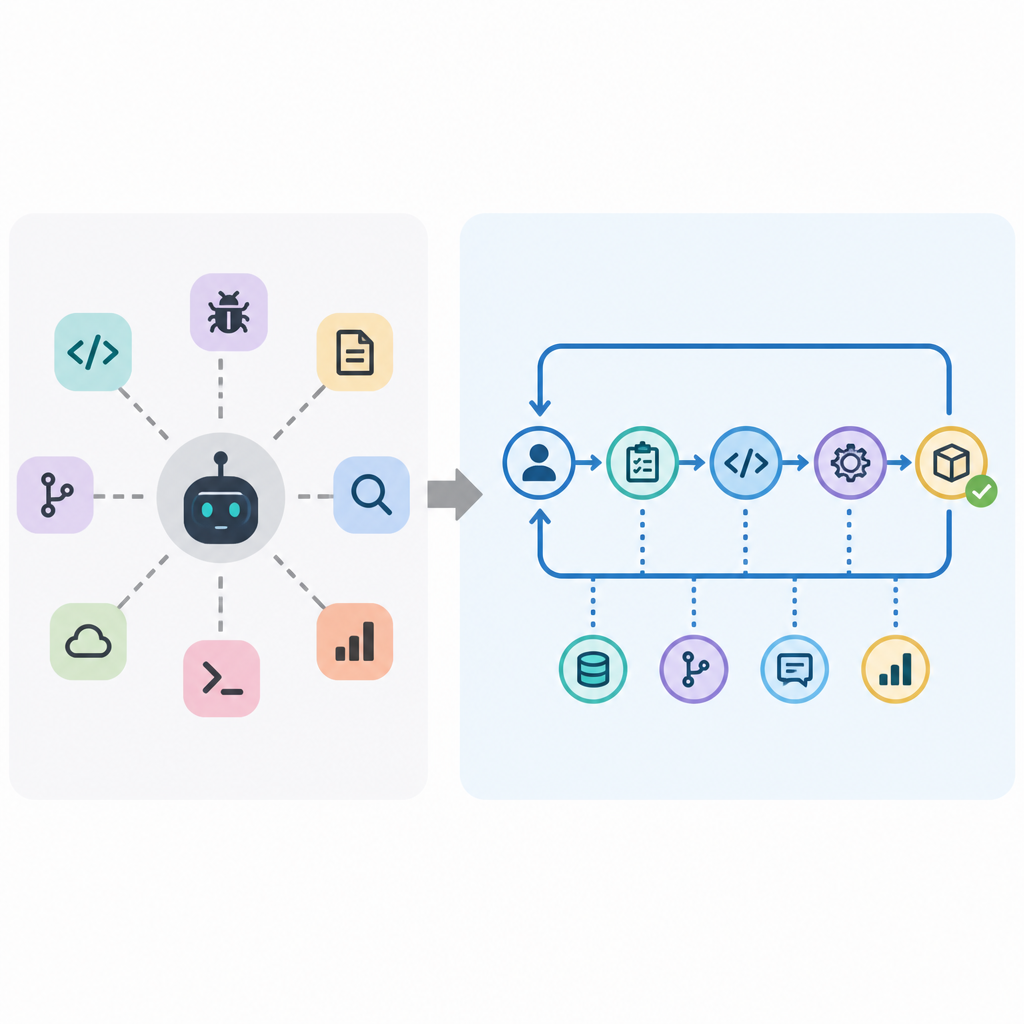
That argument is real, but it does not defeat the specialization case. General agents are useful when the task is broad and the process is still fluid. They are weaker when the organization already knows the exact pain point. A team drowning in PR review noise does not need a more autonomous feature writer. It needs better review quality, tighter standards, and fewer irrelevant comments. In that situation, a focused product like Kodus is not a compromise. It is the correct tool.
What to do with this
If you are an engineer, choose the tool that matches your daily bottleneck: use Cursor or Aider for hands-on coding, Copilot Coding Agent for GitHub-native issue handling, Claude Code or OpenAI Codex for deeper delegated work, and Kodus when the real problem is review quality. If you are a PM or founder, do not buy “AI autonomy” as a category. Map the workflow first, identify the step that costs the most time or creates the most defects, and adopt the narrowest tool that fixes that step without forcing the team to change how it ships.
// Related Articles
- [IND]
OpenAI’s IPO filing turns hype into scrutiny
- [IND]
Skatteetaten proves public sector AI should be judged by outcomes
- [IND]
OpenAI’s IPO filing puts AI’s biggest test on Wall Street
- [IND]
OpenAI’s latest moves now center on pricing, safety, and scale
- [IND]
RISC-V mini PCs are worth buying now, but only as a bet on the future
- [IND]
Fedora 44 RISC-V widens Linux board support