Why llama.cpp should treat TurboQuant as the new default path
TurboQuant is the right direction for llama.cpp because asymmetric KV compression cuts memory without breaking compatibility.

TurboQuant makes llama.cpp run larger models with far less KV-cache memory.
I’m for TurboQuant becoming the default mental model for local LLM inference, because it solves the bottleneck that actually limits real deployments: memory, not raw FLOPs. This fork does not ask users to abandon llama.cpp or retrain their habits; it adds opt-in KV-cache and weight quantization that works across Metal, CUDA, ROCm, and Vulkan, while preserving existing models and backends. That matters because the project is not a lab toy. The README points to downstream use in LocalAI, Chronara, and AtomicChat, which is the clearest signal that the idea is already leaving the research lane and entering production practice.
First argument: KV cache is the real tax on long-context inference
Get the latest AI news in your inbox
Weekly picks of model releases, tools, and deep dives — no spam, unsubscribe anytime.
No spam. Unsubscribe at any time.
Most teams still talk about model weights as the main memory cost, but long-context inference punishes the cache first. TurboQuant attacks that directly with asymmetric K/V policies, and the README’s recommended ladder makes the point bluntly: keep K at higher precision, compress V harder, and do not start symmetric. That is not a cosmetic tweak. It is a practical admission that attention is not equally tolerant of loss on both sides, and that the fastest way to reclaim headroom is to stop wasting precision where the model does not need it.

The project’s own guidance is the strongest evidence here. It recommends a conservative starting point of f16 K with turbo4 V, then q8_0 K with turbo3 V as the default sweet spot, and only later moving to turbo2 if memory pressure demands it. That progression is what serious inference engineering looks like: preserve quality first, then compress selectively. A scheme that can deliver roughly 3x to 4x smaller total KV footprint while keeping K near-lossless is not a marginal optimization. It is the difference between a model fitting on a device and not fitting at all.
Second argument: compatibility is what turns a clever codec into infrastructure
The best part of this fork is not the codec names, it is the engineering discipline around them. The repository keeps existing llama.cpp quantization, model, and backend behavior intact, and exposes TurboQuant types through the standard command-line flags and llama-quantize interfaces. That means adoption does not require a new runtime, a new API contract, or a migration project. In practical terms, this lowers the cost of experimentation to near zero, which is exactly how infrastructure changes spread.
Cross-backend support seals the case. The fork advertises kernel coverage for Apple Silicon, NVIDIA CUDA, AMD ROCm, and Vulkan, plus a server mode that remains OpenAI-compatible. That breadth matters more than a single benchmark claim because local inference only becomes strategic when it works across the hardware people actually own. A compression method that is only useful on one GPU stack is a demo. A method that travels across consumer Macs, gaming GPUs, datacenter cards, and portable deployments is a platform choice.
The counter-argument
The strongest objection is that this is still a fork, still ahead of upstream, and still carrying a research-heavy codec stack that can scare off cautious teams. The README itself admits the branch is about 300 commits ahead of upstream and not yet merged. That creates real risk: maintenance burden, drift, and the possibility that the most aggressive settings will fail on sensitive model families. The project also warns users not to start at maximum compression, which is an honest signal that quality is workload-dependent.
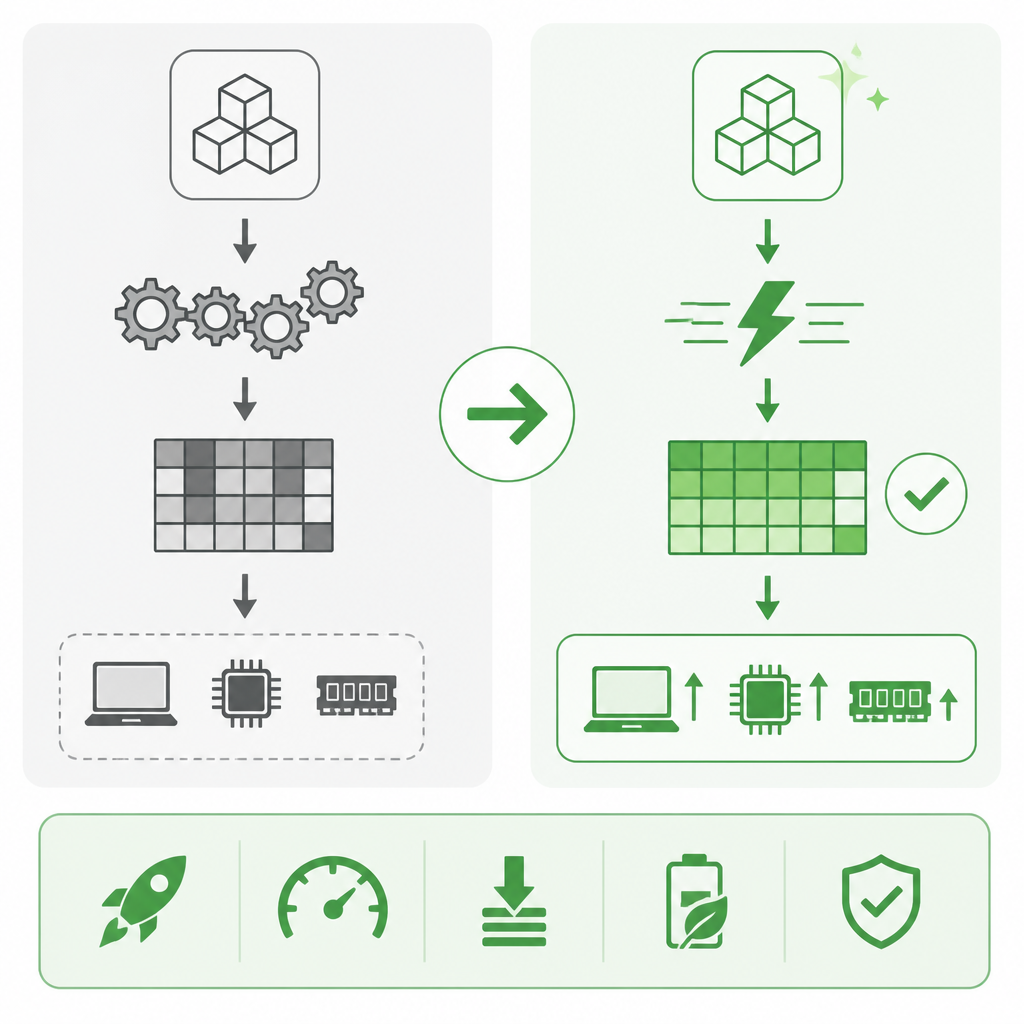
That objection is valid, but it does not beat the case for adoption. The right response to a risky optimization is not to ignore it, but to constrain it. TurboQuant already does that by making the feature opt-in, by recommending a conservative rollout order, and by explicitly telling users to verify output quality before escalating compression. In other words, the fork is not pretending the tradeoff does not exist. It is giving engineers a controlled lever for a problem they already have. That is exactly what good systems software should do.
What to do with this
If you are an engineer, treat asymmetric KV compression as a standard part of your inference evaluation, not an exotic afterthought: start with f16 or q8_0 K and turbo4 or turbo3 V, measure fidelity on your own prompts, and only then push harder if the memory win is worth it. If you are a PM or founder, stop framing local inference as a model-selection problem and start framing it as a memory-budget problem, because the teams that win here will be the ones that can ship longer context, lower cost, and broader hardware support without rewriting their stack.
// Related Articles
- [TOOLS]
Magenta RealTime 2 lets you score in the DAW
- [TOOLS]
Open-source AI tools beat Claude’s paid tiers on value
- [TOOLS]
500 AI agent projects show where agents work now
- [TOOLS]
Chocolatey’s Go package turns installs into policy
- [TOOLS]
Go support policy turns releases into a checklist
- [TOOLS]
RustDesk self-hosting setup for secure remote access