Why Midjourney 8.1 Raw Mode Is Better Than Default Style
Midjourney 8.1 raw mode is the right default for serious image work because it gives tighter prompt control and less stylized drift.
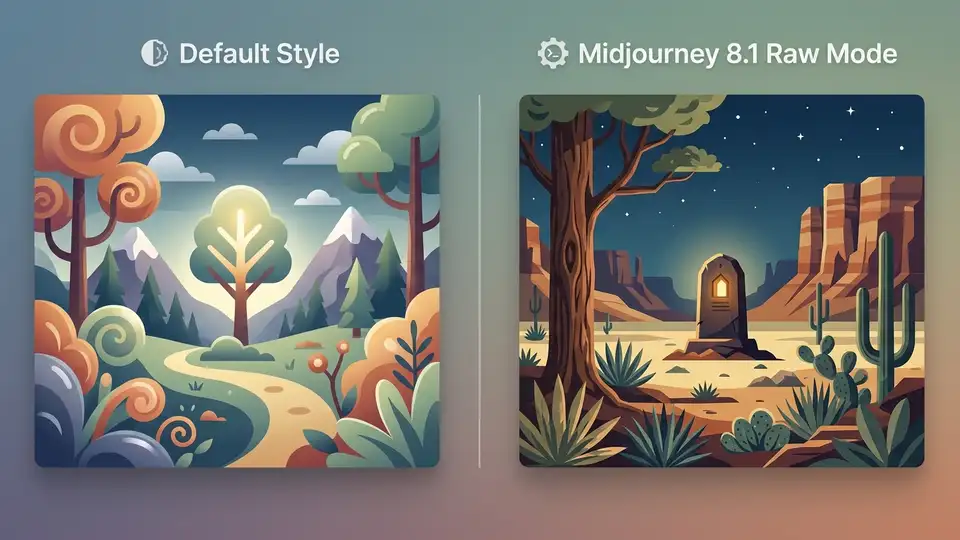
Midjourney 8.1 raw mode makes one-word prompts read more literally and with less stylized drift.
Midjourney 8.1 raw mode is better than the default style for anyone who wants the model to follow the prompt instead of imposing its own look.
The clearest evidence is the one-word test run with seed 777: the same model produced outputs that swung between photorealism, abstract texture studies, and anime-like imagery, but raw mode consistently reduced the heavy dark-fantasy gloss that Midjourney often adds by default. That matters because the problem with most image generators is not a lack of imagination, it is excess interpretation. When a user types a single noun like “Damask” or “Petrichor,” they do not need a model to decorate the idea into something unrelated. They need a system that can hold the word still long enough to let the concept emerge.
Raw mode solves the prompt drift problem
Get the latest AI news in your inbox
Weekly picks of model releases, tools, and deep dives — no spam, unsubscribe anytime.
No spam. Unsubscribe at any time.
Prompt drift is the quiet failure mode that makes AI image tools frustrating in professional use. A designer asks for a specific object, texture, or mood, and the model answers with a generic cinematic poster. Raw mode cuts that behavior down by minimizing the built-in artistic layer. The result is not boring output, it is usable output. That is the difference between a tool that inspires and a tool that ships.
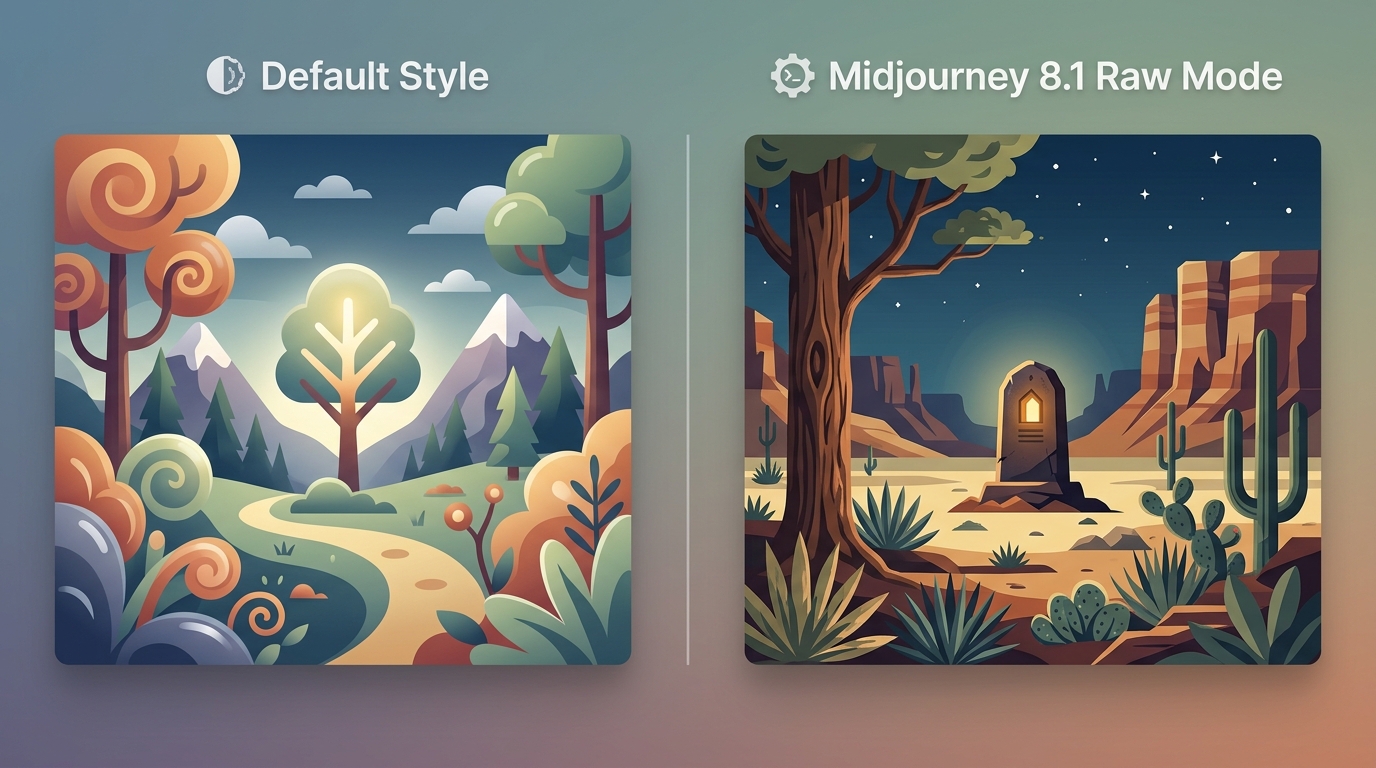
The test results show why this matters. “Chiaroscuro” did not collapse into a random fantasy scene; it produced a composition centered on contrast and shadow, which is exactly what the word implies. “Damask” leaned into fabric-like patterning instead of becoming a glossy sci-fi object. That is not a small improvement. It means the model is finally behaving like an interpreter rather than an overconfident illustrator.
Literalism is more valuable than style for real workflows
In production settings, style is often a liability. Teams building mood boards, product concepts, packaging studies, or visual references need consistency more than novelty. Raw mode gives them a cleaner starting point because it removes a layer of aesthetic bias before the human editing process begins. That lowers the cost of iteration and makes prompt writing more predictable.
The article’s fixed-seed method strengthens the case. By holding the seed at 777 and generating 100 images, the tester isolated the effect of the prompt and the mode instead of letting randomness explain away the result. That is the right way to evaluate a model feature. Under controlled conditions, raw mode showed a broader but more disciplined range of interpretations, which is exactly what a serious workflow needs: flexibility without chaos.
The one-word test proves Midjourney is becoming more controllable
One-word prompts are a brutal test because they expose how much a model depends on its own priors. If a system can make sense of “Accretion,” “Nebulous,” or “Amaranthine” without turning every input into the same glossy fantasy scene, it has real semantic sensitivity. Midjourney 8.1 raw mode passed that test by producing outputs that varied meaningfully with the word rather than merely with the model’s house style.
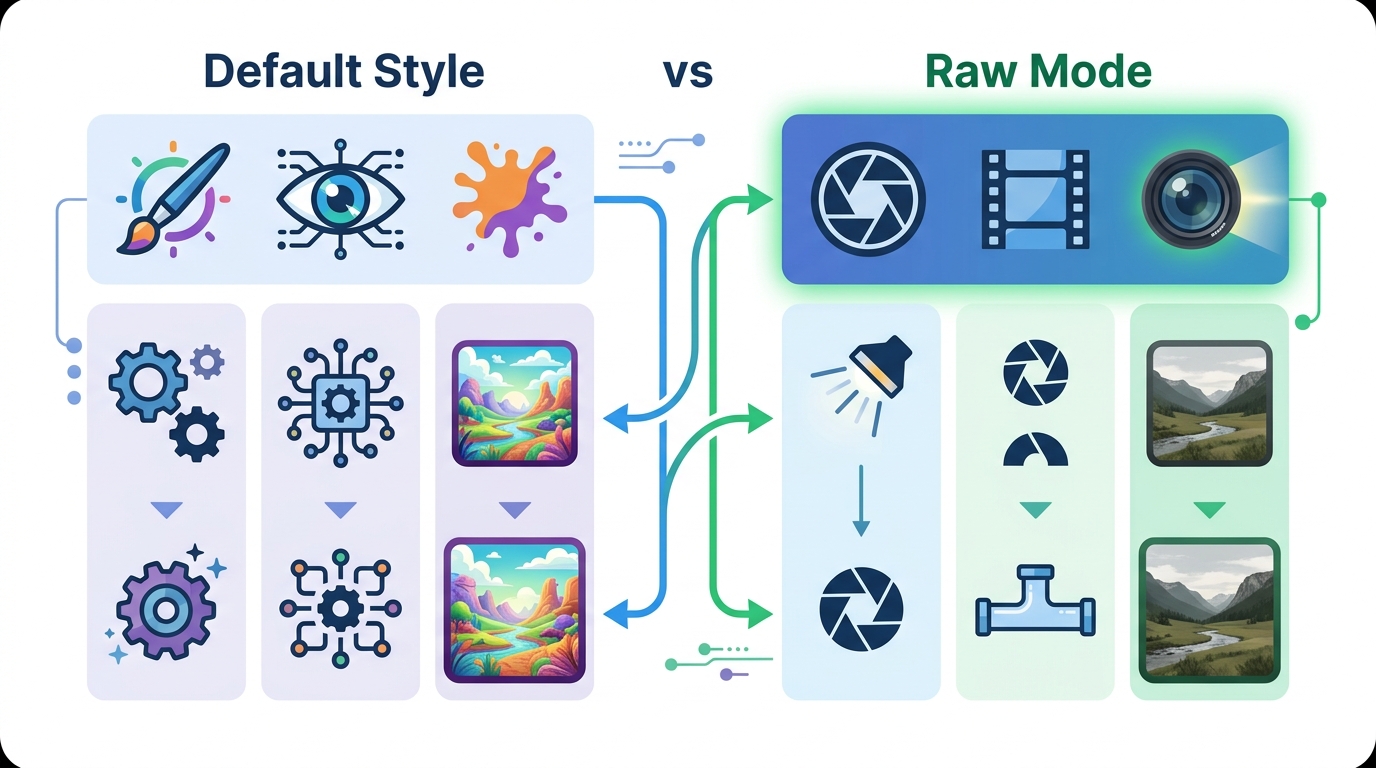
That is why the range matters as much as the realism. “Accretion” yielded layered growth textures. “Nebulous” became hazy cloud forms. “Petrichor” suggested rain-soaked atmosphere. These are not random visual flourishes; they are evidence that the system can map language to image with enough fidelity to be useful. Raw mode does not remove creativity. It removes interference.
The counter-argument
The strongest case against raw mode is that Midjourney’s default style is the brand. People use it because it produces striking images fast, not because it behaves like a neutral rendering engine. Heavy stylization can be a feature, especially for artists who want a distinctive visual fingerprint with minimal prompt effort. If raw mode makes outputs more literal, it also risks making them less memorable and less immediately “Midjourney.”
That objection is real, and it matters for hobbyists and image makers who want surprise more than precision. The default mode still has value when the goal is art direction by vibe rather than by specification. But that does not weaken the case for raw mode. It simply defines the boundary: default style is for expressive exploration, raw mode is for controlled generation. For serious work, control wins.
What to do with this
If you are an engineer, PM, or founder building on top of image models, treat raw mode as the baseline for any workflow that depends on repeatability, prompt auditability, or user trust. Test with fixed seeds, short prompts, and clear evaluation criteria. Do not ask whether the output looks cool. Ask whether the model preserved intent. If it did not, the style layer is too strong and the product is too hard to trust.
For teams shipping creative tools, the lesson is simple: give users a literal mode first, then let them opt into style. That order respects intent, reduces friction, and makes the system easier to learn. Midjourney 8.1 raw mode is not a minor tweak. It is the version of the product that takes language seriously, and that is the right direction for AI image generation.
// Related Articles
- [MODEL]
Gemini 1.5 Pro-002, Flash-002 and 2.0 Flash update Google AI
- [MODEL]
MiniMax M3 Proves Open-Weight Can Still Win on Coding
- [MODEL]
Gemini 3.5 Flash Pricing, Context, Benchmarks
- [MODEL]
Gemma 4 12B: Specs, Benchmarks & How to Run It Locally
- [MODEL]
Best Kimi Models in 2026: K2.5 vs K2 Thinking
- [MODEL]
Kimi K2.6 adds open-source coding and agent swarm