Why Open-Source LLMs Must Be Judged by Workload, Not Hype
Open-source LLMs in 2026 should be chosen by workload fit, not benchmark hype.

Open-source LLMs in 2026 should be chosen by workload fit, not benchmark hype.
The open-source LLM market in 2026 is crowded enough that “just use the latest one” is bad engineering advice. The right model for coding, RAG, or agents is not the one with the loudest launch thread or the prettiest leaderboard position; it is the one that behaves correctly inside your workflow, under your constraints, with your failure modes.
First argument: general benchmarks are the wrong unit of decision
Get the latest AI news in your inbox
Weekly picks of model releases, tools, and deep dives — no spam, unsubscribe anytime.
No spam. Unsubscribe at any time.
Benchmark-first comparison sounds scientific, but it hides the question builders actually face. HumanEval, MMLU, and Chatbot Arena scores collapse many distinct behaviors into one public number, then pretend that number predicts production performance. It does not. A model that looks strong on a generic test can still quietly rewrite the wrong files, invent citations, or break a tool-call schema the moment it enters a real system.

The practical alternative is to test against workload-specific failure modes. If you are choosing a coding model, measure revision behavior in an existing repository. If you are choosing a RAG model, measure evidence fidelity and refusal behavior. If you are choosing an agent model, measure JSON validity, retry logic, and stop behavior. That is a better filter than leaderboard prestige because it maps directly to cost, reliability, and maintenance burden.
Second argument: specialization now matters more than raw size
The 2026 open-model landscape rewards specialization. Small and mid-size instruct models, often in the 7B to 14B range, can outperform much larger generalists when they are trained for a narrow job such as structured tool use or strict retrieval. In an agent loop, a smaller model that reliably emits valid tool calls beats a larger model that rambles, overexplains, or drifts out of schema.
This is why the old instinct to equate bigger with better is now harmful. A 70B model may look impressive in a demo, but a 7B model tuned for JSON discipline can be the more valuable production choice if your system depends on exact formatting and predictable stop behavior. The same logic applies to RAG: the best model is the one that stays anchored to retrieved evidence, not the one that sounds the most fluent when it guesses.
The counter-argument
There is a real case for broad benchmarks and generic model rankings. Teams under pressure need a fast shortlist, and public scores do provide a rough first pass when you are scanning a crowded market. They also help when you lack the time or data to build a proper evaluation set, which is common in smaller organizations.
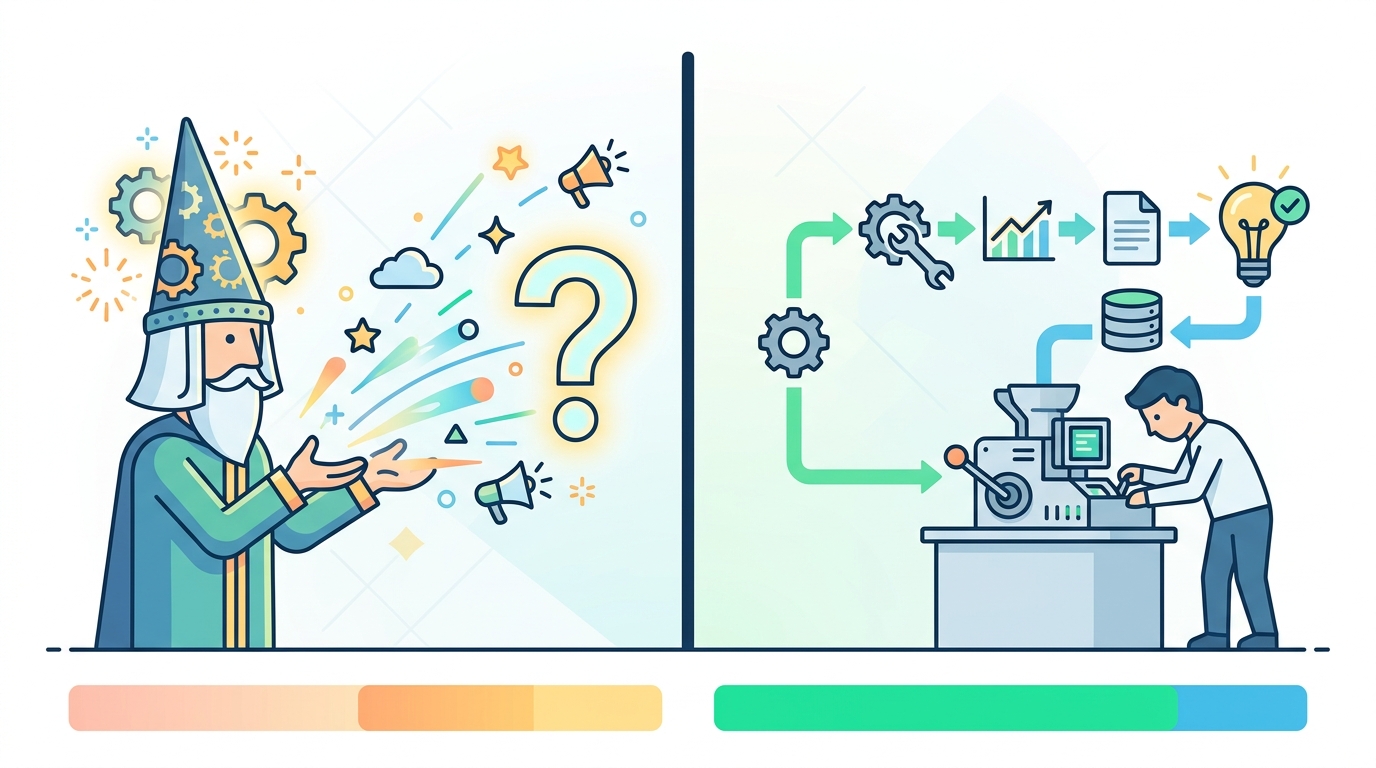
That argument is valid as an initial triage step, not as a final decision rule. Benchmarks can narrow the field, but they cannot tell you whether a model will preserve a codebase, stay grounded in retrieved documents, or survive a multi-step agent workflow. Those are not abstract qualities; they are operational behaviors, and they only show up when you test the model against your own tasks.
The limit is simple: if your use case has real production consequences, generic rankings are not enough. They are a starting point, not a buying decision. The model that wins for your team is the one that clears your task-specific bar at the lowest acceptable latency, cost, and error rate.
What to do with this
If you are an engineer, PM, or founder, stop asking “which model is best” and start asking “best for which workload, under which constraints?” Build a small golden dataset from your own production examples, test two or three models against it, and score them on the failure modes that matter: revision drift for coding, evidence fidelity for RAG, and tool-call reliability for agents. Then choose the cheapest model that reliably passes. That is how you avoid benchmark theater and ship systems that hold up in production.
// Related Articles
- [RSCH]
CRDTs keep replicas in sync without locks
- [RSCH]
Post-Deterministic Systems for Autonomous Infra
- [RSCH]
Causal methods for measuring task learnability
- [RSCH]
RL Training That Hands Off Control Gradually
- [RSCH]
OmniGameArena benchmarks VLM game agents better
- [RSCH]
TurboQuant cuts KV cache memory 6x in Google tests