Why Rust Is the AI Language of the Future
Rust will power more AI infrastructure because its compiler enforces safety and speed at compile time.

Rust will power more AI infrastructure because its compiler enforces safety and speed at compile time.
I think Rust is becoming the default language for AI infrastructure because it turns correctness, concurrency, and performance into compile-time properties instead of after-the-fact cleanup.
That matters now because AI systems are leaving the notebook and entering production. Hugging Face’s Rust-based tokenizers deliver 10x to 100x speedups over pure Python versions, and Polars consistently beats pandas in data-processing benchmarks. Those are not niche wins. They are proof that the bottlenecks in modern AI are often not model quality but the plumbing around it: parsing, streaming, search, scheduling, memory use, and failure handling.
Rust wins where AI systems actually break
Get the latest AI news in your inbox
Weekly picks of model releases, tools, and deep dives — no spam, unsubscribe anytime.
No spam. Unsubscribe at any time.
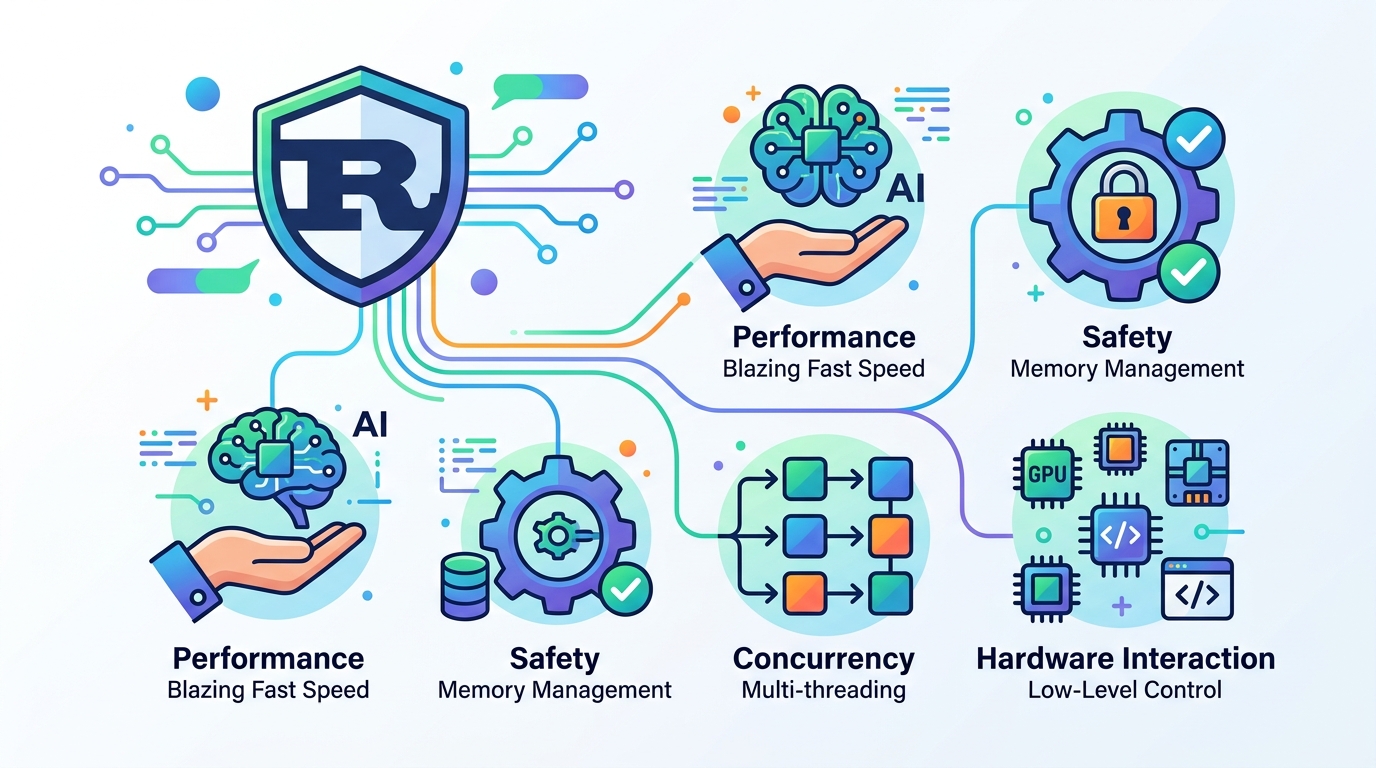
The first argument is simple: production AI fails in the boring layers, not the glamorous ones. When a system is moving embeddings, coordinating workers, or serving requests under load, memory pressure and concurrency bugs matter more than model architecture. Rust attacks those problems directly. In embedded and performance-sensitive environments, it routinely delivers near-C speed while removing entire classes of memory bugs. That is exactly what AI infrastructure needs when a workload cannot afford a crash, a leak, or a race condition.

My own reading of the trend is reinforced by the ecosystem. Rust-powered tools like Ruff and uv are winning because they make developer tooling fast enough to disappear into the background. That same logic applies to AI backends. If your vector search, tokenization, or session orchestration layer becomes an order of magnitude faster, the whole system gets cheaper and easier to scale. Python can prototype the idea, but Rust is what keeps the idea alive in production.
The compiler is the real product
The second argument is that Rust’s compiler is not just a guardrail, it is the product. Rust front-loads complexity into compile time, which is exactly where AI infrastructure wants it. Ownership, borrowing, and strict type checking force the code into a shape that is safe before it ever runs. That means fewer late-night incidents, fewer hidden edge cases, and less reliance on human review to spot concurrency mistakes that are easy to miss in dynamic languages.
This becomes more important as AI writes more code. Copilot, Claude Code, and Cursor can generate something that looks plausible in Python, JavaScript, or even C, but plausibility is not correctness. A generated concurrent service can pass tests and still fail under load. In Rust, the compiler acts like an automated reviewer that rejects unsafe sharing, invalid lifetimes, and bad assumptions before deployment. Microsoft’s estimate that 70% of security vulnerabilities stem from memory safety issues makes the case even sharper: if AI is generating more infrastructure, the language must be able to stop unsafe code at the gate.
The counter-argument
The strongest case against Rust is that AI is still a research-first field, and Python owns research. That is true. PyTorch, TensorFlow, scikit-learn, and Hugging Face created an ecosystem that Rust cannot replace for experimentation, model training, and fast iteration. Python’s weakness is not that it is bad. Its weakness is that it is too permissive for the parts of AI that now matter most in production.
There is also a real cost to Rust adoption: the learning curve is steep, the borrow checker slows onboarding, and some teams will spend more time fighting the compiler than shipping product. That criticism is fair, and it is the right reason to avoid Rust in short-lived prototypes. But it does not defeat the argument. It only defines the boundary. If the system is disposable, use Python. If the system will run critical AI workloads at scale, the compiler’s strictness is an advantage, not a tax.
That is why the Python-versus-Rust debate is the wrong frame. The real pattern is Python for exploration and Rust for infrastructure. Once an AI workflow graduates from notebook to service, the language choice stops being about convenience and starts being about operational risk. Rust wins that comparison because it removes runtime uncertainty instead of merely detecting it after deployment.
What to do with this
If you are an engineer, stop treating Rust as a side quest and start using it for the parts of your AI stack that are performance-critical, concurrent, or safety-sensitive: search, tokenization, schedulers, streaming pipelines, and agent infrastructure. If you are a PM or founder, keep Python where speed of iteration matters, but move the system of record into Rust once reliability and cost become product constraints. The winning stack is not Rust everywhere. It is Rust where failure is expensive and Python where exploration still rules.
// Related Articles
- [IND]
Skatteetaten proves public sector AI should be judged by outcomes
- [IND]
OpenAI’s IPO filing puts AI’s biggest test on Wall Street
- [IND]
OpenAI’s latest moves now center on pricing, safety, and scale
- [IND]
RISC-V mini PCs are worth buying now, but only as a bet on the future
- [IND]
Fedora 44 RISC-V widens Linux board support
- [IND]
June 2026 agentic AI platform war centers on memory