Why Rust Is Winning Systems Programming in 2026
Rust is rising because memory safety is now a commercial requirement, not a nice-to-have.

Rust is rising because memory safety is now a commercial requirement, not a nice-to-have.
I think Rust is becoming the default language for new systems work, and 2026 is the year that stopped being a contrarian take. The evidence is no longer confined to developer affection or open-source momentum. Rust sits around #7–8 in LangPop’s composite index, but the more important signal is where it is winning: the Linux kernel, Android, AWS Firecracker, Cloudflare’s edge stack, Microsoft’s kernel work, and a long tail of tooling that developers use every day. That is not a hobbyist story. It is a procurement, security, and infrastructure story.
Memory safety turned Rust from preference into policy
Get the latest AI news in your inbox
Weekly picks of model releases, tools, and deep dives — no spam, unsubscribe anytime.
No spam. Unsubscribe at any time.
The first reason Rust is rising is simple: governments and large buyers are now treating memory safety as a requirement. The US National Security Agency explicitly recommended memory-safe languages in 2022 and named Rust. The White House Office of the National Cyber Director followed with a 2024 report urging the industry to remove memory-unsafe languages from critical systems. That matters because once security guidance becomes procurement language, language choice stops being purely technical.

Rust fits that mandate better than any mainstream systems language because it delivers memory safety without a garbage collector. That is the key tradeoff. C and C++ remain fast, but they leave entire classes of bugs on the table. Go, Java, and other managed languages reduce those bugs, but they do it with runtime costs and latency tradeoffs that are unacceptable in many systems workloads. Rust gives teams a way to satisfy security requirements without paying a runtime tax, which is exactly why it is moving from “interesting option” to “approved path.”
Big platform wins have broken the skepticism
The second reason Rust is winning is that the biggest skeptics have already crossed the line. The Linux kernel merged Rust support in 2022, making it the first new language added to Linux in three decades of C dominance. That was not symbolic. It opened the door for new drivers and subsystems where memory safety is a hard requirement. When the kernel community accepts a language that aggressively, the debate changes from “is Rust real?” to “where should it be used next?”
Android reinforced that shift in 2021 by making Rust its second official language. Google has since shown that memory-safety vulnerabilities decline as Rust’s share of code rises. That is the kind of evidence the industry has needed for years: not ideology, not benchmarks, but production data. Once a language proves it can reduce real vulnerability counts at massive scale, the old argument that Rust is only for niche teams stops holding up.
Rust owns the places where performance and safety both matter
Rust is not just winning approvals; it is winning categories. WebAssembly is the clearest example. Rust is the dominant language for production Wasm modules because its no-GC model and near-zero runtime overhead match the execution model Wasm needs. That is why Rust shows up in Cloudflare Workers, Fastly Compute@Edge, and other edge-compute environments where deterministic performance matters as much as safety.
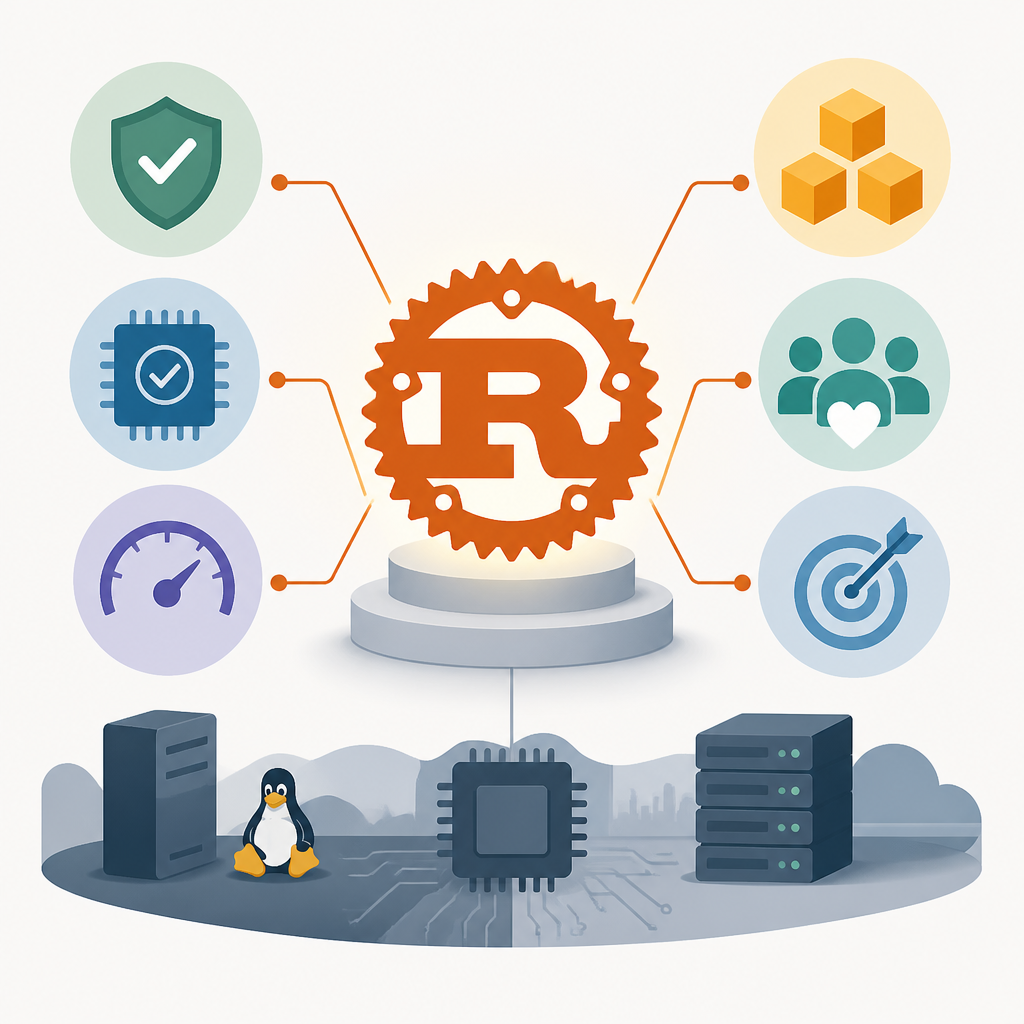
The same pattern shows up in developer tools and infrastructure software. ripgrep, fd, bat, Alacritty, Zed, and Biome are all Rust projects, and they are popular for the same reason: Rust gives them low memory use, fast startup, and predictable latency. On the enterprise side, AWS Firecracker, Bottlerocket, Cloudflare Pingora, Meta’s Buck2, and Microsoft’s kernel work show that Rust is no longer confined to greenfield experiments. It is being trusted with the systems that make money and keep the lights on.
The counter-argument
The strongest objection is that Rust is still hard to hire for and hard to learn. That is true. The borrow checker forces developers to think differently about ownership, lifetimes, and mutation, and teams pay for that shift with slower onboarding and a smaller talent pool. The LangPop data reflects this reality: Rust ranks much higher in GitHub activity, Reddit engagement, and “most loved” sentiment than it does in job postings. Companies that need to hire quickly still reach for Go because the market is broader and the learning curve is gentler.
That objection is real, but it does not overturn the trend. It explains why Rust adoption is selective, not why it is weak. High-friction languages do not win everywhere; they win where the payoff is large enough to justify the cost. Infrastructure teams, kernel developers, security-sensitive platforms, and embedded systems all fit that profile. The job market lags because adoption starts with elite teams and expands later. The gap is a timing problem, not a verdict.
What to do with this
If you are an engineer, learn Rust for the parts of your stack where failure is expensive: services near the kernel, edge infrastructure, parsers, build tools, embedded code, and anything exposed to untrusted input. If you are a PM or founder, stop asking whether Rust is trendy and start asking whether your product has a memory-safety problem, a latency problem, or a trust problem. If the answer is yes, Rust is no longer an experiment. It is the safer default for new systems work, and the companies that accept that now will move faster later because they will spend less time paying for bugs they should never have shipped.
// Related Articles
- [IND]
OpenAI’s IPO filing turns hype into scrutiny
- [IND]
Skatteetaten proves public sector AI should be judged by outcomes
- [IND]
OpenAI’s IPO filing puts AI’s biggest test on Wall Street
- [IND]
OpenAI’s latest moves now center on pricing, safety, and scale
- [IND]
RISC-V mini PCs are worth buying now, but only as a bet on the future
- [IND]
Fedora 44 RISC-V widens Linux board support