Why Snowflake’s Anthropic deal is a smart enterprise AI move
Snowflake’s expanded Anthropic partnership is the right enterprise AI strategy because it puts Claude where company data already lives.

Snowflake’s Anthropic partnership puts Claude inside the data platform enterprises already use.
Snowflake’s expanded partnership with Anthropic is the right move for enterprise AI because it puts frontier models inside the data platform where companies already store, govern, and query their most sensitive information.
That matters more than another standalone chatbot or a flashy model demo. The real bottleneck in enterprise AI is not model quality alone; it is access to governed data, permissioning, auditability, and a path from prototype to production. By integrating Claude into Snowflake Cortex AI, Snowflake is betting on the part of the stack that actually controls adoption.
First, enterprise AI fails when it lives outside the data layer
Get the latest AI news in your inbox
Weekly picks of model releases, tools, and deep dives — no spam, unsubscribe anytime.
No spam. Unsubscribe at any time.
Most enterprise AI pilots stall because teams have to copy data into a separate environment, then rebuild security, compliance, and monitoring around it. Every extra system creates friction. Every manual export creates risk. A model can be impressive and still be unusable if it sits too far from the data warehouse.

Snowflake’s advantage is distribution through existing customer workflows. If an analyst, engineer, or business user can invoke Claude where the data already resides, the company removes a major barrier to deployment. That is not a minor convenience. It is the difference between a pilot that gets discussed in meetings and a system that ships into daily operations.
Second, model choice matters less than operational fit
Enterprise buyers do not purchase AI the way consumers buy apps. They buy control, reliability, and integration. A company can switch among models, but it cannot easily switch out its governance model, identity layer, data policies, and compliance posture. That is why platform integration beats model branding almost every time.
Anthropic’s Claude has a strong reputation for reasoning and safety, but the strategic value here is not just Claude itself. It is Snowflake making a credible claim that its platform can host serious AI workloads without forcing customers to assemble a brittle toolchain from scratch. For enterprises, that lowers implementation cost and shortens the route from experimentation to repeatable use.
The counter-argument
Critics will say this is just another cloud-platform partnership dressed up as strategy. They are not wrong to worry about vendor lock-in. When one platform controls data, orchestration, and model access, customers can end up with fewer escape routes and higher switching costs. There is also a real risk that model performance differences get blurred once everything is abstracted behind a single interface.
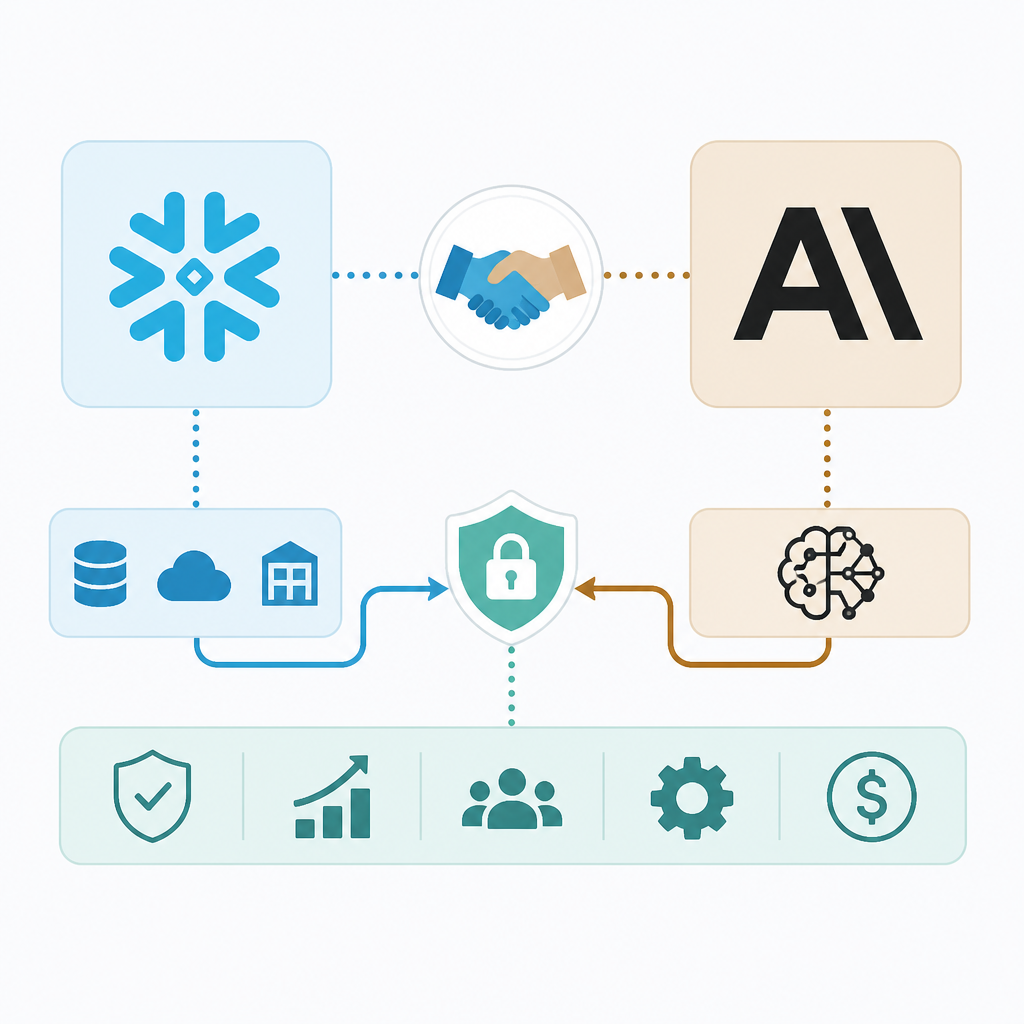
That critique has teeth, especially for buyers that want to keep model optionality open. But it does not beat the core logic of the deal. Enterprises already live with lock-in tradeoffs across databases, clouds, and security tools. The question is not whether some dependence exists. The question is whether the platform reduces enough operational complexity to justify it. In this case, it does.
What to do with this
If you are an engineer, PM, or founder, treat this as a reminder that enterprise AI wins on integration, not novelty. Build around the systems where data already lives, minimize context switching, and make governance part of the product rather than an afterthought. If your AI feature cannot inherit permissions, logging, and policy controls from day one, it is not enterprise-ready.
// Related Articles
- [IND]
AMD and Microsoft push Windows ML on GPU and NPU
- [IND]
OpenAI’s IPO filing turns hype into scrutiny
- [IND]
Skatteetaten proves public sector AI should be judged by outcomes
- [IND]
OpenAI’s IPO filing puts AI’s biggest test on Wall Street
- [IND]
OpenAI’s latest moves now center on pricing, safety, and scale
- [IND]
RISC-V mini PCs are worth buying now, but only as a bet on the future