Why Verkor’s TurboQuant silicon IP matters more than the headline says
Verkor’s TurboQuant accelerator is a real step for LLM inference, but the bigger story is how quickly algorithm ideas are becoming silicon IP.

Verkor’s TurboQuant accelerator turns a fresh LLM algorithm into downloadable silicon IP.
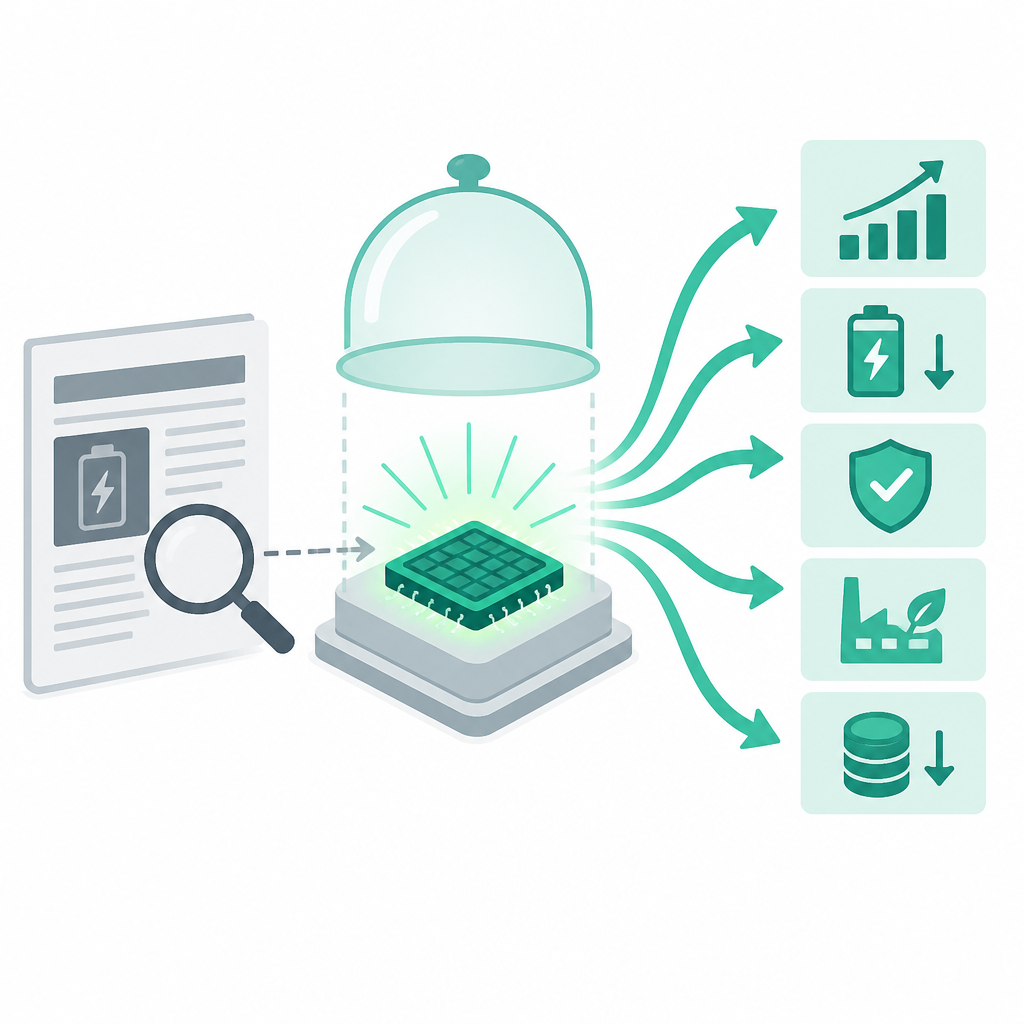
Verkor’s VerTQ is not just another AI press release. It is a concrete hardware implementation of Google’s TurboQuant idea, and that matters because inference bottlenecks are now dominated by memory, not raw math. The company says its design cuts KV cache memory use by 4.3x, keeps the attention path on-chip, and was built into a timing-verified FPGA implementation in about 80 hours. That is the real shift: algorithm papers are no longer ending at arXiv, they are being translated into deployable silicon IP fast enough to change product planning.
First, memory bandwidth is the real tax on LLM inference
Get the latest AI news in your inbox
Weekly picks of model releases, tools, and deep dives — no spam, unsubscribe anytime.
No spam. Unsubscribe at any time.
For large language models, the expensive part is often not the matrix multiply everyone likes to benchmark. It is moving KV cache data back and forth, which burns bandwidth, power, and latency every time a model generates a token. Verkor’s pitch is built around that reality: TurboQuant reduces KV cache memory usage by 4.3x, and VerTQ keeps compression and Flash Attention operations on-chip so the system does not have to decompress data just to keep computing. That is a practical answer to a practical bottleneck.

This is why the announcement matters beyond one vendor. Google’s TurboQuant paper appeared on March 24, 2026, and Verkor says there was no known hardware implementation before VerTQ. If that claim holds, then Verkor did something more important than optimize a benchmark. It proved that a published algorithm can be turned into silicon IP quickly enough to influence how edge inference products are built, especially where every watt and every byte of memory counts.
Second, the agentic design flow is the product, not just the accelerator
Verkor is also making a second claim: Conductor 2.0 built the design autonomously, from algorithm to verified FPGA image, in roughly 80 hours. That is not a minor detail. The industry has spent years talking about AI-assisted chip design, but most of the market still treats RTL generation, verification, and implementation as slow human-heavy loops. Here, Verkor is arguing that the loop can be compressed from months or years into days when the target is a well-scoped accelerator IP.
The deliverable list reinforces that this is not hand-wavy automation. Verkor says the package includes product and microarchitecture specs, test plans, verification IP, unit and system testbenches, hierarchical RTL, a netlist, and a downloadable FPGA image. In other words, the value is not simply that an AI wrote some code. The value is that an AI-driven pipeline produced the artifacts a customer actually needs to evaluate, integrate, and ship silicon. That is the kind of capability that can change who gets to participate in custom chip design.
The counter-argument
The strongest objection is that an FPGA demo is not a silicon product. A Xilinx XCVU29P-3 running at 125 MHz is useful proof, but it is not a shipping ASIC. The resource footprint is also large for a single attention decoder, with Verkor citing 500,619 LUTs, 247,022 flip-flops, 748 DSPs, and several RAM blocks. Skeptics can fairly say that real-world deployment still depends on power, area, thermal behavior, compiler integration, and model compatibility that a press release does not settle.
That objection is right about one thing: the market should not confuse first-pass validation with commercial scale. But it misses the point if it treats the hardware form factor as the only thing that matters. In accelerator markets, the first credible implementation often creates the real moat, because it proves feasibility, exposes integration constraints, and gives customers a concrete artifact to test. If Verkor can show that TurboQuant works in hardware without decompressing KV cache data, then the next ASIC port is an engineering problem, not a research gamble.
So the right response is not to dismiss VerTQ because it is “only” FPGA-based. The right response is to recognize that the industry’s threshold has changed. A hardware implementation of a new inference algorithm now arrives quickly enough to become part of the product conversation, and that is a meaningful competitive event whether the final form is FPGA, chiplet, or full ASIC.
What to do with this
If you are an engineer, treat TurboQuant-style accelerators as a signal to design around memory movement first and FLOPs second. If you are a PM, ask every inference roadmap question in terms of KV cache, bandwidth, and deployment target, not just model size. If you are a founder, the lesson is sharper: the winning company is no longer the one that only discovers a better algorithm, but the one that can turn that algorithm into verifiable silicon IP before the rest of the market finishes reading the paper.
// Related Articles
- [AGENT]
Claude Code 动态工作流:AI 自写 Harness
- [AGENT]
Agent orchestration is the missing layer for enterprise AI
- [AGENT]
AI agents use blockchain as a trust layer
- [AGENT]
8 RAG patterns that turn demos into prod
- [AGENT]
Fine-tuning beats RAG when the goal is style, not facts
- [AGENT]
OpenClaw shows how small businesses use AI staff