Why WebAssembly is the runtime stack that finally matters
WebAssembly is no longer niche; it is becoming the production runtime for edge, plugins, and performance-critical apps.

WebAssembly is becoming the production runtime for edge, plugins, and performance-critical apps.
WebAssembly is no longer a browser curiosity; it is the right runtime for production systems that need portability, sandboxing, and near-native speed.
That stance is not based on hype. In the source article’s benchmark, a Rust WASM build of Fibonacci(40) ran in 0.8ms while JavaScript took 1200ms, a gap that captures the real reason teams adopt WASM: CPU-bound work behaves differently when the interpreter tax disappears. The same article points to Cloudflare Workers running WASM-based edge functions across 300+ data centers and to products like Figma and Photoshop Web using WASM for performance-critical paths. This is no longer a speculative experiment. It is a deployment pattern.
WASM wins when the work is compute-heavy
Get the latest AI news in your inbox
Weekly picks of model releases, tools, and deep dives — no spam, unsubscribe anytime.
No spam. Unsubscribe at any time.
The first argument for WASM is simple: if the bottleneck is computation, not DOM work or network latency, WASM gives you a better cost-performance profile than JavaScript. The benchmark example in the source is dramatic for a reason. Recursive Fibonacci is a toy problem, but it exposes the overhead difference between interpreted execution and compiled code. When teams move image processing, parsing, simulation, compression, or analytics into WASM, they are not chasing novelty. They are removing a structural penalty.

That is why the strongest production examples cluster around creative tools and infrastructure, not ordinary app logic. Figma compiled C++ to WASM to keep complex design interactions responsive in the browser. Adobe Photoshop Web uses WASM for image operations where every millisecond matters. In both cases, the value is not abstract portability. It is the ability to ship serious native-class workloads into environments that used to force a choice between speed and reach.
The platform story is finally complete
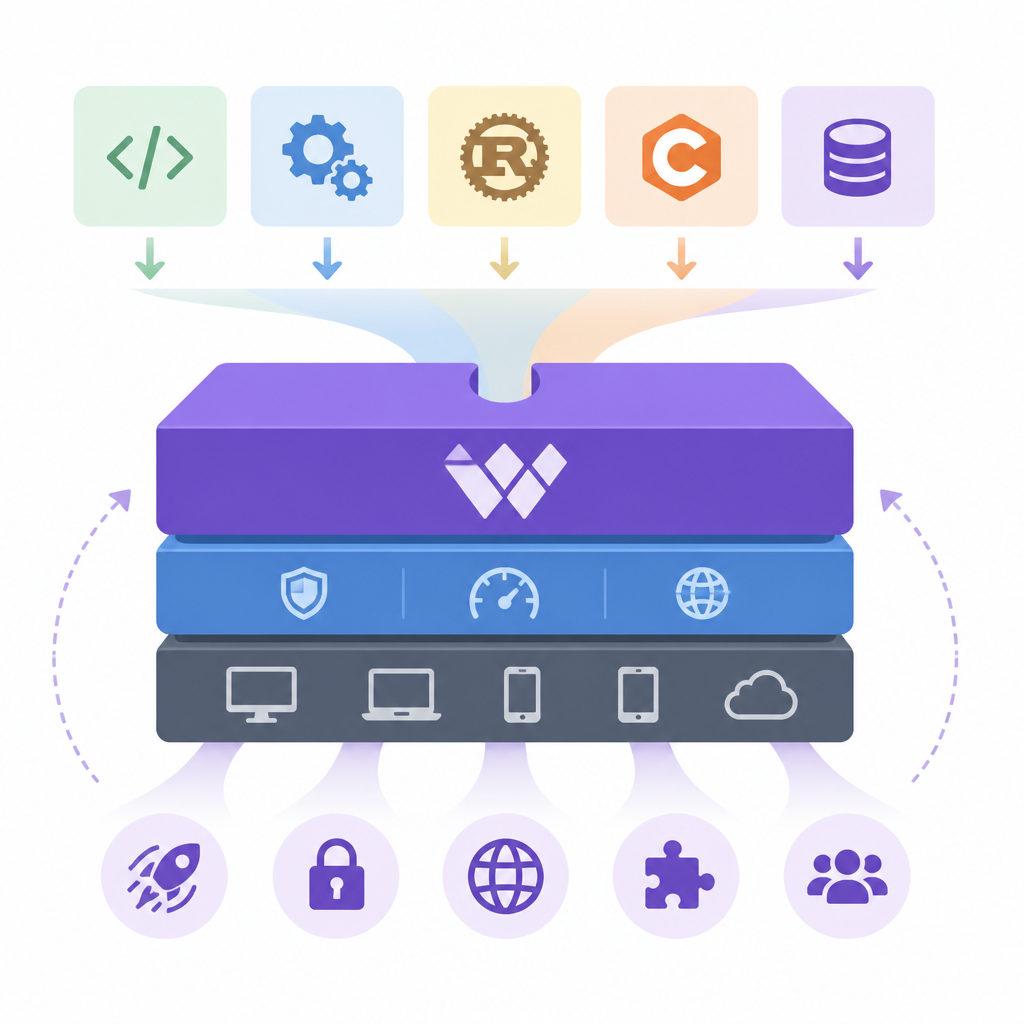
The second argument is that WASM has crossed the line from “fast code” to “real platform.” WASI Preview 2 gives it a standardized system interface outside the browser, which means file access, networking, and clocks are no longer ad hoc extensions. The WebAssembly Component Model goes further by letting modules written in Rust, Go, and C++ compose through WIT interfaces without shared memory. That is the missing piece that turns WASM from an execution format into an application architecture.
This matters because platform maturity changes engineering decisions. A runtime becomes strategic when teams can isolate untrusted plugins, ship the same binary logic to edge and server, and compose services across language boundaries without rewriting everything into one stack. Extism is a good example of this shift: host applications can run untrusted plugins in a WASM sandbox while keeping the host language intact. That is not just convenience. It is a cleaner security and deployment model than loading native extensions or stitching together a zoo of containers for small units of logic.
The counter-argument
The best objection is that WASM still adds complexity and does not replace JavaScript for broad application work. That is true. UI logic, DOM manipulation, and I/O-bound flows remain better in JS because the boundary crossing cost can erase any speed gain. A team that compiles everything to WASM will build a slower, harder-to-debug system with more tooling friction than benefit. The source article itself admits this by warning against using WASM for simple UI logic or non-bottleneck code.
There is also a legitimate operational concern: a new runtime can become a new failure mode. If the team lacks profiling discipline, component boundary design, or a clear performance target, WASM becomes another layer of abstraction instead of a solution. That criticism is valid.
But it does not overturn the case for WASM. It only defines the boundary of good use. The right question is not “should we use WASM everywhere?” The right question is “do we have a workload where portability, sandboxing, or compute density is the constraint?” For that class of problems, WASM is not extra complexity. It is the simpler answer because it replaces environment-specific rewrites with one portable runtime.
What to do with this
If you are an engineer, use WASM for the hot path only: parsing, transforms, crypto, image work, plugins, and edge logic. Keep orchestration, UI, and I/O in the host language. If you are a PM or founder, treat WASM as a product enabler when you need safe extensibility, multi-language reuse, or global deployment at the edge. Do not adopt it to look modern. Adopt it when you need a runtime that turns performance and isolation into a shipping advantage.
// Related Articles
- [TOOLS]
Magenta RealTime 2 lets you score in the DAW
- [TOOLS]
Open-source AI tools beat Claude’s paid tiers on value
- [TOOLS]
500 AI agent projects show where agents work now
- [TOOLS]
Chocolatey’s Go package turns installs into policy
- [TOOLS]
Go support policy turns releases into a checklist
- [TOOLS]
RustDesk self-hosting setup for secure remote access