Agent orchestration is the missing layer for enterprise AI
Agent orchestration coordinates multiple AI agents so enterprises can control handoffs, governance, and production workflows.
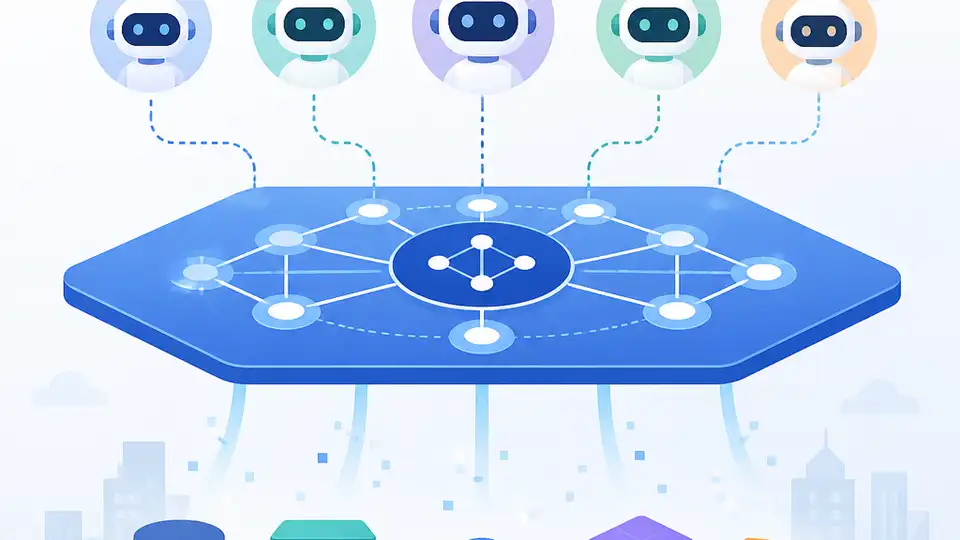
Agent orchestration coordinates multiple AI agents into one governed workflow.
Enterprises are no longer asking whether AI agents can do useful work. They are asking why so many of them break the moment they need to hand off a task, share state, or follow policy. In Lyzr’s guide, the answer is blunt: the missing layer is orchestration.
The article frames orchestration as the control logic that makes multiple agents behave like one system. It also argues that 2026 is the year this problem moved from theory to budget line item, because agent sprawl, tool sprawl, and governance pressure all hit at once.
| Fact | Value | Why it matters |
|---|---|---|
| Enterprise agent sprawl creating security and operational headaches | 94% | Shows the problem is already widespread |
| Enterprise agents reaching production | 5% | Reveals the bottleneck is deployment, not demos |
| Vendor lead in VB Pulse Q1 2026 | Microsoft by 13 points | Signals demand for a default orchestration layer |
| Publication date | May 24, 2026 | Places the discussion in the current enterprise AI cycle |
Why orchestration matters once you have more than one agent
Get the latest AI news in your inbox
Weekly picks of model releases, tools, and deep dives — no spam, unsubscribe anytime.
No spam. Unsubscribe at any time.
A single agent can answer questions, summarize text, or route a ticket without much ceremony. The trouble starts when one agent depends on another. Then you need rules for ordering, retries, data transfer, failure handling, logging, and who gets the final say.
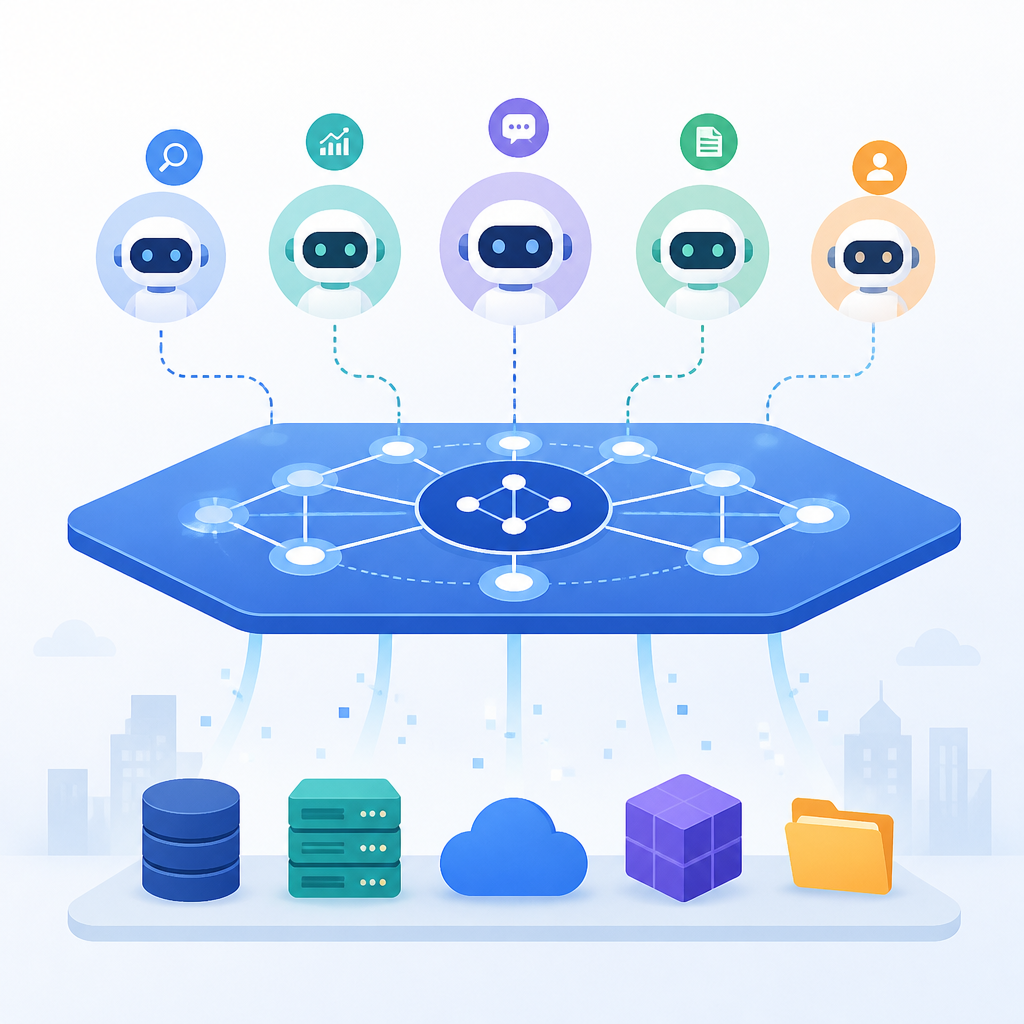
Lyzr defines agent orchestration as coordinating multiple AI agents so they work together as a single system. That means the orchestration layer decides what runs first, what gets passed along, what gets audited, and what happens when one agent stalls or disagrees with another.
The article makes an important distinction here: connecting agents through APIs is easy, but coordinating them is the hard part. In other words, a working demo is not the same thing as a production workflow.
That difference shows up fast in enterprise use cases. A bank onboarding customer might need one agent to verify documents, another to check credit, another to draft an agreement, and a final agent to send the welcome message. Without orchestration, the flow becomes a pile of brittle handoffs.
- Orchestration is system-level, not agent-level.
- It decides order, authority, and failure handling.
- It becomes necessary the moment two agents depend on each other.
- It is the layer that turns separate tools into a workflow.
The numbers explain why this category got hot in 2026
The article’s strongest claim is that orchestration is now the dominant enterprise AI problem. That sounds broad until you look at the numbers it cites. IBM says 94% of enterprises already see agent sprawl creating security and operational headaches, which is a polite way of saying the tool pile is getting out of control.
Then there is the production gap. Lyzr says only 5% of enterprise agents make it into production, and the failures cluster around orchestration boundaries rather than model quality. That matches what most teams see in practice: the prototype works, then the handoff logic, governance checks, or deployment path breaks.
“The architecture of the future will be based on the orchestration of AI agents.” — Satya Nadella, Microsoft Build 2024
That quote matters because it comes from the company most enterprises already trust to manage identity, cloud, and productivity software. If Microsoft is treating orchestration as core infrastructure, it tells you where the market is heading.
The article also points to VentureBeat’s VB Pulse Q1 2026 tracker, which puts Microsoft as the enterprise default orchestration platform with no other vendor within 13 percentage points. That is a signal, not a verdict, but it shows buyers want consolidation more than novelty.
- 94% of enterprises report agent sprawl headaches, according to IBM.
- Only 5% of enterprise agents reach production, according to Lyzr’s analysis.
- Microsoft leads the VB Pulse Q1 2026 tracker by 13 points.
- The article is dated May 24, 2026, which places it after the first wave of agent hype and into the operational phase.
The orchestration patterns that actually show up in production
Lyzr breaks orchestration into patterns that map well to real systems. The most familiar is sequential orchestration, where one agent finishes before the next begins. That is the loan workflow, the onboarding flow, the approval chain.
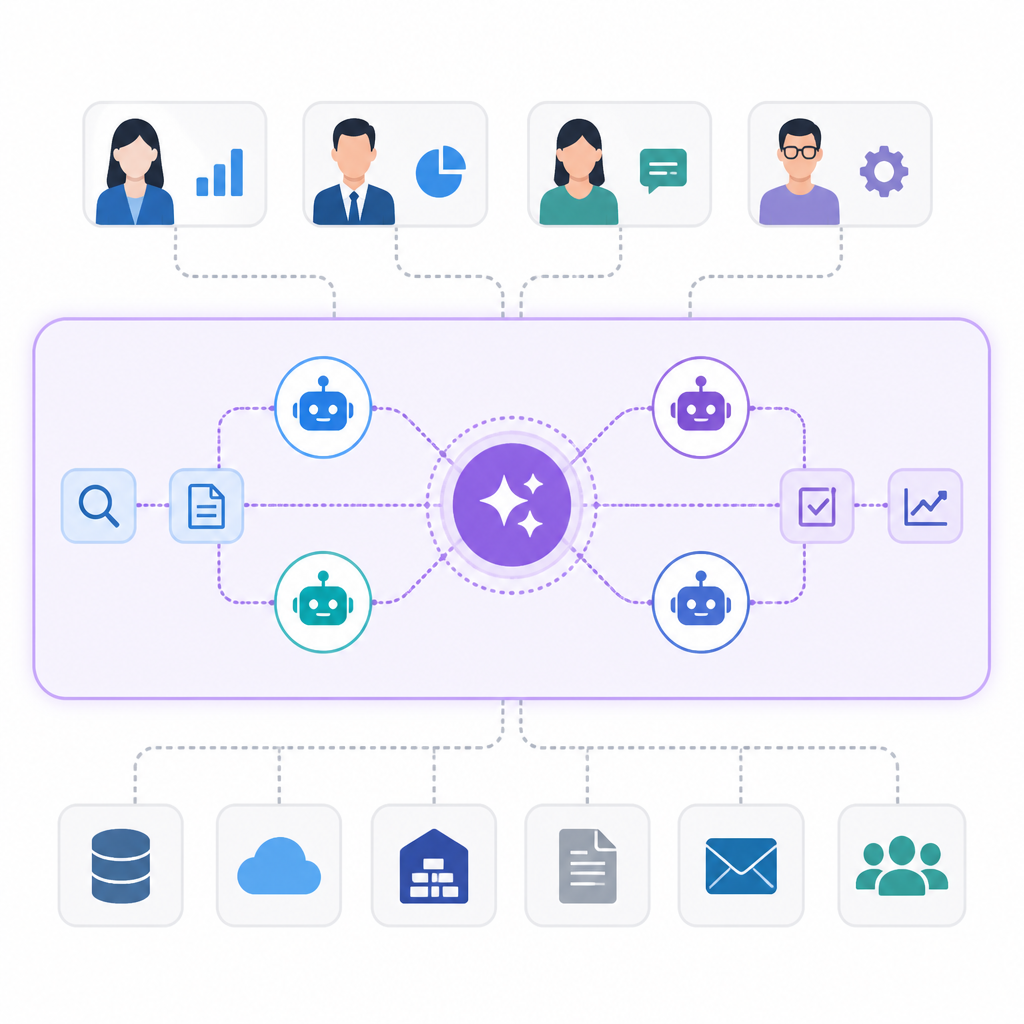
Parallel orchestration is the fan-out model. Multiple agents work at the same time, then the system collects their outputs. This is useful when you want a research agent, a compliance agent, and a summarizer to work on the same case independently.
Hierarchical orchestration adds a manager agent that assigns work to specialist agents. Handoff orchestration routes a task to the right agent based on context. Loop orchestration repeats a task until the output passes evaluation.
Those patterns matter because most enterprise systems are hybrids. A support workflow may start with routing, run parallel checks, then loop through validation before sending a final response.
- Sequential orchestration fits fixed workflows.
- Parallel orchestration fits analysis and review.
- Hierarchical orchestration fits manager-worker setups.
- Loop orchestration fits evaluation-heavy tasks.
Centralized, decentralized, and federated control are different bets
The article also tackles a question that matters more than it sounds: where does control live? In a centralized model, one orchestrator has authority over every agent. That gives you clean governance, consistent audit logs, and a single place to enforce policy.
Decentralized orchestration spreads control across agents or services. That can reduce bottlenecks, but it makes audit and consistency harder. Federated orchestration sits between the two, with multiple control domains coordinating under shared rules.
For regulated sectors, centralized control is the easiest sell. A bank, insurer, or government team usually wants one policy layer, one identity model, and one audit trail. For looser internal automation, federated control may be enough.
If you want a practical comparison, the trade-off is simple: more central control means better visibility, while more distributed control means more flexibility. The right answer depends on whether the workflow is handling customer data, money movement, or a low-risk internal task.
That’s why Lyzr’s framing is useful. It treats orchestration as an operational decision, not a buzzword. The same is true of platforms like Microsoft Copilot Studio, Salesforce Agentforce, and LangGraph, which all approach coordination from different angles.
What teams should take from this right now
The practical takeaway is that agent strategy is no longer just about picking a model or a framework. It is about deciding how agents will talk to each other, who can override what, and how much evidence the system must keep.
Teams that ignore orchestration will keep shipping impressive demos that collapse under real usage. Teams that treat orchestration as infrastructure will have a much easier time with auditability, retries, and cross-team automation.
If you are starting now, the smartest move is to map one workflow that already uses multiple agents, then write down the handoffs, failure points, and approval steps before adding more automation. That will show you whether you need a central control plane, a federated setup, or a simpler chain.
My read: the next buying decision in enterprise AI will be less about which agent is smartest and more about which platform can keep five agents from stepping on each other. That is where the real competition is heading.
// Related Articles
- [AGENT]
Claude Code 动态工作流:AI 自写 Harness
- [AGENT]
AI agents use blockchain as a trust layer
- [AGENT]
8 RAG patterns that turn demos into prod
- [AGENT]
Fine-tuning beats RAG when the goal is style, not facts
- [AGENT]
OpenClaw shows how small businesses use AI staff
- [AGENT]
LiteLLM launches a minimal Rust gateway for agents