Agentic AI Needs Better Harnesses, Not Just Bigger Models
This paper argues agentic AI progress will depend on system design around models, not model scaling alone.

This paper argues agentic AI progress will depend on system design around models, not model scaling alone.
- Research org: Unspecified in arXiv abstract
- Core data: No benchmark numbers in abstract
- Breakthrough: Treats the agent harness as a first-class design target
For developers building agents, this is a useful shift in framing. The paper says the bottleneck is no longer just the foundation model itself, but the structured execution layer wrapped around it: memory, retrieval, routing, orchestration, verification, and governance.
That matters because most agent evaluations still focus on whether the final task succeeded. This paper argues that misses the real story: long-horizon behavior emerges from how the whole system is put together, not just from the model’s raw capability.
What problem this paper is trying to fix
Get the latest AI news in your inbox
Weekly picks of model releases, tools, and deep dives — no spam, unsubscribe anytime.
No spam. Unsubscribe at any time.
The paper starts from a familiar pain point in agentic AI. Modern large language models can already use tools, retrieve information, maintain memory, and run multi-step workflows. But the surrounding system is often treated as plumbing instead of part of the core design.

According to the paper, that model-centric view is increasingly inadequate. If you only measure final-task success, you can miss failures in memory hygiene, context handling, tool coordination, verification, and governance. Those are exactly the things that make an agent reliable over long runs.
The authors call this broader stack the “agent harness.” In their framing, the harness is the structured execution layer that turns model capability into long-horizon behavior. The main argument is simple: future gains will come from scaling that harness, not just scaling the model.
What “scaling the harness” means
The paper defines harness scaling as making the system around the model auditable, persistent, modular, and verifiable. That means treating the execution layer as a first-class object of design, evaluation, and optimization.
In plain English, the harness is everything that shapes what the model sees, what it remembers, which skills it calls, how it coordinates steps, and how it checks itself. The paper breaks this into interacting components: the foundation model, memory substrate, context constructor, skill-routing layer, orchestration loop, and verification-and-governance layer.
This is not presented as a single algorithmic trick. It is a systems view of agent design. The paper’s point is that the behavior users experience comes from the interaction of these parts, so improving one piece in isolation is not enough.
The three bottlenecks the paper focuses on
The authors organize the discussion around three core bottlenecks: context governance, trustworthy memory, and dynamic skill routing. They also include orchestration and governance mechanisms that coordinate and constrain those parts.
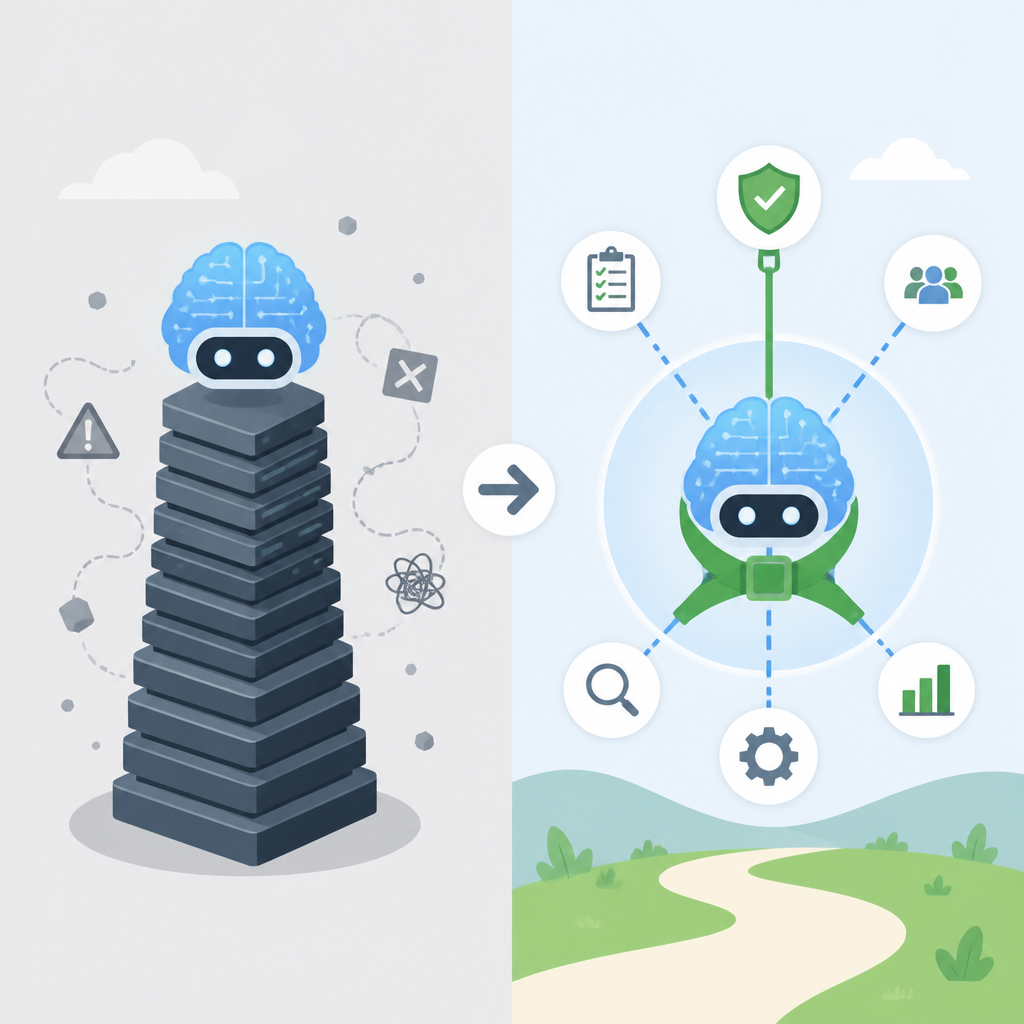
Context governance is about controlling what enters the model’s working context and how that context is assembled. Trustworthy memory is about storing and retrieving information in a way that supports long-horizon work without corrupting the agent’s state. Dynamic skill routing is about choosing the right capability or tool at the right time instead of using a one-size-fits-all path.
These are practical concerns for anyone building agents that need to run for more than a few turns. If the context grows noisy, memory drifts, or routing is brittle, the system can fail even when the underlying model is strong.
What the paper actually shows
The paper is primarily a framing and research-agenda paper, not a benchmark-heavy empirical study. The abstract does not provide benchmark numbers, so there is no reported accuracy, throughput, or cost result to compare here.
To make the discussion concrete, the authors develop CheetahClaws, a Python-native reference harness, and compare it with Claude Code and OpenClaw. The abstract does not include the comparison results, so the source material does not let us claim which system performs better or by how much.
What the paper does provide is a proposed direction for future evaluation. It argues that harness-level benchmarks should go beyond one-shot task success and measure trajectory quality, memory hygiene, context efficiency, communication fidelity, verification cost, and safe evolution over time.
That benchmark list is important because it changes what “good” looks like. Instead of only asking whether an agent eventually solved a task, the paper wants developers to measure whether it solved it cleanly, efficiently, safely, and in a way that remains stable over time.
Why developers should care
If you build production agents, this paper is basically telling you to move your attention up one layer. The model is only one component. The harness determines whether the model is usable in long-running, tool-heavy, stateful systems.
That has direct engineering implications. You need to think about how context is constructed, how memory is written and read, how skills are routed, when verification happens, and who or what governs the loop. Those choices can matter as much as prompt quality or model selection.
The paper also suggests that current evaluation culture is underpowered. A system can look good on final answer accuracy and still be fragile, leaky, or expensive when run as an agent. If you are shipping software, those hidden failures are the ones that usually hurt you first.
At the same time, the source is careful not to overclaim. It does not give benchmark numbers in the abstract, and it does not establish a new state-of-the-art result there. So the value here is the framework: a way to think about agent systems as engineered harnesses rather than model wrappers.
Limitations and open questions
The biggest limitation in the source material is that the abstract gives a conceptual agenda, not detailed experimental evidence. We know the paper compares CheetahClaws with Claude Code and OpenClaw, but we do not get the outcome of that comparison in the abstract.
That leaves several open questions. How should harness components be evaluated independently when they interact so tightly? Which metrics best capture memory hygiene or verification cost? How do you balance stronger governance with system flexibility?
Those are the right questions for the next wave of agent engineering. The paper’s main contribution is to argue that they should be treated as first-order research problems, not implementation details hidden behind a model API.
For developers, the takeaway is practical: if your agent only works in clean demos, the missing piece may not be the model. It may be the harness.
- Agent performance depends on the full system stack, not just the foundation model.
- The paper pushes evaluation toward trajectory quality, memory hygiene, and verification cost.
- CheetahClaws is presented as a Python-native reference harness, but the abstract gives no results.
// Related Articles
- [RSCH]
CRDTs keep replicas in sync without locks
- [RSCH]
Post-Deterministic Systems for Autonomous Infra
- [RSCH]
Causal methods for measuring task learnability
- [RSCH]
RL Training That Hands Off Control Gradually
- [RSCH]
OmniGameArena benchmarks VLM game agents better
- [RSCH]
TurboQuant cuts KV cache memory 6x in Google tests