Anthropic’s $65B round turns AWS and Google Cloud into winners
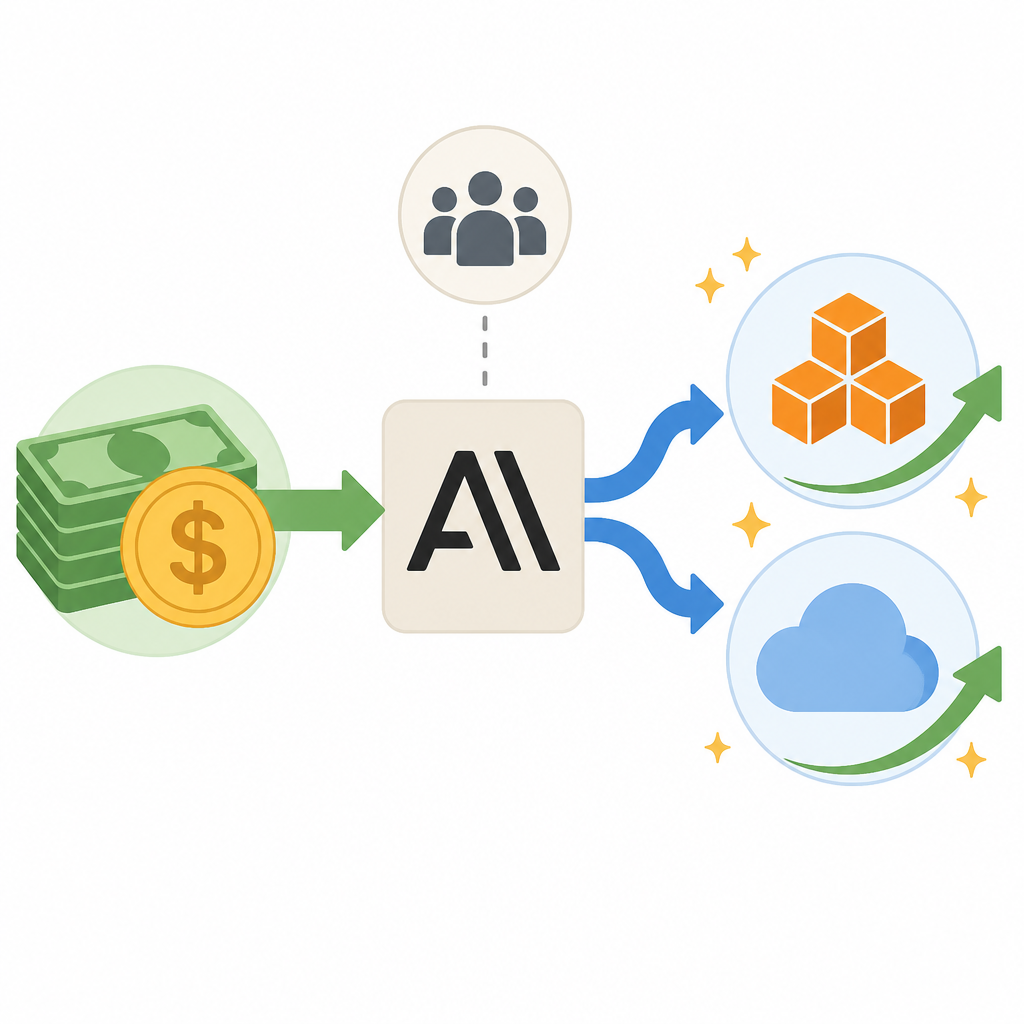
Anthropic’s giant funding round makes Amazon and Alphabet look richer on paper and pushes more AI spend into AWS and Google Cloud.

Anthropic’s huge funding round turns Amazon and Alphabet into the clearest winners.
I’ve been watching AI partnerships turn into these weird, circular money machines for a while now. A model company raises a monster round, then that cash gets funneled right back into the cloud and chip vendors that helped make the company valuable in the first place. On paper it looks elegant. In practice, it often feels like everyone is cheering the same dollar as it moves through three balance sheets.
That’s why this Motley Fool piece hit me as more than just another “AI is hot” headline. It’s not really about Anthropic alone. It’s about what happens when a private model company gets big enough to move AWS, Google Cloud, Broadcom, Amazon, and Alphabet in one shot. The article is here: The Motley Fool. And the part that matters is simple: Anthropic raised $65 billion at a $965 billion valuation, then immediately reinforced the spending loop that benefits its infrastructure partners.
That’s the real story I want to unpack. Not the stock-promo gloss. The actual mechanics of how one AI company’s funding round turns into cloud revenue, chip demand, and paper gains for the companies sitting closest to the compute faucet.
1) The headline is about Anthropic, but the money trail runs to AWS and Google Cloud
Get the latest AI news in your inbox
Weekly picks of model releases, tools, and deep dives — no spam, unsubscribe anytime.
No spam. Unsubscribe at any time.
“Anthropic plans to use the process to ‘expand its compute to meet growing demand for Claude, and scale the products and partnerships our customers rely on.’”
What this actually means is: the money is not sitting idle. It’s going straight into infrastructure. Anthropic isn’t raising $65 billion to polish a logo or hire ten more marketers. It’s buying the right to keep training models, serving users, and signing larger enterprise deals without running into compute starvation.

The article says Anthropic signed an agreement with Amazon for five gigawatts of new capacity, and with Google and Broadcom for five gigawatts of TPU capacity. That is an absurd amount of compute by normal software standards. But in AI, this is just the bill for staying in the race.
I’ve run into this pattern before when teams think they’re buying “AI capability” and what they’re really buying is a monthly infrastructure headache. The model is the shiny part. The actual constraint is capacity. If you can’t train, fine-tune, and serve at scale, the model is just a demo with good PR.
How to apply it: if you’re building or investing in AI, stop asking only “what model did they ship?” Start asking “where does the compute come from, who gets paid, and how locked in is the buyer?” That tells you more about durability than most product announcements do.
- Check whether the company is training, serving, or both.
- Look for cloud commitments, chip commitments, and long-term usage deals.
- Assume every major model company is also a demand generator for infrastructure vendors.
2) Amazon and Alphabet aren’t just investors, they’re infrastructure toll collectors
The Motley Fool piece points out that Amazon has invested $13 billion in Anthropic and pledged another $20 billion as milestones are met. Alphabet has also committed up to $40 billion on top of at least $13 billion already invested. Those are not passive bets. They’re strategic positions with a very specific payoff structure.
What this actually means is that Amazon and Alphabet are getting paid twice. First, they hold equity in Anthropic. Second, they sell the cloud and chip capacity Anthropic needs to keep growing. That’s why this news matters so much to both companies. If Anthropic keeps scaling, the upside doesn’t just accrue through valuation marks. It also shows up as recurring infrastructure revenue.
I’ve always thought this was the part outsiders underestimate. People see “investment” and think venture-style upside. But for a cloud provider, the real prize is being the default utility. Equity is nice. Usage is better. Usage means sticky revenue, and sticky revenue is what public-market investors actually reward.
The article also says AWS remains Anthropic’s primary cloud provider and training partner. That matters. Once a model company builds around a cloud stack, switching becomes painful, expensive, and politically messy. I’m not saying impossible. I’m saying the switching cost is the whole game.
How to apply it: when you evaluate a platform company’s AI exposure, separate ownership from consumption. A company can own a stake in a model lab and still miss the bigger win if it isn’t also selling the compute underneath it.
- Equity gives optionality.
- Cloud spend gives recurring revenue.
- Preferred infrastructure status gives long-term leverage without me using the banned word.
3) The valuation jump is less important than the revenue run rate
Anthropic’s valuation climbing to $965 billion is the kind of number that makes headlines because it looks almost fake. But the article also says Anthropic’s revenue reached a run rate of $47 billion this month. That’s the line I’d pay more attention to.
What this actually means is that the market is no longer pricing Anthropic like a speculative lab with a cool chatbot. It’s pricing it like a company with real commercial traction and serious usage. A giant valuation can be dismissed as froth. A giant revenue run rate is harder to hand-wave away.
I’ve seen investors get hypnotized by valuation and miss the operational signal. Valuation is just the price tag. Revenue run rate tells you whether customers are actually paying and whether the model can support the infrastructure bill it’s creating. In AI, that matters a lot because the cost structure is brutal.
The article says Anthropic’s valuation looks reasonable compared with public software companies if you use the sales multiple lens. That’s the kind of comparison people like to argue about, but the core point is fair: if the revenue is real and scaling, then the market stops treating the company like a moonshot and starts treating it like a very expensive business with a very real customer base.
How to apply it: don’t evaluate AI companies only by model quality. Put revenue growth, customer concentration, and infrastructure commitments on the same page. If the revenue can’t keep up with compute demand, the story gets ugly fast.
4) OpenAI is still the name everyone knows, but Anthropic is forcing a rerate
The article says OpenAI was valued at $852 billion in its most recent round, but it has been falling short of growth targets while Anthropic has sped past it. That’s a notable shift. A year or two ago, OpenAI was the default reference point. Now Anthropic is the company making the market do a double take.
What this actually means is that AI leadership is no longer a single-name story. The market is starting to split the prize into multiple winners, and Anthropic is claiming a bigger slice than most people expected. That doesn’t automatically make OpenAI weak. It does mean the competitive frame is changing.
I ran into this exact kind of narrative shift in earlier platform cycles. At first, everyone assumes the first big name owns the category forever. Then a second player shows up with better enterprise fit, better economics, or better distribution. Suddenly the whole conversation changes from “who wins?” to “who gets the bigger enterprise contract?”
Anthropic’s Claude products and plug-ins are also competing directly with existing enterprise software products, according to the article. That’s important because it means Anthropic isn’t just a model supplier. It’s becoming a product layer that can threaten software vendors too.
How to apply it: if you’re tracking AI competition, stop treating it like a single winner-take-all race. Watch for category fragmentation. The winners may be the companies that own enterprise trust, compute access, and product distribution, not just the one with the loudest consumer brand.
5) Broadcom, Samsung, Micron, and SK Hynix are part of the same story
The funding round included investors like Samsung, Micron, and SK Hynix, which is not a random list. Those companies are deeply tied to memory, chips, and the hardware stack that makes large-scale AI possible. Broadcom also shows up in the article because of the TPU capacity agreement.
What this actually means is that Anthropic’s growth is not isolated software growth. It’s hardware demand with a software wrapper. Every time Anthropic raises more capital and expands compute, it creates more business for the chip and memory ecosystem around it.
I think a lot of people still talk about AI like it’s mostly a model competition. It isn’t. It’s a supply chain. The model gets the press, but the real bottlenecks are in memory, networking, accelerators, and cloud capacity. That’s why the investor list matters. These companies aren’t just buying into Anthropic. They’re buying visibility into the demand curve for the whole stack.
The article says Anthropic plans to plow the $65 billion into cloud infrastructure services, including AWS and Google Cloud. That means the money doesn’t just support Anthropic’s own growth. It reinforces the capital expenditure cycle of the companies building the picks and shovels.
How to apply it: when you model AI exposure, map the stack:
- Foundation model company
- Cloud provider
- Chip designer
- Memory supplier
- Enterprise software layer
Once you do that, you stop over-crediting the app layer and start seeing where the actual cash flow lands.
6) The real lesson for investors is that AI spending is becoming self-funding
This is the part that feels almost circular, and honestly a little ridiculous. Anthropic raises money, then spends it on cloud and chips, which makes Amazon and Alphabet stronger, which in turn makes those partners more willing to keep backing Anthropic. It’s a feedback loop with a balance sheet.
What this actually means is that AI spending is becoming self-reinforcing. The better the model company does, the more infrastructure it buys. The more infrastructure it buys, the better the infrastructure vendors look. The better those vendors look, the easier it is for them to keep funding or supporting the model company. Everyone gets to tell a growth story at the same time.
I’m not saying that makes the whole thing fake. I’m saying it makes the structure worth understanding. If you’re an investor, you need to know whether you’re buying a product company, an infrastructure company, or a loop that makes both look better for a while.
The Motley Fool article frames this as spectacular news for Amazon and Alphabet, and that’s fair. But the deeper takeaway is that AI capital is concentrating around a few giant platforms, and the companies closest to compute are the ones most likely to keep winning even when model preferences shift.
How to apply it: if you want exposure to AI without trying to pick the next model winner, focus on the companies that collect spend regardless of which model wins the benchmark. That usually means cloud, chips, networking, and the enterprise software layers that sit adjacent to the model providers.
The template you can copy
# AI infrastructure winner breakdown template

## What happened
[Company] raised [amount] at a [valuation] valuation and said it will use the capital to expand compute, train models, and scale product delivery.

## Why it matters
This is not just a funding story. It redirects spending toward:
- Cloud infrastructure
- Accelerator chips
- Memory and networking hardware
- Enterprise distribution partners

## Who benefits first
1. The model company itself
2. The cloud provider supplying training and inference capacity
3. The chip and memory vendors feeding the compute stack
4. The enterprise software layer competing with or integrating the model

## What to watch next
- New cloud commitments
- Chip supply agreements
- Revenue run rate growth
- Customer concentration
- Evidence of switching costs

## Investor takeaway
If the company is raising capital to buy more compute, the real winners may be the infrastructure partners collecting recurring spend rather than the headline model name.

## One-sentence summary
[Company] turned a funding round into a larger infrastructure spend cycle that benefits its cloud and chip partners.
If you want the original framing, start with the Motley Fool piece here: https://www.fool.com/investing/2026/05/28/anthropic-just-delivered-spectacular-news-for-amaz/. My breakdown is derivative of that article, but the template above is mine and meant to be reused for any AI funding story that really ends up being a cloud and chip story.
// Related Articles
- [IND]
AMD and Microsoft push Windows ML on GPU and NPU
- [IND]
OpenAI’s IPO filing turns hype into scrutiny
- [IND]
Skatteetaten proves public sector AI should be judged by outcomes
- [IND]
OpenAI’s IPO filing puts AI’s biggest test on Wall Street
- [IND]
OpenAI’s latest moves now center on pricing, safety, and scale
- [IND]
RISC-V mini PCs are worth buying now, but only as a bet on the future