Why awesome lists are the wrong way to pick AI agent tools
Curated AI agent lists help with discovery, but they are the wrong tool for choosing what to build on.

Curated AI agent lists help with discovery, but they are the wrong tool for choosing what to build on.
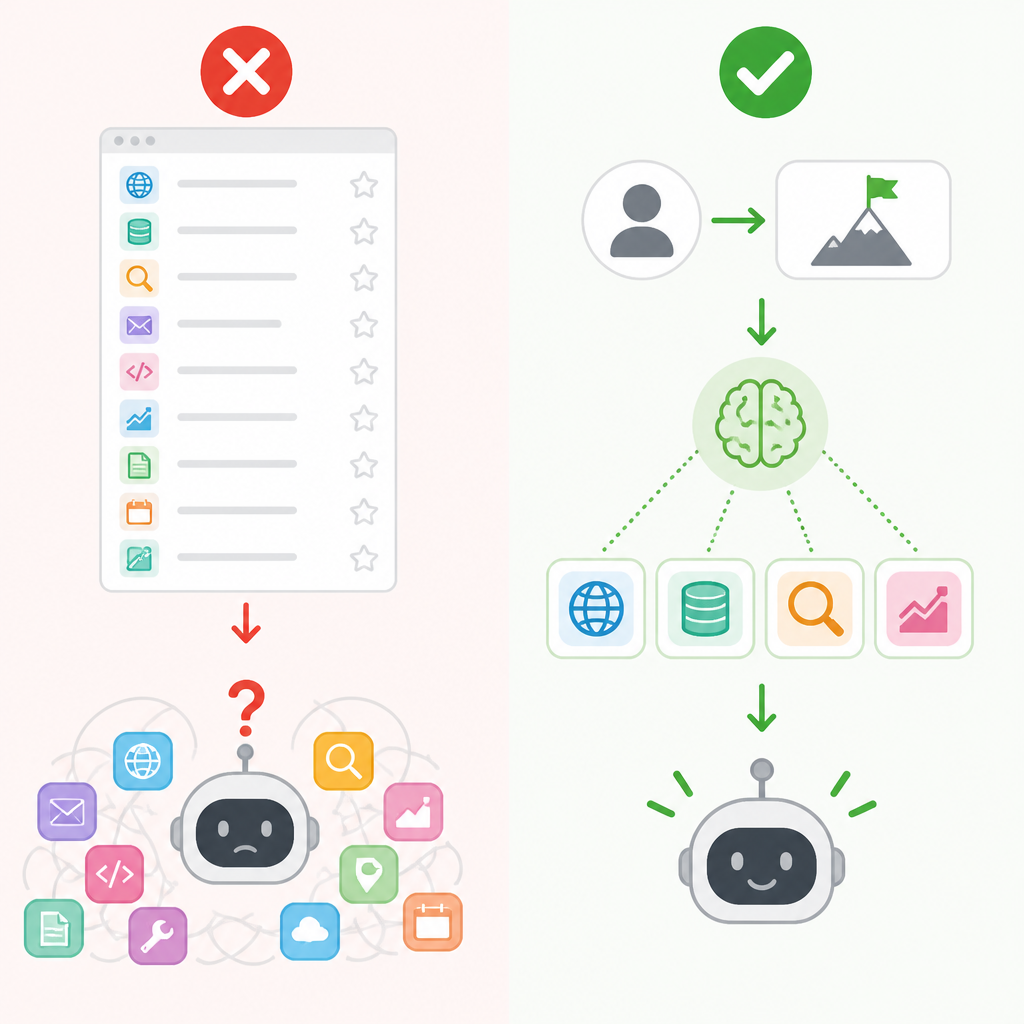
This repository is useful, and that is exactly why it is dangerous as a decision aid. It bundles 445-plus resources, 25 categories, and status labels like fresh, stale, experimental, and audited into one place, which makes it easy to mistake breadth for judgment. A founder scanning a page like this sees MCP, A2A, coding agents, browser agents, sandboxing, and enterprise platforms sitting side by side and walks away with the feeling that the market is coherent. It is not. The market is noisy, and a list that tries to cover everything encourages teams to optimize for coverage instead of outcomes.
Discovery is not selection
Get the latest AI news in your inbox
Weekly picks of model releases, tools, and deep dives — no spam, unsubscribe anytime.
No spam. Unsubscribe at any time.
The first job of an awesome list is to show the map, not choose the route. This one does that well: it points readers to protocols, frameworks, evaluation tools, and even anti-picks, which is far more helpful than a random GitHub search. But the same feature that makes it valuable also makes it weak as a decision system. When 23-plus frameworks sit next to 18-plus enterprise platforms and 17 observability tools, the list becomes a catalog of possibilities, not a ranked answer to “what should I use?”

That distinction matters because agent projects fail on integration, reliability, and cost, not on lack of options. The README itself tries to solve this with scenario guides, stack recipes, and compare tables, and that is the right instinct. Still, those additions are evidence for my point: once you need guidance on tradeoffs, the raw list has already stopped being enough. A list can tell you that LangGraph, AutoGen, CrewAI, and OpenAI’s tools exist. It cannot tell you which one will survive your security review, your latency budget, or your team’s maintenance load.
Most agent frameworks are not interchangeable
Agent frameworks are sold like Lego bricks, but in practice they are opinionated operating models. A coding agent that lives inside a developer workflow has different needs from a browser agent that clicks through a legacy portal, and both differ from a customer support agent with strict policy constraints. The repository’s own category split makes this obvious: coding, computer use, browser, voice, personal, mobile, and enterprise are separate sections because the underlying problems are separate. Treating them as one market is how teams end up rebuilding the same orchestration layer three times.
The better signal in this list is not the number of entries, but the existence of status tags and anti-picks. Those labels admit that maturity varies wildly, which is the real story of agent tooling in 2026. An experimental sandbox is not the same thing as an audited security layer. A hot project with fast star growth is not the same thing as a stable runtime. If your selection process does not distinguish between those, you are not evaluating tools, you are collecting logos.
Standards matter more than framework churn
The strongest part of the repository is its emphasis on protocols like MCP and A2A. That is where the real leverage lives. Frameworks rise and fall, but protocols define how agents talk to tools, data, and each other. When a list gives protocols equal footing with frameworks, it reveals the direction of the market: the stack is moving from isolated agent apps toward interoperable systems.
That shift is more important than any single library because it changes the economics of adoption. Teams can swap a framework if the protocol layer stays stable. They can also mix vendors without rewriting every integration. In other words, the future of agents is less about picking the smartest orchestration package and more about avoiding lock-in at the interface layer. The repository is strongest when it nudges readers toward that view, and weakest when it tempts them to treat framework popularity as strategy.
The counter-argument
Supporters of awesome lists are right about one thing: the tooling landscape is moving too fast for static blog posts or vendor pages to keep up. A maintained list with 445-plus resources, update timestamps, and category filters is a real service to the community. For newcomers, it lowers the cost of entry. For experienced builders, it surfaces adjacent tools they would otherwise miss. In a fragmented market, curation is not trivial.
They are also right that lists can encode judgment when they include status labels, compare tables, and anti-picks. That is not a neutral index. It is a guided tour, and guided tours save time. If a team is early in exploration, a broad, well-maintained repository is a practical starting point and often the fastest way to avoid dead-end tooling.
But that defense only goes so far. The moment a team uses the list as a procurement shortcut, it becomes a liability. Curation can reduce search cost, but it cannot replace benchmarked evaluation, threat modeling, or a proof-of-concept in your own stack. The specific reason is simple: agent tooling fails in context, and context never lives in a README. The right use of this repository is as an index of candidates, not as a decision engine.
What to do with this
If you are an engineer, use a list like this to build a short candidate set, then force every option through the same harness: one real workflow, one security test, one latency test, one rollback plan. If you are a PM, stop asking which framework is “best” and start asking which failure mode you can tolerate. If you are a founder, treat protocols, evals, and sandboxing as the durable layer of your stack and treat frameworks as replaceable implementation detail. That is how you turn a curated list from a distraction into a useful input.
// Related Articles
- [TOOLS]
Magenta RealTime 2 lets you score in the DAW
- [TOOLS]
Open-source AI tools beat Claude’s paid tiers on value
- [TOOLS]
500 AI agent projects show where agents work now
- [TOOLS]
Chocolatey’s Go package turns installs into policy
- [TOOLS]
Go support policy turns releases into a checklist
- [TOOLS]
RustDesk self-hosting setup for secure remote access