Deterministic multicalibration finally hits optimal sample use
This paper shows multicalibration and omniprediction can be made deterministic without giving up optimal sample complexity.

This paper shows multicalibration and omniprediction can be made deterministic without giving up optimal sample complexity.
- Research org: Unspecified in arXiv abstract
- Core data: tilde O(epsilon^{-3}) sample complexity
- Breakthrough: Deterministic algorithm for minimax-optimal multicalibration
For engineers building decision systems, the practical question is not just whether a model is accurate, but whether its probabilities stay trustworthy across the slices and reweightings that matter in deployment. This paper tackles that problem at the level of calibration guarantees, and it matters because calibration is often the difference between a score you can operationalize and one you can only inspect.
The big news here is simple: the authors show that you do not need randomization to get the best-known sample complexity for multicalibration. That closes an open question raised in prior work and gives a deterministic route to guarantees that were previously only known through randomized predictors.
What problem this paper is trying to fix
Get the latest AI news in your inbox
Weekly picks of model releases, tools, and deep dives — no spam, unsubscribe anytime.
No spam. Unsubscribe at any time.
Multicalibration is a stronger version of calibration. A predictor is not only supposed to be unbiased overall; it should remain unbiased even after you condition on its own prediction and after you reweight the data by a collection of group weights G. In other words, the model should not just look calibrated in the aggregate while hiding systematic mistakes in subpopulations or under specific test reweightings.

That matters in downstream applications where predictions feed into decisions, ranking, resource allocation, or auditing. If a model says 0.8, engineers want that to mean something stable across relevant groups, not just on the full dataset. Multicalibration is one of the formal tools for making that promise precise.
The paper focuses on a long-standing gap: before this work, the minimax-optimal tilde O(epsilon^{-3}) sample complexity rate for epsilon-multicalibration was only known for randomized predictors. Deterministic predictors existed, but with substantially worse sample complexity. The question was whether randomness was actually necessary to hit the optimal rate.
How the method works in plain English
The abstract does not spell out the full algorithmic machinery, so it does not let us reconstruct the implementation step by step. What it does tell us is the key structural result: the authors give a minimax-optimal multicalibration algorithm whose output predictor is deterministic.
That is the core engineering idea. Instead of relying on stochastic prediction to achieve the calibration guarantee, the algorithm is designed so the final predictor itself is fixed and repeatable while still meeting the same sample-complexity target. For practitioners, that is appealing because deterministic outputs are easier to reason about, test, reproduce, and deploy.
The authors then generalize the same approach beyond multicalibration. They extend it to outcome indistinguishability, or OI, with respect to finite or finitely covered collections of tests. From there, they derive deterministic omnipredictors and panpredictors with optimal sample complexity.
What the paper actually shows
The central result is a resolution of the open question about whether randomization is necessary for optimal multicalibration sample complexity. According to the abstract, the answer is no: the paper provides a deterministic predictor that achieves the minimax-optimal tilde O(epsilon^{-3}) rate for epsilon-multicalibration.
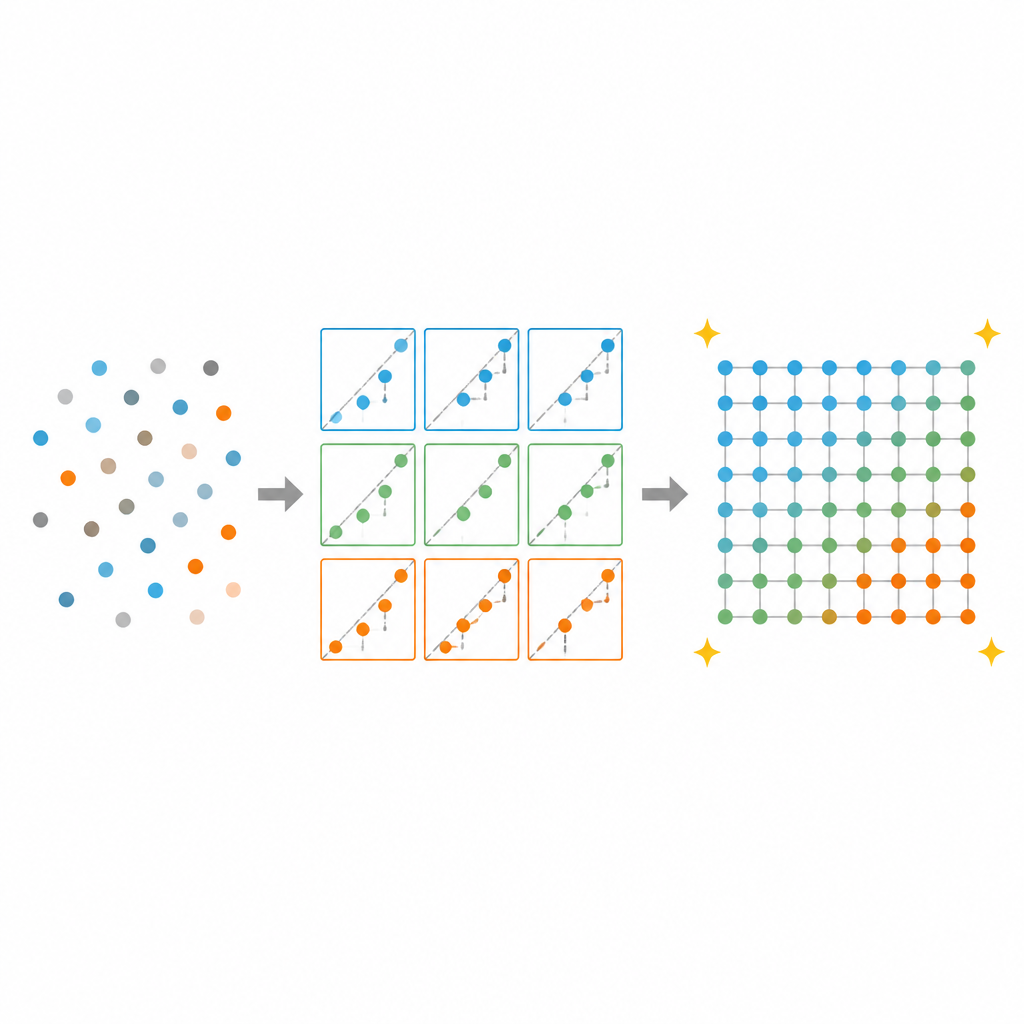
The abstract does not provide benchmark tables, empirical results, or dataset-specific numbers. So there is no reported accuracy lift, runtime comparison, or wall-clock speedup to cite here. What we do have is a theoretical guarantee: the sample complexity is optimal in the minimax sense, and the predictor is deterministic.
The second result is a broader guarantee for outcome indistinguishability. The paper says the algorithm can be adapted to finite or finitely covered collections of tests, which then yields deterministic omnipredictors and panpredictors with optimal sample complexity. The abstract frames this as resolving open problems posed in prior work.
That matters because omniprediction and panprediction are not just niche theory terms; they are part of the broader toolkit for building predictors that behave well across a family of downstream tasks. If you are trying to design systems whose outputs can be reused safely across multiple decision rules, this kind of guarantee is exactly the sort of thing you care about.
Why developers should care
For a developer, deterministic guarantees are easier to operationalize than randomized ones. A deterministic predictor is simpler to debug, simpler to reproduce in audits, and less awkward to integrate into pipelines where repeated evaluations should not drift because of sampling noise.
Multicalibration also speaks directly to fairness and reliability workflows. If your model is used on groups, slices, or test families, you want to know whether its confidence scores are meaningful after conditioning and reweighting. This paper says you can get that kind of guarantee without paying an extra sample-complexity penalty just because you insisted on determinism.
There is also a broader architectural lesson here: sometimes what looks like a mathematical convenience, such as randomization, is not actually required for the best asymptotic guarantee. That can simplify deployment choices in settings where deterministic inference is preferable for governance, compliance, or reproducibility reasons.
Limitations and open questions
The abstract is strong on theory but thin on implementation detail. It does not tell us how the algorithm behaves in practice, how expensive it is computationally, or whether the deterministic construction is easy to implement at scale. Those are important questions for anyone thinking about production use.
It also does not include empirical benchmarks, so there is no evidence here about real-world calibration error, latency, or memory use. The result is about sample complexity and theoretical optimality, not an end-to-end systems evaluation.
Even so, the paper closes a clean theoretical loop. It answers a question explicitly raised in prior work: randomization is not necessary to reach the minimax-optimal sample complexity for multicalibration, and the same deterministic framing extends to OI, omniprediction, and panprediction.
For anyone working on trustworthy ML infrastructure, that is a useful result to have in hand. It sharpens the boundary between what calibration theory requires and what was merely an artifact of earlier constructions.
Bottom line
This paper gives a deterministic path to optimal multicalibration and extends that guarantee to related prediction frameworks. The abstract does not give empirical benchmarks, but it does settle an open theoretical question that matters for how dependable prediction systems are built and audited.
- Deterministic predictors can match the best-known tilde O(epsilon^{-3}) multicalibration sample complexity.
- The result extends to outcome indistinguishability, omniprediction, and panprediction.
- The abstract provides theory, not implementation details or empirical benchmarks.
// Related Articles
- [RSCH]
TurboQuant does not hurt search quality at equal byte budgets
- [RSCH]
UNIEGO unifies egocentric video with proxy teachers
- [RSCH]
DiffusionGemma’s transparency problem, measured
- [RSCH]
Nitro’s split kernel turns isolation into math
- [RSCH]
Blackwell wins because agentic AI needs full-stack infrastructure
- [RSCH]
LOCUS opens U.S. local law for legal AI