Hiring algorithms can create monocultures
A study of 3 million applicants finds shared hiring algorithms can produce repeated rejections and racial disparities.
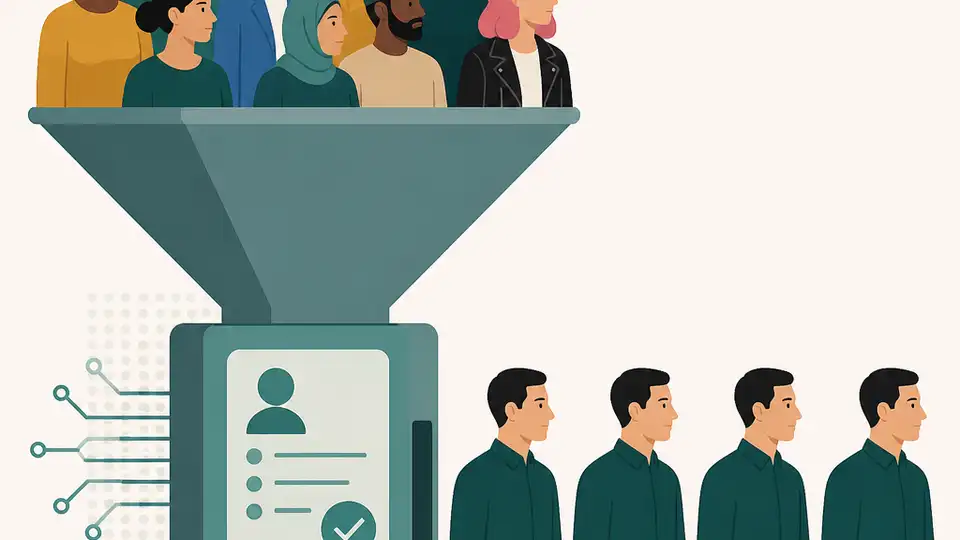
Shared hiring algorithms can repeatedly reject the same applicants and racial groups.
- Research org: Unspecified in arXiv abstract
- Core data: 3 million applicants
- Breakthrough: Analyze one vendor’s deterministic hiring outcomes across 4 million applications
Hiring software is usually sold as a way to standardize screening, reduce manual work, and make decisions more consistent. This paper argues that when many employers rely on algorithms from the same small set of vendors, that consistency can turn into a new kind of risk: the same people can be rejected again and again across different jobs.
That matters for engineers because these systems are not just making one-off predictions. They are shaping who gets seen by a human at all, and the paper suggests that shared model behavior can create correlated failures across employers, not just isolated mistakes in one workflow.
What problem this paper is trying to fix
Get the latest AI news in your inbox
Weekly picks of model releases, tools, and deep dives — no spam, unsubscribe anytime.
No spam. Unsubscribe at any time.
The paper is focused on what it calls algorithmic monoculture in hiring. In plain English, that means lots of employers are using screening systems built by the same few vendors, so different companies may be making decisions in very similar ways.

The authors hypothesize that this setup can lead to the same individuals, and members of the same racial groups, facing rejection across many applications. That is a different problem from bias in a single model. It is a systems problem: if many employers outsource screening to similar algorithms, the downside can compound across the labor market.
To study this, the authors acquire and analyze a novel dataset covering 3 million applicants and 4 million applications. All of those applications were screened by algorithms built by the same vendor, which gives the paper a rare look at how one vendor’s system behaves at scale.
How the method works in plain English
The core idea is straightforward: look at real hiring outcomes from a large pool of applicants, then check whether those outcomes cluster in ways that suggest repeated rejection rather than independent, random screening.
The paper uses deterministic replicability as a key feature of the hiring algorithms. Because the algorithms are deterministic, the authors can infer what outcomes applicants would have received if they had applied to all positions in the dataset. That lets them ask a more interesting question than “did one application get rejected?” They can ask whether the same applicant would likely be rejected across many jobs.
This is useful because hiring systems are often evaluated one application at a time. But applicants do not live one application at a time. They apply across many roles, and repeated algorithmic screening can create a pattern where some people are consistently filtered out before a human ever sees them.
What the paper actually shows
The paper reports clear racial disparities in applicant outcomes. Of all applications submitted by Asian applicants, 14.74% were submitted to positions that adversely impact Asian applicants according to U.S. employment discrimination standards. For Black applicants, the figure was 25.87%.
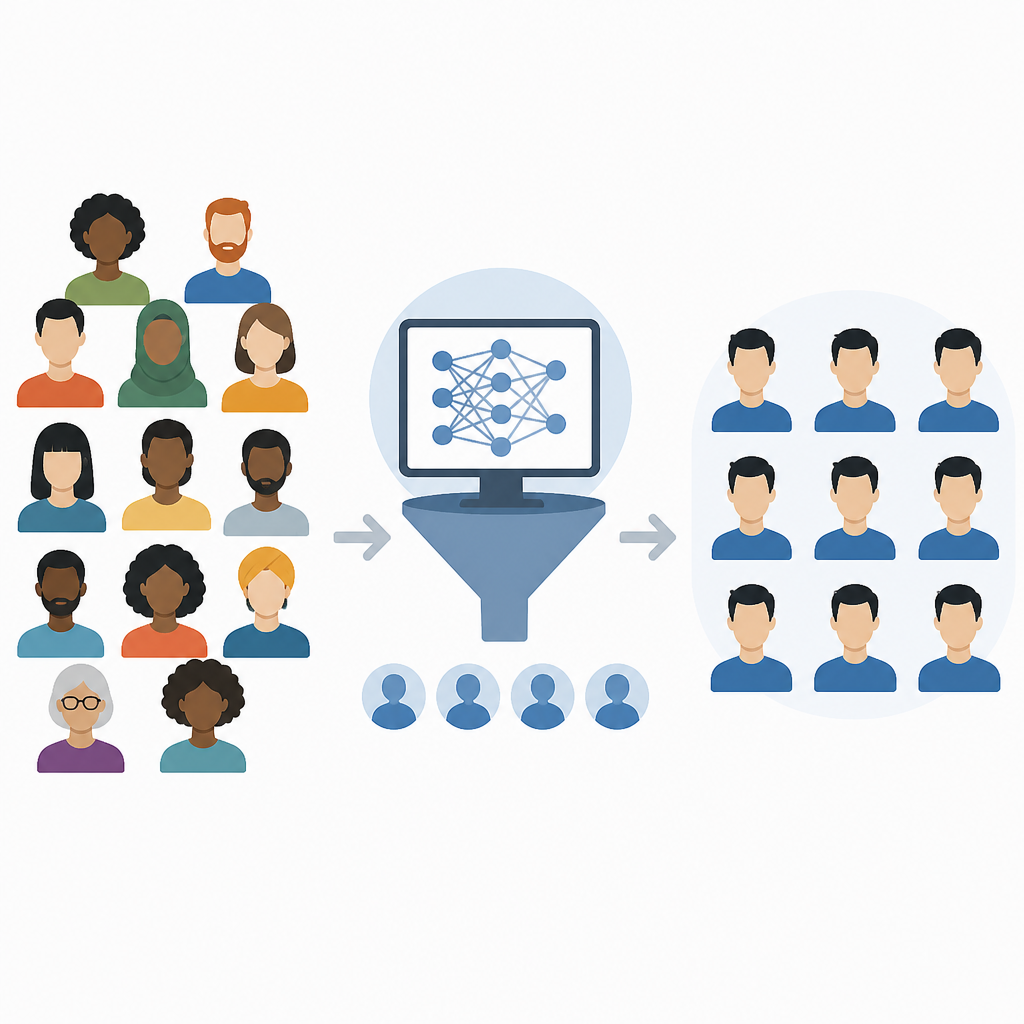
It also finds homogeneous outcomes at the individual level. Four percent of all applicants who apply to 10 positions are recommended for rejection from all positions, and the authors say this rate is higher than expected by chance.
That second result is the important systems-level signal. It suggests the problem is not only that some groups fare worse on average. It is also that some individuals can get locked into a repeated rejection pattern across multiple applications.
The paper does not provide benchmark numbers in the usual ML sense, such as accuracy, F1, or AUC. Instead, its evidence is organizational and statistical: large-scale real-world application data, outcome disparities, and repeated rejection patterns across positions.
Why developers and hiring teams should care
If you build or buy hiring automation, the obvious risk is not just model quality. It is correlated model behavior across customers. A vendor can be “consistent” in a way that scales the same screening logic across many employers, which means a single failure mode can propagate widely.
For practitioners, that raises a few practical questions. Are you auditing one model in isolation, or the vendor’s behavior across many job postings? Are you checking whether outcomes differ by applicant group? And are you looking for repeated rejection patterns that might never show up in a standard single-task evaluation?
The paper also implies that matching and ranking systems should not be treated as neutral plumbing. If the same screening logic is reused across many positions, the system can become a gatekeeper that shapes entire career trajectories before a human reviewer is involved.
Limitations and open questions
The abstract gives a strong signal, but it also leaves some important details out. We do not get the full implementation of the screening algorithms, the specific vendor, or the exact experimental setup behind the counterfactual “apply to all positions” analysis.
We also do not get a full causal story. The paper shows disparities and repeated rejection patterns, but from the abstract alone we cannot tell how much is driven by the model, the job mix, the applicant pool, or employer-specific preferences. That is a limitation worth keeping in mind.
Even so, the paper is valuable because it shifts the discussion from “is this one classifier biased?” to “what happens when many employers share the same screening logic?” That is the right question for anyone building infrastructure that gets reused across customers.
Bottom line
This paper argues that hiring algorithms can create a monoculture effect: when the same vendor’s systems are used broadly, they can produce repeated rejection patterns and racial disparities at scale.
For engineers, the takeaway is simple. Shared automation can amplify risk across organizations, so auditability, group-level analysis, and cross-position outcome checks matter just as much as single-model performance.
- Shared hiring algorithms can create repeated rejection patterns across jobs.
- The dataset spans 3 million applicants and 4 million applications.
- The paper highlights racial disparities and deterministic outcome homogeneity.
// Related Articles
- [RSCH]
CRDTs keep replicas in sync without locks
- [RSCH]
Post-Deterministic Systems for Autonomous Infra
- [RSCH]
Causal methods for measuring task learnability
- [RSCH]
RL Training That Hands Off Control Gradually
- [RSCH]
OmniGameArena benchmarks VLM game agents better
- [RSCH]
TurboQuant cuts KV cache memory 6x in Google tests