ContextRL teaches LLMs to pick the right evidence
ContextRL uses contrastive context selection to improve grounding in long and multimodal reasoning.

ContextRL improves LLM grounding by training them to pick the context that supports an answer.
- Research org: Unspecified in arXiv abstract
- Core data: +2.2% average over standard GRPO on 5 long-horizon benchmarks
- Breakthrough: Contrastive context-selection RL with query, answer, and two similar contexts
Large language models can be very good at producing fluent answers and still miss the one detail that actually matters. This paper is aimed at that failure mode: long traces, messy tool outputs, and images where the decisive evidence is easy for a human to spot but easy for a model to ignore.
For developers building agents or multimodal systems, that matters because the model’s final answer is only as good as the evidence it learns to attend to. If the model can’t reliably identify the relevant slice of context, you get brittle behavior: wrong tool use, shaky reasoning, and answers that sound plausible without being grounded.
What problem this paper is trying to fix
Get the latest AI news in your inbox
Weekly picks of model releases, tools, and deep dives — no spam, unsubscribe anytime.
No spam. Unsubscribe at any time.
The paper starts from a familiar LLM weakness: when the correct answer depends on a small but decisive piece of evidence buried inside a long or complex context, models often fail. The abstract gives two concrete examples: a single line in a tool trace and a subtle detail in an image.

That is a practical problem for agentic systems and multimodal assistants alike. In both settings, the model may receive more context than it can use cleanly. The challenge is not just generating an answer, but finding the part of the input that actually supports that answer.
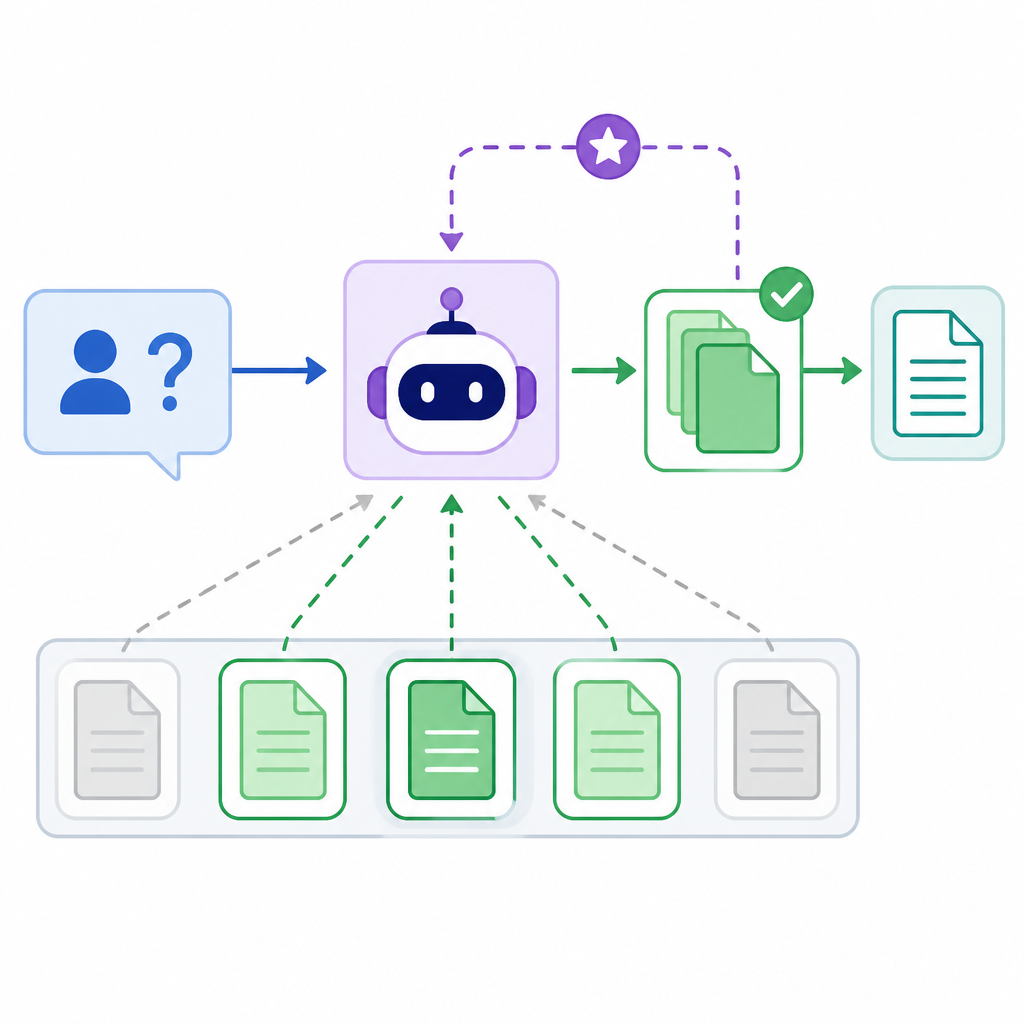
ContextRL is designed to improve that kind of fine-grained grounding. Instead of only rewarding the model for the final answer, it adds an auxiliary objective that asks the model to choose which of two highly similar contexts best supports a given query-answer pair.
How ContextRL works in plain English
The method is called Context-Aware RL for Agentic and Multimodal LLMs, and the core idea is simple: teach the model to recognize supporting evidence, not just to emit the right text.
During training, the model is shown three things: a query, an answer, and two contexts that look very similar to each other. One of those contexts actually supports the query-answer pair, and the other does not. The model is rewarded for selecting the supporting context.
That makes this an indirect supervision signal. The model is not being told, “here is the exact token span you should cite.” Instead, it learns through reinforcement learning to prefer the context that matches the answer. The paper frames this as a way to encourage fine-grained grounding.
The contrastive data is built differently for the two domains the paper studies. For coding agents, trajectories are used as contexts, and the authors build 1k pairs via condition filtering. For multimodal reasoning, images are used as contexts, and the authors build 7K pairs via generative editing and similarity search.
What the paper actually shows
The reported results are encouraging, but the abstract gives only aggregate gains rather than per-task breakdowns. ContextRL achieves an average improvement of +2.2% over standard GRPO on 5 long-horizon benchmarks.
On multimodal tasks, it reports +1.8% across 12 diverse visual question answering benchmarks. The paper does not include the benchmark names or the full metric table in the abstract, so those details are not available from the source material here.
A key part of the paper’s claim is not just that the method works, but that the gain comes from the objective itself. To test that, the authors compare against data-augmentation baselines that reuse the same contrastive contexts as standard query-context-answer examples.
Those baselines reportedly provide little to no improvement. That matters because it suggests the benefit is not simply “more data helps.” Instead, the context-selection reinforcement objective appears to be doing the real work.
Why this should matter to developers
If you are building agentic workflows, this paper points at a useful training signal: models may need to be optimized for evidence selection, not just answer generation. That can be especially relevant when your system has access to long tool traces, retrieval results, logs, or other noisy context where only a small part is relevant.
For multimodal systems, the same idea applies to images. A model that can identify which image best supports a query-answer pair is likely to be more reliable when subtle visual details matter. The paper’s setup suggests a path for training that behavior without requiring direct token-level supervision.
There are also clear limits in what the abstract tells us. We do not get benchmark names, task-by-task results, compute cost, or failure analysis. We also do not know how well the approach generalizes beyond the two domains studied here, or how expensive it is to construct the contrastive pairs at scale.
Even so, the paper is useful because it targets a real engineering gap: models that can talk about context without actually using it. ContextRL is an attempt to close that gap by making context choice itself part of the learning problem.
What to watch next
The most interesting follow-up question is whether this kind of contrastive RL can be applied beyond the paper’s two settings. The abstract focuses on coding trajectories and images, but the same pattern could matter anywhere a model must sift through long, ambiguous inputs.
Another open question is how stable the gains are when the contexts become even noisier or more adversarial. The paper shows average improvements, but the abstract does not say how robust the method is under harder distribution shifts.
For now, the takeaway is straightforward: if you want LLMs to be better at long-horizon reasoning or multimodal grounding, training them to choose the right supporting context may be more effective than only training them to produce the right final answer.
- Context selection can be a better training target than answer-only supervision.
- The method uses contrastive pairs for both coding trajectories and images.
- The reported gains come from the RL objective, not just from adding more data.
// Related Articles
- [RSCH]
Exact posterior scores for inverse problems
- [RSCH]
Language models have a “value axis”
- [RSCH]
Persona-Pruner trims models for role-playing
- [RSCH]
ClinHallu maps where medical MLLMs hallucinate
- [RSCH]
Gaze Heads: Steering VLMs by Redirecting Attention
- [RSCH]
AI Benchmarks 2026: Top Evaluations and Limits