RRFP Makes Pipeline Training Follow Readiness
RRFP reorders pipeline-parallel training around what is ready now, cutting idle bubbles under runtime variability.

RRFP reorders pipeline-parallel training around what is ready now, cutting idle bubbles under runtime variability.
- Research org: Unspecified in arXiv abstract
- Core data: Up to 2.77× speedup on multimodal workloads
- Breakthrough: Treats schedule order as a hint and dispatches currently ready work
Pipeline parallelism is still one of the main ways to scale large-model training, but it starts to break down when the real world does not match the planned schedule. This paper argues that modern workloads introduce enough runtime variability in computation and communication that static or precommitted execution orders can leave stages waiting even when other work is available.
For engineers, that matters because the cost is not abstract: stage misalignment turns into idle bubbles, lower utilization, and slower training runs. RRFP, short for Runtime-Readiness-First Pipeline, is the paper’s answer to that problem.
What problem this paper is trying to fix
Get the latest AI news in your inbox
Weekly picks of model releases, tools, and deep dives — no spam, unsubscribe anytime.
No spam. Unsubscribe at any time.
The core issue is simple: existing pipeline systems usually assume that the order they planned ahead of time is the order they should follow at runtime. That works only when task readiness lines up cleanly with the schedule. In practice, the paper says, runtime variability in both computation and communication can make that assumption wrong.

When a stage is forced to wait for the next item in a fixed order, it may sit idle even though some other task is already executable. The result is a pipeline that looks organized on paper but underperforms on real workloads because readiness and order drift apart.
RRFP is designed to remove that mismatch. Instead of making the schedule the boss, it makes readiness the boss and treats the schedule as guidance.
How RRFP works in plain English
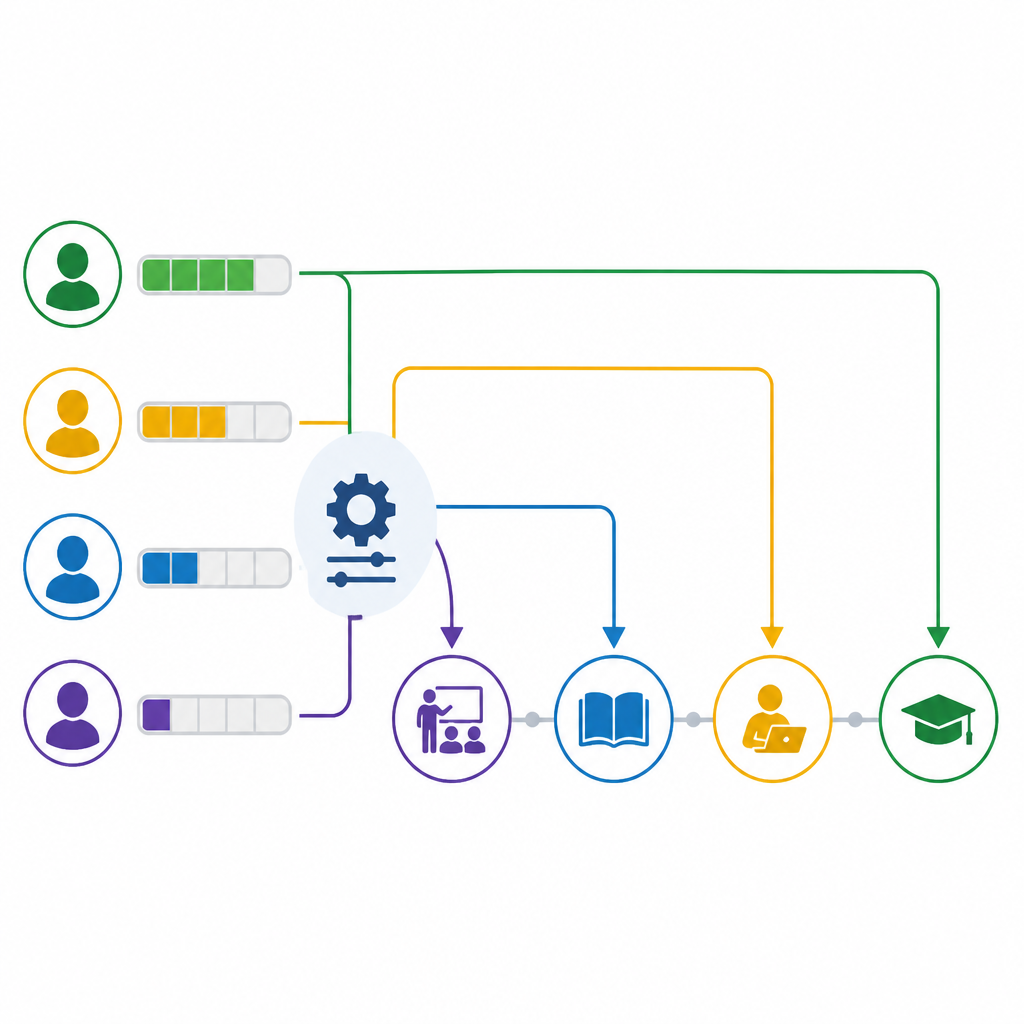
The paper’s main idea is to change how schedules are consumed at runtime. Rather than treating a schedule as a sequence that a stage must follow strictly, RRFP treats it as a non-binding hint order used to rank work that is already ready to run.
That sounds subtle, but it changes the control model in a meaningful way. The runtime is no longer blocked by the next item in the script if another eligible task can keep the stage busy. In other words, RRFP tries to keep the pipeline moving based on actual readiness, not just planned order.
To make that work, RRFP combines three mechanisms: message-driven asynchronous communication, lightweight tensor-parallel coordination for collective consistency, and ready-set arbitration for low-overhead dispatch. The abstract does not go into implementation detail beyond those components, but the structure is clear enough: communication, coordination, and dispatch are all tuned to support readiness-first execution.
The paper implements RRFP in a Megatron-based training framework, so this is not just a scheduling thought experiment. It is positioned as a runtime system that can be evaluated on real training workloads.
What the paper actually shows
The evaluation covers language-only and multimodal workloads, and the system is tested at up to 128 GPUs. That matters because pipeline issues tend to get worse as scale increases, where small inefficiencies can turn into large amounts of wasted accelerator time.
On the results side, the abstract does include concrete numbers. Using the BFW hint, RRFP achieves up to 1.77× speedup on language-only workloads and up to 2.77× on multimodal workloads. Those are meaningful gains, especially because they come from runtime behavior rather than a model change.
The paper also compares against external systems. In cross-framework comparisons, RRFP with the default BF hint outperforms the faster available external system by up to 1.84× while preserving training correctness. That last clause is important: the paper is not claiming a faster but approximate runtime; it says correctness is maintained.
What the abstract does not provide is a breakdown of where the gains come from in terms of absolute throughput, step time, memory overhead, or per-component ablation numbers. It also does not list benchmark names beyond the workload categories and the BFW/BF hints. So while the headline is strong, the abstract alone does not let us quantify the full tradeoff picture.
Why developers should care
If you build or operate large-model training systems, the practical lesson is that scheduling should be more adaptive to runtime readiness than many current pipeline stacks assume. This paper is a reminder that a “correct” schedule on paper can still waste GPU time if the runtime cannot react to what is actually ready.
That is especially relevant for mixed workloads, where communication delays and compute variance are harder to predict. In those environments, a readiness-driven runtime can potentially turn waiting time into useful work without changing the training algorithm itself.
For framework authors, RRFP also points to a design pattern: decouple schedule intent from dispatch order, then build low-overhead mechanisms that let the runtime choose among ready tasks. The paper’s message-driven async communication and ready-set arbitration are examples of how to do that without turning the runtime into a heavyweight coordinator.
Limitations and open questions
The abstract is strong on the problem and the headline results, but it leaves several questions open. It does not say how much overhead RRFP adds in the common case, how sensitive it is to the quality of the hint order, or how it behaves when readiness information itself becomes noisy or delayed.
It also does not explain whether the gains depend more on the workload type, the number of GPUs, or the specific pipeline shape. Since the paper mentions both language-only and multimodal settings, the method appears broad, but the abstract alone does not prove how general the approach is across all training stacks.
Still, the direction is clear: as training workloads become less predictable, rigid pipeline execution becomes a liability. RRFP tries to make the runtime flexible enough to keep the hardware busy without giving up correctness, and that is exactly the kind of systems idea developers should watch.
Bottom line
RRFP reframes pipeline-parallel training around readiness instead of fixed order, and the reported speedups suggest that this is more than a small scheduling tweak. For teams pushing large-model training at scale, the paper is a useful signal that runtime adaptability is becoming just as important as the pipeline plan itself.
// Related Articles
- [RSCH]
How VLMs Learned Complex Scene Descriptions
- [RSCH]
Visual Pretraining Beats Text-Only in Language Models
- [RSCH]
PHINN-EEG brings topology to dream-state EEG
- [RSCH]
Google’s Android Bench update exposes Gemini’s gap
- [RSCH]
Benchmarks should not pick your LLM in 2026
- [RSCH]
Rust Breaks Into TIOBE’s Top 10