Why embedding layer LR dominates hyperparameter transfer
The paper shows that embedding-layer learning rate is the main reason μP transfers better than standard parameterization.

The paper shows that embedding-layer learning rate is the main reason μP transfers better than standard parameterization.
- Research org: Unspecified in arXiv abstract
- Core data: No benchmark numbers in abstract
- Breakthrough: Quantifies transfer with fit quality, extrapolation robustness, and asymptotic loss penalty
For anyone training large language models, hyperparameter transfer is the difference between a useful small-scale experiment and a wasted large-scale run. This paper is about making that transfer more measurable, and about explaining why one popular parameterization trick, μP, seems to carry over better than standard parameterization.
The practical angle is simple: if you can predict good optimization settings from smaller models, you save time, compute, and a lot of trial-and-error. The authors argue that the field has relied on two broad strategies—fit a scaling law, or use a parameterization that makes hyperparameters nearly scale invariant—but the real mechanics of why transfer works have not been fully pinned down.
What problem the paper is trying to fix
Get the latest AI news in your inbox
Weekly picks of model releases, tools, and deep dives — no spam, unsubscribe anytime.
No spam. Unsubscribe at any time.
Hyperparameter transfer is one of those ideas that sounds straightforward until you try to operationalize it. You tune learning rates, weight decay, and other optimization settings on a small model, then hope those settings still make sense when you scale up. In LLM training, that hope can be expensive.

The paper frames the issue around two common approaches. One is to fit a scaling law for hyperparameters and extrapolate from there. The other is to choose a parameterization, such as Maximal Update (μP), that is designed to keep optimal hyperparameters approximately scale invariant. The problem is that these approaches are usually judged informally, and the authors say existing theory does not adequately explain why μP often works so well relative to standard parameterization (SP).
Instead of treating transfer as a vague success-or-failure story, the paper tries to turn it into something you can measure. That matters for engineers because once you can quantify transfer, you can compare methods more cleanly and identify which knobs are actually doing the work.
How the method works in plain English
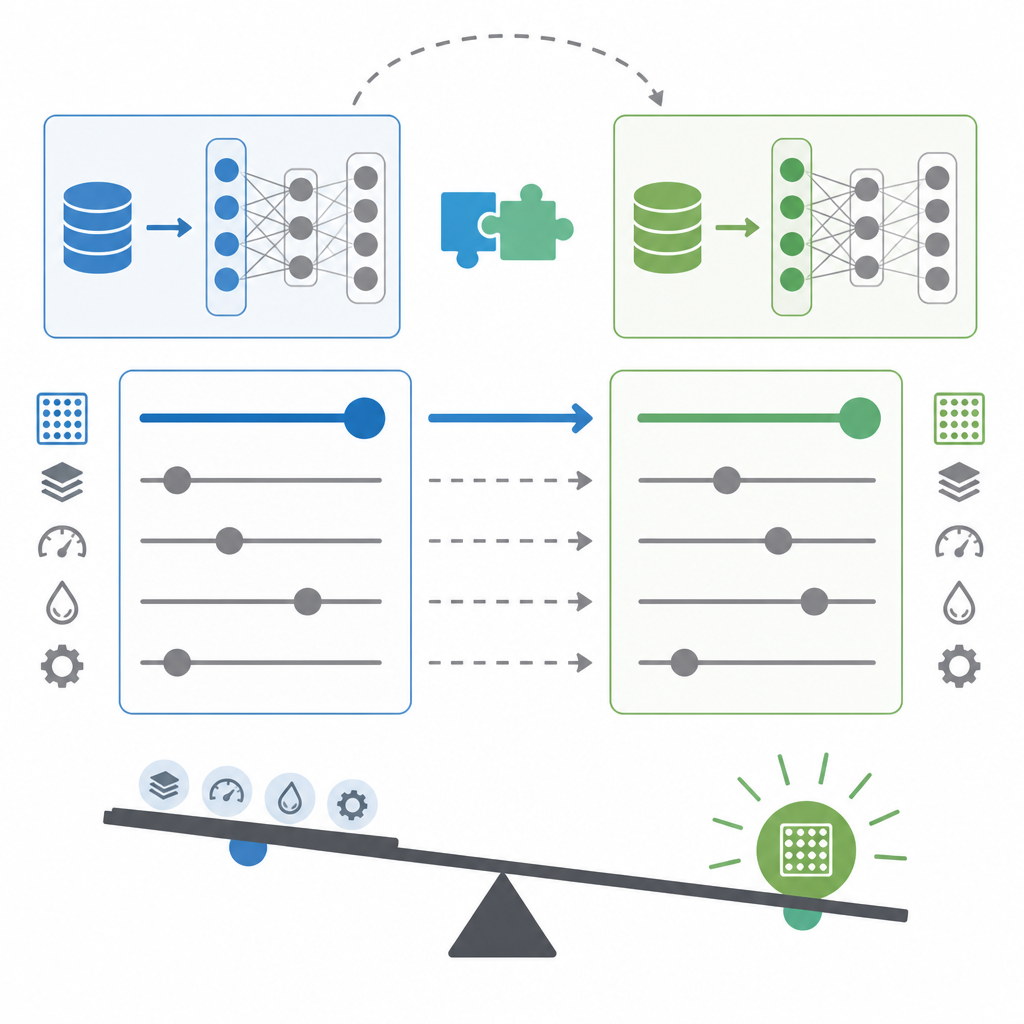
The main contribution is a framework with three metrics for hyperparameter transfer. First, it measures the quality of the scaling law fit. Second, it measures robustness to extrapolation errors. Third, it measures the asymptotic loss penalty caused by the choice of parameterization.
That trio is useful because it separates different failure modes. A scaling law might fit nicely but still extrapolate badly. A parameterization might look stable at one scale but carry a hidden penalty at larger scales. By splitting the problem into these pieces, the authors can ask not just “does transfer work?” but “why does it work, and where does it break?”
The paper then uses a series of ablations to compare μP and SP under AdamW training. The goal is to isolate the source of μP’s apparent advantage rather than assuming the entire parameterization is magic. In other words, they are looking for the smallest mechanism that explains the biggest behavior change.
According to the abstract, that mechanism is the embedding layer learning rate. The authors find that the main benefit of μP relative to SP comes from maximizing the embedding layer learning rate. In SP, the embedding layer learning rate becomes a bottleneck that can create training instabilities. Increasing it by a factor of width to match μP smooths training and improves hyperparameter transfer.
What the paper actually shows
The strongest claim in the abstract is not that μP is broadly superior in some abstract sense, but that its advantage largely comes from one specific adjustment: the embedding layer learning rate. That is a useful engineering result because it suggests you may not need to adopt the entire μP framework to get most of the transfer benefit.
The paper also reports two additional findings about weight decay. First, weight decay improves scaling law fits. Second, in the fixed token-per-parameter setting, weight decay hurts the robustness of extrapolation. Those two results point in different directions, which is exactly the kind of nuance practitioners need when turning a paper into a training recipe.
What the abstract does not provide is benchmark numbers. There are no specific losses, accuracies, scaling constants, or compute savings listed in the summary we have here. So the safe reading is qualitative: the paper establishes a measurement framework and uses ablations to identify the embedding layer learning rate as the key driver of μP’s transfer behavior.
Why developers should care
If you train models at multiple scales, this paper suggests a more targeted way to think about transfer. Instead of treating all learning-rate settings as equally important, pay special attention to the embedding layer. In SP, that layer can become the bottleneck that destabilizes training as width changes.
That is especially relevant if your team is doing early-stage sweeps on small models and then scaling up for final runs. A learning-rate choice that looks fine in one regime may fail because the embedding layer is under-tuned relative to the rest of the network. The paper’s takeaway is that matching the embedding layer learning rate by width can smooth training and make extrapolation more reliable.
There is also a broader workflow lesson here: a good scaling-law fit is not the whole story. You want fit quality, but you also want extrapolation robustness and a low asymptotic penalty from the parameterization itself. The paper’s framework gives you a way to reason about those tradeoffs instead of collapsing them into one vague “it transferred” judgment.
Limitations and open questions
The abstract leaves some important questions open. It does not tell us how widely the findings hold across architectures, datasets, or optimizer settings beyond AdamW. It also does not give concrete benchmark numbers in the abstract, so we cannot tell from this source alone how large the gains are in practice.
Another open question is how much of the result depends on the specific training setup used in the ablations. The paper argues that μP’s benefit comes overwhelmingly from the embedding layer learning rate, but the abstract does not spell out whether that holds equally well across all model families or only in the settings studied.
Even with those limits, the paper is still useful because it narrows the search space. If the real issue is embedding-layer learning rate rather than a mysterious global property of μP, that gives practitioners a more actionable lever to pull when scaling models.
Bottom line
This paper is a reminder that hyperparameter transfer is often won or lost on one overlooked part of the model. Here, that part is the embedding layer. The authors provide a framework for measuring transfer and argue that the main practical advantage of μP comes from a learning-rate adjustment that removes an SP bottleneck.
For developers, the takeaway is not “always use μP” or “always change the embedding LR.” It is that scaling behavior can hinge on a very specific optimization detail, and that detail may be more important than the headline parameterization choice.
- Hyperparameter transfer can be measured with separate fit, robustness, and penalty metrics.
- Embedding-layer learning rate appears to be the main bottleneck behind SP’s weaker transfer.
- Weight decay helps fit quality but can reduce extrapolation robustness in fixed token-per-parameter settings.
// Related Articles
- [RSCH]
CRDTs keep replicas in sync without locks
- [RSCH]
Post-Deterministic Systems for Autonomous Infra
- [RSCH]
Causal methods for measuring task learnability
- [RSCH]
RL Training That Hands Off Control Gradually
- [RSCH]
OmniGameArena benchmarks VLM game agents better
- [RSCH]
TurboQuant cuts KV cache memory 6x in Google tests