Why LLM agents are becoming real vulnerability hunters
LLM agents are now useful for finding real software vulnerabilities, not just writing code.

LLM agents are now useful for finding real software vulnerabilities, not just writing code.
LLM agents are no longer a novelty in security research; they are becoming a practical vulnerability discovery tool, and the latest kernel, Docker, and OpenSSL findings prove it.
That matters because these are not toy targets. The reported workflow used a self-orchestrating team of agents plus activation steering to surface remote out-of-bounds write bugs in the Linux kernel and additional flaws in Docker and OpenSSL. Those are the kinds of systems that sit at the center of modern infrastructure, where one missed memory-safety issue can turn into remote code execution, container escape, or cryptographic compromise. When an automated agent chain can move from broad search to credible bug discovery across such different codebases, the security field has crossed into a new phase.
First argument: agentic systems do what single-model prompts cannot
Get the latest AI news in your inbox
Weekly picks of model releases, tools, and deep dives — no spam, unsubscribe anytime.
No spam. Unsubscribe at any time.
The real breakthrough is not that an LLM can suggest a bug pattern. It is that a coordinated set of agents can divide the work the way a small research team would: one agent explores code paths, another evaluates exploitability, another refines hypotheses, and another keeps the search from stalling. That orchestration is what turns a language model from a clever autocomplete into a persistent researcher. The reported use of activation steering adds another layer, because it shows the system was not just reacting to prompts but being guided toward a security-specific mode of reasoning.
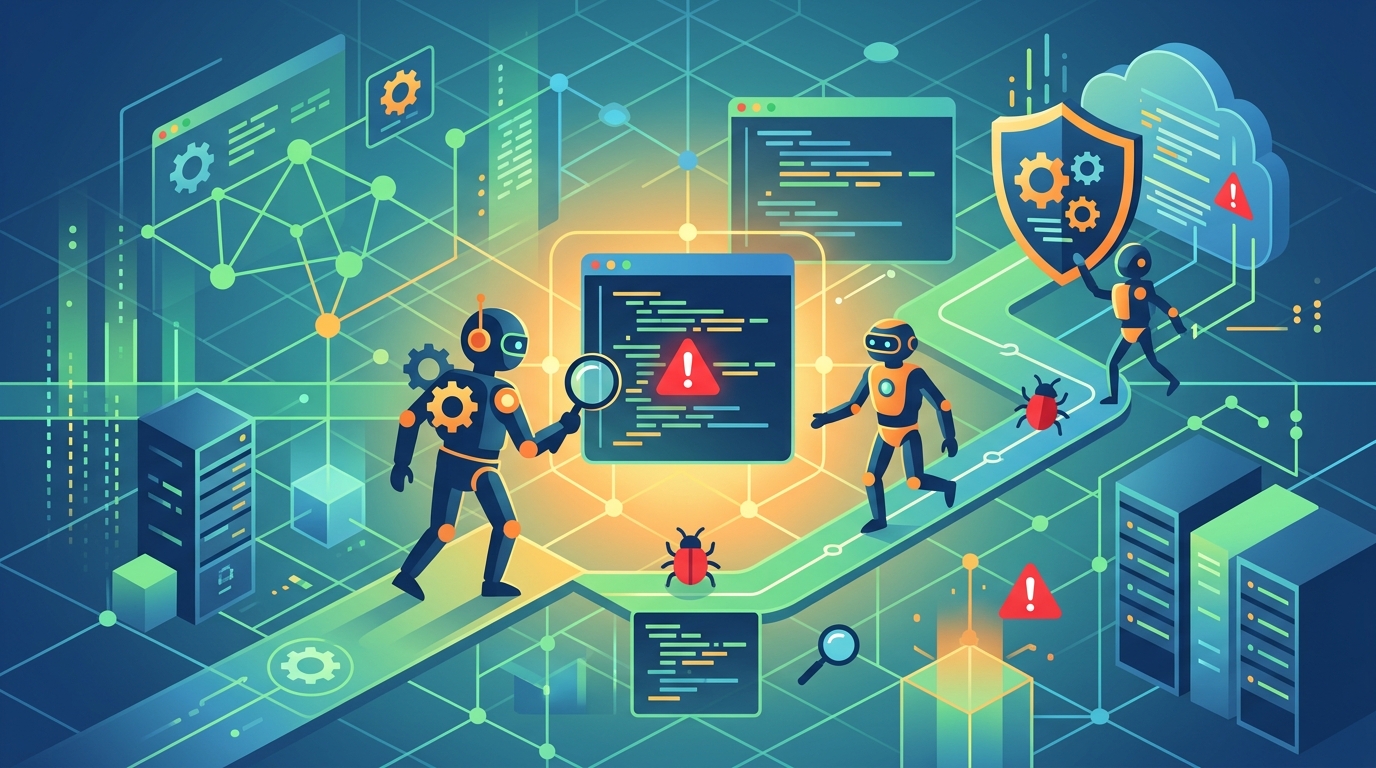
A useful comparison is how traditional fuzzing evolved. Early fuzzers were fast but narrow, and serious gains came when teams combined fuzzing with symbolic execution, sanitizers, and human triage. Agentic LLM workflows follow the same pattern. The headline is not “an AI found a bug.” The headline is “a workflow found bugs across kernel, container, and crypto software by chaining reasoning steps that humans normally perform manually.” That is a much stronger signal, and it is exactly why this approach deserves attention from security teams.
Second argument: the target set is the story
Finding a flaw in one application is useful. Finding credible bugs in the Linux kernel, Docker, and OpenSSL in the same broad workflow is a different class of result. These projects represent the layers of modern compute: the kernel at the base, containers in the middle, and cryptography at the edge of trust. If an automated system can surface defects across all three, then it is not just learning one codebase’s quirks. It is learning how to reason about systems software, memory safety, and security boundaries in a way that transfers.
That transferability is the part defenders should care about most. The Linux kernel is one of the hardest places to find remotely reachable memory corruption bugs because the code is huge, subtle, and full of historical complexity. Docker introduces isolation and runtime logic that can fail in ways that matter operationally. OpenSSL adds a different threat model, where a bug can undermine confidentiality or integrity in almost any downstream product. A discovery pipeline that can touch all three tells us the bottleneck is shifting from “can AI understand code?” to “can humans keep up with AI-assisted reconnaissance?”
The counter-argument
The skeptical view is strong: these systems still need expert supervision, and vulnerability discovery is not the same as reliable exploitation or responsible disclosure. Security researchers have seen plenty of demos that look impressive until they are tested against real-world review standards. A one-off success can be the result of narrow prompting, lucky code selection, or heavy human curation behind the scenes. If the workflow depends on hand-tuned steering and careful orchestration, then it is not fully autonomous, and calling it a breakthrough risks overselling the maturity of the method.

That critique is fair, but it does not defeat the conclusion. Full autonomy is not the bar that matters. Repeatable assistance is. The question is whether the system consistently expands the search space and surfaces candidate bugs that merit expert validation. The reported kernel, Docker, and OpenSSL findings clear that bar. Even if humans still need to confirm impact and write the report, the expensive part of security research is often the initial discovery phase, and this workflow materially reduces that cost. The limit is real, but it is a limit on deployment, not on significance.
What to do with this
Security teams should stop treating agentic LLMs as side experiments and start treating them as part of the vulnerability research stack. Engineers should pair them with fuzzers, static analysis, and sanitizer output, then measure precision, triage time, and bug quality over real codebases. PMs should budget for evaluation harnesses instead of one-off demos. Founders building devtools or security tools should focus on workflows that let agents search, rank, and hand off findings to humans, because that is where the value is already showing up. The winners will not be the teams asking whether agents can find bugs; they will be the teams building systems that make the findings actionable.
// Related Articles
- [RSCH]
How VLMs Learned Complex Scene Descriptions
- [RSCH]
Visual Pretraining Beats Text-Only in Language Models
- [RSCH]
PHINN-EEG brings topology to dream-state EEG
- [RSCH]
Google’s Android Bench update exposes Gemini’s gap
- [RSCH]
Benchmarks should not pick your LLM in 2026
- [RSCH]
Rust Breaks Into TIOBE’s Top 10